


The doors of the Iraqi prime minister's office swung open and in walked Condoleezza Rice and the UK foreign secretary Jack Straw.
Their handshakes with Ibrahim Jaafari, the man they hoped to push into resignation, were formal and stiff. Behind them a beaming figure loped forward, thrust out a smiling face, and kissed the prime minister three times on the cheeks.
Zalmay Khalilzad, the American ambassador to Baghdad, reaches the parts that no other Western official in Iraq dares to touch. A Muslim born in Afghanistan, who went to university in Beirut, he is as much at home in the local
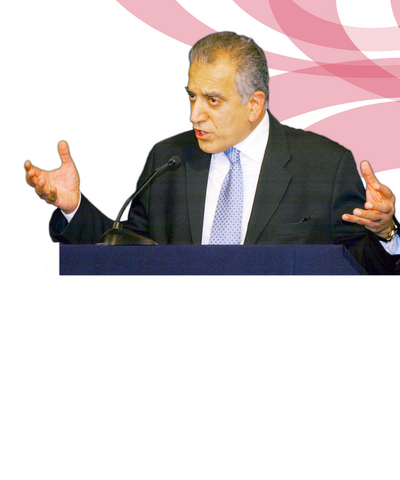
PHOTOS: AFP
customs and manners of the Middle East as he is in the
corridors of Washington.
Iraqis respect him for it, even though they have few illusions about his true loyalties. "He'll embrace you while stabbing you in the back," said one Baghdad journalist while watching the Khalilzad-Jaafari clinch on TV earlier this month.
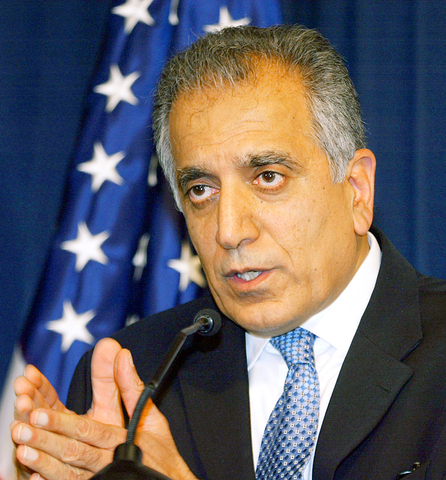
The Bush administration has had three viceroys in Baghdad since Saddam Hussein was toppled in April 2003. After the non-consulting arrogance of Paul Bremer and the low-key plotting of John Negroponte, the gregariousness and hands-on energy of Zalmay Khalilzad came as a relief to Iraq's politicians. Here was a man who would fiddle with worry beads and engage in rambling conversation over thin glasses of tea without an obvious agenda and the usual clock watching.
He uses Farsi (which is close to his native Dari) to talk to Iraq's Kurdish President Jalal Talabani as well as to Shiite politicians who spent years of exile in Iran. He was nominated by US President George W. Bush to lead the US talks with Iran, in the hope that his mellifluous linguistic and cultural skills will smooth the tough message he has been told to give.
Khalilzad came to Baghdad last year when Iraqis were nominally in charge of their own country, with an elected transitional government in place of an occupation administration. So his role was more complex than that of his predecessors. He had to flatter Iraqi politicians' wish to be in control of their own destiny even as he coaxed and cajoled them into doing what Washington wanted done.
What made it harder was that the timing and context were
different for Khalilzad. The Iraq which Bremer and Negroponte ran seemed a relatively hopeful place but by the time he came, the Iraqi political class was splitting. Sunnis felt increasingly alienated. The Shiite were toying with ideas of regional autonomy which threatened to undermine the concept of a central government. Anti-American militancy was rising in Shiite as well as Sunni areas. Suicide car-bombing was taking a huge toll in lives.
The American effort to remove the Shiite leader Jaafari, whom Washington considered vain, ineffectual, and insufficiently accommodating to the interests of Kurds and Sunnis, finally succeeded on April 21. It was not Khalilzad's first such delicate assignment.
Four years ago, when he was Washington's man in Kabul, he had to break the will of an even more distinguished figure, Zahir Shah, the former ruler of Afghanistan. As delegates waited for the formal opening of the country's ersatz parliament, word swept round that a majority wanted to nominate the 87-year-old king to be the country's chief executive.
This was not part of the Bush administration's script. Its leader for Afghanistan was Hamid Karzai, a dynamic, English-speaking Pashtu fighter. Khalilzad rushed to see the king and persuaded him to stick to the agreement. This was impressive in itself, but the real Khalilzad touch was to seal it publicly by summoning the media to the heavily fortified US embassy compound.
Astonished Afghan journalists heard the US envoy announce that the king would renounce his claim to power at a press
conference that evening. Blaming the press for misquoting the king, Khalilzad declared: "It appears the broadcast statements were incorrect. The former king is not a candidate for any position." The monarch was trapped and, later that night, he sat glumly as an aide read out a statement saying the king would open the parliament a day late, but had no wish to be Afghanistan's president.
It was an ironic triumph for Khalilzad. His father was a civil servant in the king's government, working in the northern city of Mazar-I-Sharif where Zalmay was born in 1951. An unusually bright schoolboy, he won an exchange scholarship to spend a year with a family in California. The experience opened his eyes to Afghanistan's misery and it was no surprise when, after enrolling at Kabul University, he was offered a four-year scholarship to switch to the American University in Beirut.
On graduation from Beirut, he went on to the University of
Chicago, a fellowship at New York's Council on Foreign Relations and jobs as an adviser in the Pentagon and the Department of State. A hawk and neocon, Khalilzad favored open US support for the anti-Soviet insurgency in his home country after Moscow sent troops there in 1979.
In Iraq, Khalilzad lives the same danger-ridden existence as any other official in Baghdad's green zone, the Hyde Park-sized enclave where diplomats, UN officials, Saddam trial judges and many Iraqi ministers live behind blast walls and razor wire. His predecessors worked in a large office off the domed entrance hall of Saddam's Republican Palace. Khalilzad has moved to newly refurbished and more intimate offices on an upstairs floor in the north wing.
He gets out more than most officials, swooping round in a
helicopter to land unannounced at regional meetings on US bases or racing by convoy through Baghdad in SUVs with darkened glass to frivolous events such as a poolside dinner at the New York Times' fiercely guarded compound.
Khalilzad's first priority in Iraq was to try to defeat the Sunni insurgency. The way to do it politically, he decided, was to woo Sunni leaders. He persuaded Washington to stop its negative references to Baathists (the former ruling party) and talk of Saddamists instead. The idea was that most Baathists had joined the party for career reasons and were not killers. Even many of those who once revered Saddam knew his time was over; only a few wanted him back. The rest should not be demonized, especially as they were the bedrock of Iraq's professions whom the new Iraq needed.
Khalilzad felt that post-Saddam Iraq had tilted too far towards the Shiites and the Kurds. He persuaded most Sunni leaders to support the new constitution with its federal provisions by promising them a chance to amend it once a new parliament was elected. They took the bait and ran in the December elections.
In a recent interview, he described Iraq as "the defining challenge of our time -- the way that containing the Soviets was the defining challenge of a previous era. Or managing the European balance of power was the defining challenge of an era before that."
He asks the critics to take a long-term perspective. "Iraq is an ancient country, but a new nation. This is the first time in my judgment that people are freely sitting across the table -- Kurds, Sunni, Shiite, Arabs -- talking about how they're going to relate to each other."

In late October of 1873 the government of Japan decided against sending a military expedition to Korea to force that nation to open trade relations. Across the government supporters of the expedition resigned immediately. The spectacle of revolt by disaffected samurai began to loom over Japanese politics. In January of 1874 disaffected samurai attacked a senior minister in Tokyo. A month later, a group of pro-Korea expedition and anti-foreign elements from Saga prefecture in Kyushu revolted, driven in part by high food prices stemming from poor harvests. Their leader, according to Edward Drea’s classic Japan’s Imperial Army, was a samurai

Approaching her mid-30s, Xiong Yidan reckons that most of her friends are on to their second or even third babies. But Xiong has more than a dozen. There is Lucky, the street dog from Bangkok who jumped into a taxi with her and never left. There is Sophie and Ben, sibling geese, who honk from morning to night. Boop and Pan, both goats, are romantically involved. Dumpling the hedgehog enjoys a belly rub from time to time. The list goes on. Xiong nurtures her brood from her 8,000 square meter farm in Chiang Dao, a mountainous district in northern Thailand’s
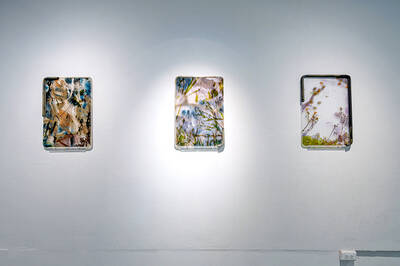
Located down a sideroad in old Wanhua District (萬華區), Waley Art (水谷藝術) has an established reputation for curating some of the more provocative indie art exhibitions in Taipei. And this month is no exception. Beyond the innocuous facade of a shophouse, the full three stories of the gallery space (including the basement) have been taken over by photographs, installation videos and abstract images courtesy of two creatives who hail from the opposite ends of the earth, Taiwan’s Hsu Yi-ting (許懿婷) and Germany’s Benjamin Janzen. “In 2019, I had an art residency in Europe,” Hsu says. “I met Benjamin in the lobby
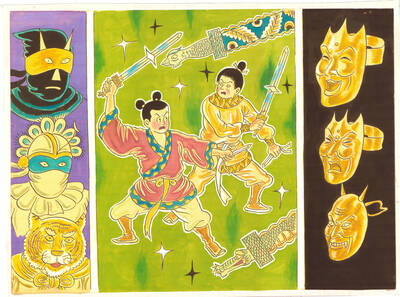
April 22 to April 28 The true identity of the mastermind behind the Demon Gang (魔鬼黨) was undoubtedly on the minds of countless schoolchildren in late 1958. In the days leading up to the big reveal, more than 10,000 guesses were sent to Ta Hwa Publishing Co (大華文化社) for a chance to win prizes. The smash success of the comic series Great Battle Against the Demon Gang (大戰魔鬼黨) came as a surprise to author Yeh Hung-chia (葉宏甲), who had long given up on his dream after being jailed for 10 months in 1947 over political cartoons. Protagonist


 RSS
RSS