


Screaming kindergartners crawl through a smoke-filled hallway, searching for the exit. Later in a room downstairs, they duck under a table as the floor shakes beneath them. Meanwhile, a dozen high school students clamber out a window and descend a fire escape.
These aren't scenes from an earthquake. This is the Taipei Fire Department's Fire Safety Museum (防災科學教育館). And by all accounts the kids love it.
"They also like playing with the fire extinguishers," Kang Jin-shan (康金山) , a museum guide, said of the thousands of students who visit each year to learn what to do when disaster strikes.
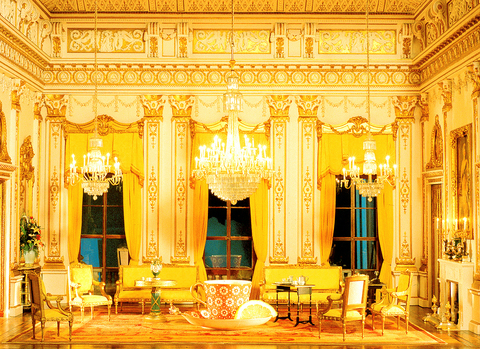
PHOTO COURTESY OF MINIATURE MUSEUM OF TAIWAN
Taipei is known for its National Palace Museum, and exhibits at its Fine Arts Museum occasionally attract international coverage. Not so famous but in some ways more intriguing are the city's dozens of museums and galleries devoted to odd topics such as paper, contraband and old Chinese battles.
A few of these institutions would probably not exist if not for field trips and government subsidies, but many are worth a visit and offer unique perspectives on life in Taiwan.
Such as the museum for tap water. Yes, tap water.
The Taipei Museum of Drinking Water (自來水博物館) reopened in 2000 after NT$80-million worth of renovations. Its original attractions included a Baroque-style museum building that was built to house water pumps, and a collection of decommissioned valves, faucets and circuit boards.
The vintage technology is still inside the building, which was built in 1908 and is now a third-class historic site. On a recent visit, couples posed for wedding pictures outside while long lines of schoolchildren waited for a peek at 1950s Hitachi and Allis-Chalmers pumps under the museum's vaulted ceiling.
"In other countries, water treatment facilities aren't open to the public," noted Wu Neng-hung (吳能鴻) the museum's director.
But what really sets this place apart from the like-minded, but more sober institutions run by other government agencies is the result of the renovations. Wu said the complex attracted 330,000 visitors last year.
The adjacent Taipei Water Park (台北自來水園區) features hiking trails for grownups, a large jungle gym with slides and water cannons in a shallow pool, and a concrete stream that winds through gushing fountains and is safe enough for toddlers to wade in. The kids will have so much fun they won't even notice if they learn a thing or two in the new learning center.
"I hope that (visitors) will understand where tap water comes from," Wu said. "Every stage in the process is very difficult. Although our water is cheap, it's also very precious."
On the opposite end of the scale, in terms of size and utility, is the Miniature Museum of Taiwan (袖珍博物館), a private institution tucked away in the basement of a high rise on Jianguo North Road.
Unlike other museums that showcase models and replicas, the miniatures in this gallery are, as much as possible, made of the same materials used in the real-life objects they represent. The museum is the first of its kind in Asia and attracted 100,000 visitors last year, said guide Chen Sheng-yi (陳生儀).
Among the highlights is a replica of a 19th-century Californian mansion, which took an American who was getting his PhD in architecture four years to complete. Walls of the "Rose Mansion" are cut away to reveal scenes from domestic life: the master of the house entertaining a woman in the bedroom, a spread of desert and champagne on ice, a tiny pool table with billiard balls and a cue stick.
"I don't have space for this at home," said Vicky (謝曉汶), a 22-year-old tourist from Hong Kong who had been admiring the model. Her arms fluttering with excitement, she said: "The decorations are very detailed. The painting is good, too."
Unlike the drinking water museum, the majority of the visitors here are tourists. Most come from Singapore, Hong Kong and Malaysia, Chen said.
Just as conservation and lack of space are concerns in Taipei's crowded urban environment, so too are earthquakes and typhoons.
The Fire Safety Museum draws more than 60,000 visitors each year, Kang said, and teaches them how to deal with natural disasters and man-made incidents such as fires and car accidents.
In the earthquake room, children are instructed to don hard hats, turn off a gas meter and open the door before crouching under a table. In the smoke room, they practice ducking below the smoke and crawling towards the exit. There are also phones with computer terminals where kids learn how to dial 119. A test at the end reminds them only to use the service during emergencies.
And it's free. Unfortunately, high school students and adults can't use the earthquake room. Not to worry. For them there are the fire escape and the typhoon chamber, which is rigged with metal rails for visitors to hang on to while they are subjected to strong currents of air and a torrents of water. The museum supplies raincoats and boots. The less adven-turous can watch through a glass wall as those inside get buffeted and splashed.
Conditions in the room are similar to those during a medium-force typhoon. "I don't know how strong the wind is," Kang said, "but it's pretty strong."
MUSEUM NOTES:
Taipei Water Park:
● 1 Siyuan St, Taipei
● Open Tuesdays through Sundays, 9am to 6pm. Ticket booth closes at 5pm; Tel: 02 8369 5145
Miniature Museum of Taiwan:
● B1, 96 Jianguo N Rd, Taipei
● Open Tuesdays through Sundays, 10am to 6pm. Purchase tickets before 5pm; Tel: 02 2515 0583
Fire Safety Museum:
● 37 Chenggong Rd Sec 2, Neihu, Taipei (台北市內湖區成功路二段37號)
● Open Tuesdays through Sundays, from 9am to 12pm and from 2pm to 5pm. Only groups of 15 or more, which must call in advance, can use facilities such as the typhoon room; Tel: 02 2791 9786

Last week Joseph Nye, the well-known China scholar, wrote on the Australian Strategic Policy Institute’s website about how war over Taiwan might be averted. He noted that years ago he was on a team that met with then-president Chen Shui-bian (陳水扁), “whose previous ‘unofficial’ visit to the US had caused a crisis in which China fired missiles into the sea and the US deployed carriers off the coast of Taiwan.” Yes, that’s right, mighty Chen caused that crisis all by himself. Neither the US nor the People’s Republic of China (PRC) exercised any agency. Nye then nostalgically invoked the comical specter
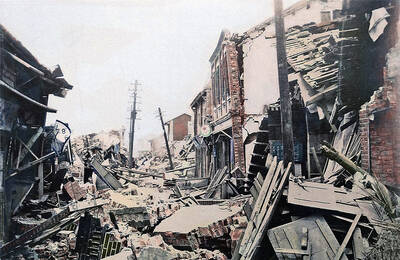
April 15 to April 21 Yang Kui (楊逵) was horrified as he drove past trucks, oxcarts and trolleys loaded with coffins on his way to Tuntzechiao (屯子腳), which he heard had been completely destroyed. The friend he came to check on was safe, but most residents were suffering in the town hit the hardest by the 7.1-magnitude Hsinchu-Taichung Earthquake on April 21, 1935. It remains the deadliest in Taiwan’s recorded history, claiming around 3,300 lives and injuring nearly 12,000. The disaster completely flattened roughly 18,000 houses and damaged countless more. The social activist and

Over the course of former President Ma Ying-jeou’s (馬英九) 11-day trip to China that included a meeting with Chinese Communist Party (CCP) leader Xi Jinping (習近平) a surprising number of people commented that the former president was now “irrelevant.” Upon reflection, it became apparent that these comments were coming from pro-Taiwan, pan-green supporters and they were expressing what they hoped was the case, rather than the reality. Ma’s ideology is so pro-China (read: deep blue) and controversial that many in his own Chinese Nationalist Party (KMT) hope he retires quickly, or at least refrains from speaking on some subjects. Regardless

Approaching her mid-30s, Xiong Yidan reckons that most of her friends are on to their second or even third babies. But Xiong has more than a dozen. There is Lucky, the street dog from Bangkok who jumped into a taxi with her and never left. There is Sophie and Ben, sibling geese, who honk from morning to night. Boop and Pan, both goats, are romantically involved. Dumpling the hedgehog enjoys a belly rub from time to time. The list goes on. Xiong nurtures her brood from her 8,000 square meter farm in Chiang Dao, a mountainous district in northern Thailand’s


 RSS
RSS