


The Taipei Fine Arts Museum's collection is rich and extensive, and lends itself to various juxtapositions for exhibitions such as the current Hyper Reality -- Contem-porary Images from the Museum Collection. The premise of the show is that with the advent of digital technology the distinctions between photography and fine arts are becoming blurred. As these digital images transcend appearance to convey reality, they then become hyper real, as they evoke otherworldly types of feelings, according to the show's curator Sharleen Yu.
The exhibition could have been stronger by focusing entirely on the post-martial law period when Taiwanese artists flourished after 1987. Moreover, the works of several European and Japanese artists are included, thus diluting one of the stronger themes of the show.
Narahara Ikko's Two Garbage Cans, Amerindian Village shows two garbage cans frozen in mid-air as if primal spirits elevated them to float amidst huge cumulus clouds. Working with silver bromide paper provides a sterling quality to the images.
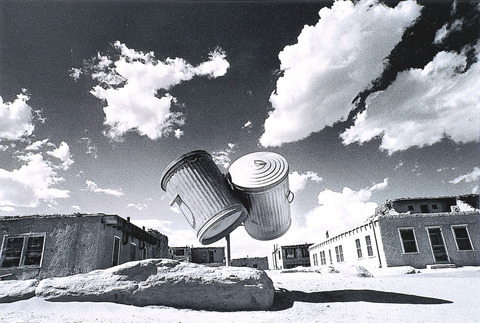
PHOTO COURTESY OF TFAM
Martin Franck juxtaposed surreal elements, such as a shadow of a tree trunk projected on a wall combined with the tree hidden behind, thus creating a whole tree, one that is part shadow and part leaves.
American photographer Arthur Tress created what he termed "scripted images," a series where children posed for him in run-down shacks and desolate areas. In Masked Children two youngsters wear dime-store Halloween costumes while stiffly posing in a run-down urban neighborhood. The contrast of the shabby surroundings with their attire hints at their aspirations for a middle-class life.
In this grouping of photographs, the local artists stand out. And no wonder as there is a movement afoot to make Taiwan a digital art paradise. Yet, it is not only the recent art that is striking. Veteran filmmaker Chang Chao-tang's (
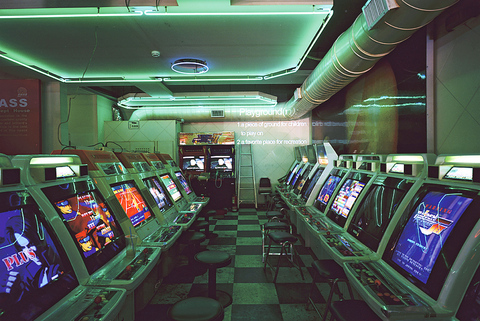
PHOTO COURTESY OF TFAM
Several Taiwanese artists deal with political themes. Yao Jui-chung's (姚瑞中) Attacking the Mainland Action Series shows the artist jumping in front of historical buildings in China and Hong Kong. As he is suspended in midair he conveys his sense of both being in limbo and of cultural displacement.
Chen Chieh-jen's (陳界仁) morbid black and white digital print shows an orgy of naked massacred bodies with the artist's face superimposed on the soldiers' bodies. These macabre works may not seem like fine art to the general public, but they take their histor-ical place in a long tradition of anti-war art.
Wu Tien-chang's (吳天章) Farewell Ceremony of Injury I-IV is a group of portraits where the face is made mute and is obscured by various objects. Framed by local cultural artifacts such as crushed velvet and plastic flowers, the work is about repression and freedom of expression. This sense of voicelessness is a common thread in many artworks of the post-martial law period.
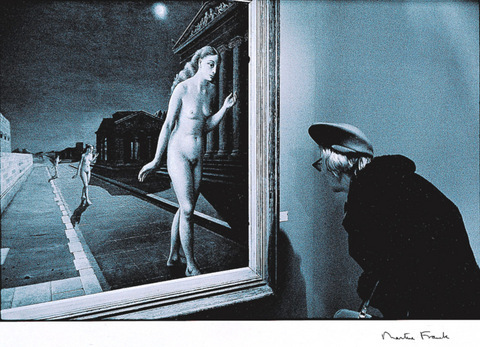
PHOTO COURTESY OF TFAMN
Daniel Lee's (
Yuan Goang-ming's (袁廣鳴) large (246cm by 320 cm) C Prints are technically stunning in his series titled City Disqualified. The blown-up scale of the busy Ximending intersection with all traces of people and vehicles obliterated makes for quite a disturbing contrast.
Hyper Reality, a collection of pictures of the world we live in -- both real and imagined -- will inspire you to start making your own digital images.
What: Hyper Reality - Contemporary Images from the Museum Collection
Where: Taipei Fine Arts Museum, 181 Zhongshan N Rd Sec 3, Taipei (台北市中山北路3段181號)
Telephone: (02) 2595-7656
When: Until June 11
Last week Joseph Nye, the well-known China scholar, wrote on the Australian Strategic Policy Institute’s website about how war over Taiwan might be averted. He noted that years ago he was on a team that met with then-president Chen Shui-bian (陳水扁), “whose previous ‘unofficial’ visit to the US had caused a crisis in which China fired missiles into the sea and the US deployed carriers off the coast of Taiwan.” Yes, that’s right, mighty Chen caused that crisis all by himself. Neither the US nor the People’s Republic of China (PRC) exercised any agency. Nye then nostalgically invoked the comical specter
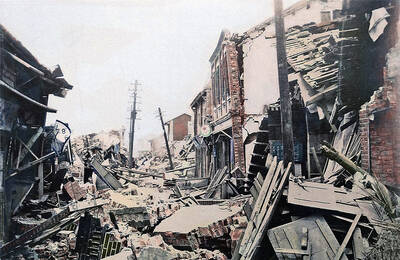
April 15 to April 21 Yang Kui (楊逵) was horrified as he drove past trucks, oxcarts and trolleys loaded with coffins on his way to Tuntzechiao (屯子腳), which he heard had been completely destroyed. The friend he came to check on was safe, but most residents were suffering in the town hit the hardest by the 7.1-magnitude Hsinchu-Taichung Earthquake on April 21, 1935. It remains the deadliest in Taiwan’s recorded history, claiming around 3,300 lives and injuring nearly 12,000. The disaster completely flattened roughly 18,000 houses and damaged countless more. The social activist and

Over the course of former President Ma Ying-jeou’s (馬英九) 11-day trip to China that included a meeting with Chinese Communist Party (CCP) leader Xi Jinping (習近平) a surprising number of people commented that the former president was now “irrelevant.” Upon reflection, it became apparent that these comments were coming from pro-Taiwan, pan-green supporters and they were expressing what they hoped was the case, rather than the reality. Ma’s ideology is so pro-China (read: deep blue) and controversial that many in his own Chinese Nationalist Party (KMT) hope he retires quickly, or at least refrains from speaking on some subjects. Regardless

Approaching her mid-30s, Xiong Yidan reckons that most of her friends are on to their second or even third babies. But Xiong has more than a dozen. There is Lucky, the street dog from Bangkok who jumped into a taxi with her and never left. There is Sophie and Ben, sibling geese, who honk from morning to night. Boop and Pan, both goats, are romantically involved. Dumpling the hedgehog enjoys a belly rub from time to time. The list goes on. Xiong nurtures her brood from her 8,000 square meter farm in Chiang Dao, a mountainous district in northern Thailand’s


 RSS
RSS