


I have seen dinner guests recoil from the offer of a silver fork, and resist when said fork was later dispatched to the dishwasher. But I refuse to be scared of using real silverware: Silver is strong stuff, and even when slightly tarnished, I like its warmth and heft.
But I'm in a shrinking minority: The number of American couples who register for sterling goes down every year, according to Caroline Baize of the Christofle silver company. "More couples want to save their money for a nice honeymoon," she said. Many of them may have already found themselves in custody of sterling silver that they consider "too good" for regular use.
But Feeding Desire: Design and the Tools of the Table, an exhibition of Western eating utensils opening May 5 at the Cooper-Hewitt National Design Museum in New York, may inspire people to use the good stuff.
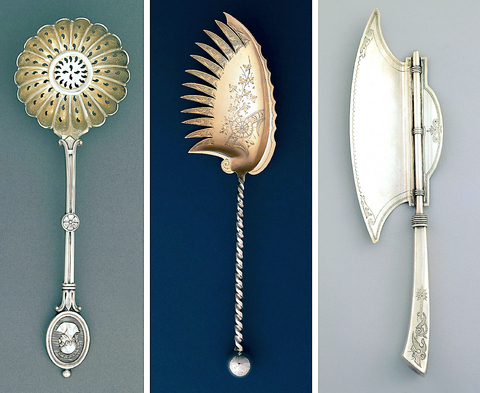
PHOTO: NY TIMES NEWS SERVICE
In the paneled dining room of the old Andrew Carnegie mansion that houses the museum, visitors will gaze upon Renaissance-era utensils whose carved ivory handles are tiny religious masterpieces, Napoleon's traveling silverware, and modern upstart utensils like the spork and its relatives.
These items might sound trivial, even boring -- the culinary equivalent of a museum show dedicated to old blankets or early toothbrush designs.
But passionate defenders of this declining art form see the show as a chance to revive the stature it once had at the table.
"These are the tools that turned eating into dining" said Sarah Coffin, a curator at the museum who has been researching the subject for almost 30 years. "Today we seem to be moving in the other direction, toward everyone eating in their cars with their hands, so it's pure pleasure to spend time with these objects and realize how useful they are."
"The fork, knife and spoon are clearly perfect forms," Coffin said as she pulled out drawer after drawer of them, all polished and ready for their moment in the spotlight. "How many things we use today have been virtually unchanged for the last 400 years?"
Western utensils are relative latecomers: while the Romans were sticking shells onto sticks to make early spoons, the Chinese had already refined the use of chopsticks over thousands of years.
In the West, knives were the first tool to come to the table, as personal weapons that were also used for cutting and spearing meat. In the 1600s, the pointed tip of the knife was rounded by decree of King Louis XIII of France. Some historians say this was to prevent violence at the dinner table, others, to prevent unsightly tooth-picking by courtiers, a particular irritant to Cardinal Richelieu. If the knife was associated with the hunt and the manly act of stabbing, the spoon was maternal, used for soft gruels or to feed babies and the elderly.
"Spoons were originally round, but the advent of purees and smooth soups made a more oval shape more practical, to let you tip the liquid directly into the front of your mouth," Coffin said.
The fork, which came much later, brought with it associations of the Devil's pitchfork and the perceived effeminacy of the East; it was an 11th-century Byzantine princess who made its first recorded use in Europe, as a golden tool to prevent her fingers from getting sticky from candied fruit. Medieval Christians were frequently banned from using forks by the Church, and even Louis XIV, a monarch not known for his austerity, refused to eat with a fork because of its associations with his effete predecessor Henri III.
The triumvirate of knife, fork and spoon together was in common use in Europe by the end of the 1700s. All three pieces traveled from place to place with their owners -- often worn on the body in a kind of holster -- until the following century, when households began stockpiling utensils. This opened the door to flatware as a visible marker of wealth, developing patterns, crests, and flourishes that reflected on the household's stature and its taste.
And so we arrive at the late 19th-century sterling nut picks, strawberry spoons, and monogrammed terrapin forks on display at the Cooper-Hewitt, which seem like artifacts of a civilization as distant as Pompeii, not our own relatively recent Gilded Age. When Mark Twain gave that title to his 1873 novel, it was a caustic reference to the era's rampant corruption in business and politics, but it is also tempting to apply it to its culture of excess in flatware. "One service at the time had over 300 different pieces," Coffin said as we inspected an ornate gold-covered dessert service presented to J.P. Morgan by the understandably grateful directors of the New York Central Railroad.
Not only Morgans and Carnegies were caught up in the frenzy for flatware.
"There is something very touching about many of these pieces" said Annamarie Sandecki, the director of the Tiffany and Co archive, which loaned numerous pieces to the show. "We were such a young country, with no inherited wealth, no family silver. Buying silverware was a way to establish yourself as a person of substance."
Gilded Age designers brought Japanese influence and playful naturalistic decoration to the table, affixing tiny silver birds' nests with eggs to egg spoons and applying scalloped edges to scallop forks.
"This was one of the first art movements to start in America and then make its way to Europe," Coffin said.
In return, modern designers in Germany and Scandinavia stripped utensils down to their most unadorned. Throughout the process, designers have tinkered with the basic forms to see if they could be improved on or consolidated. The spork, according to Coffin, is probably the earliest innovation, but the Cooper-Hewitt show also includes knorks, knoons and even an intriguing utensil that can act as all three.

In late October of 1873 the government of Japan decided against sending a military expedition to Korea to force that nation to open trade relations. Across the government supporters of the expedition resigned immediately. The spectacle of revolt by disaffected samurai began to loom over Japanese politics. In January of 1874 disaffected samurai attacked a senior minister in Tokyo. A month later, a group of pro-Korea expedition and anti-foreign elements from Saga prefecture in Kyushu revolted, driven in part by high food prices stemming from poor harvests. Their leader, according to Edward Drea’s classic Japan’s Imperial Army, was a samurai

Located down a sideroad in old Wanhua District (萬華區), Waley Art (水谷藝術) has an established reputation for curating some of the more provocative indie art exhibitions in Taipei. And this month is no exception. Beyond the innocuous facade of a shophouse, the full three stories of the gallery space (including the basement) have been taken over by photographs, installation videos and abstract images courtesy of two creatives who hail from the opposite ends of the earth, Taiwan’s Hsu Yi-ting (許懿婷) and Germany’s Benjamin Janzen. “In 2019, I had an art residency in Europe,” Hsu says. “I met Benjamin in the lobby
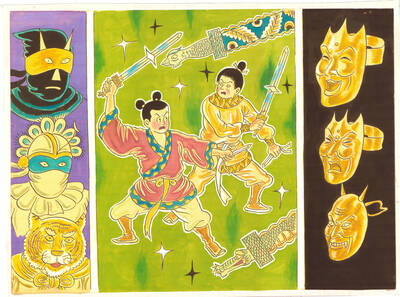
April 22 to April 28 The true identity of the mastermind behind the Demon Gang (魔鬼黨) was undoubtedly on the minds of countless schoolchildren in late 1958. In the days leading up to the big reveal, more than 10,000 guesses were sent to Ta Hwa Publishing Co (大華文化社) for a chance to win prizes. The smash success of the comic series Great Battle Against the Demon Gang (大戰魔鬼黨) came as a surprise to author Yeh Hung-chia (葉宏甲), who had long given up on his dream after being jailed for 10 months in 1947 over political cartoons. Protagonist

Peter Brighton was amazed when he found the giant jackfruit. He had been watching it grow on his farm in far north Queensland, and when it came time to pick it from the tree, it was so heavy it needed two people to do the job. “I was surprised when we cut it off and felt how heavy it was,” he says. “I grabbed it and my wife cut it — couldn’t do it by myself, it took two of us.” Weighing in at 45 kilograms, it is the heaviest jackfruit that Brighton has ever grown on his tropical fruit farm, located


 RSS
RSS