


For most of recorded history, human beings have been embroiled in violent conflict, either as victims or aggressors. Life, filled with pain and suffering, has been shaped by unpredictable forces beyond mortal ken. In The Great Transformation, Karen Armstrong, the historian of religion, offers a sweeping account of the centuries-long struggle by spiritual seekers to address these problems and transcend them in China, India, Israel and Greece.
The Great Transformation looks far into the past. It begins with the first stirrings of religious consciousness, about 3,500 years ago among the Aryans of the southern Russian steppes, that would eventually lead humanity from nature worship and sacrifice to an inward-looking, self-critical and compassionate approach to life.
This transformation occurred independently in four different regions during the Axial Age, a pivotal period lasting from 900BC to 200BC, producing Taoism and Confucianism in China, Buddhism and Hinduism in India, Judaism in the Middle East and philosophic rationalism in Greece.
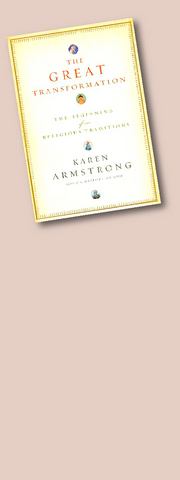
Moving back and forth from one culture to another, Armstrong, the author of A History of God and histories of Buddhism and Islam, provides a lucid, highly readable account of complex developments occurring over many centuries. For the general reader The Great Transformation is an ideal starting point for understanding how the crowded heaven of warring gods, worshiped in violent rites, lost its grip on the human imagination, which increasingly looked inward rather than upward for enligh-tenment and transcendence.
In historical time the great transformation is remote. But Armstrong argues passionately for its relevance to a world still embroiled in military conflict and sectarian hatreds. This is the powerful undertow to her book. "In times of spiritual and social crisis, men and women have constantly turned back to this period for guidance," she writes. "They may have interpreted the Axial discoveries differently, but they have never succeeded in going beyond them."
Even further, Armstrong argues that the radicalism of the great Axial thinkers has yet to be understood. Their notion of the religious life was concerned less with belief systems than with self-transformation. Most were uninterested in questions of theology. "Their objective was to create an entirely different kind of human being," she writes.
Spiritual change took place in specific historical, social and economic contexts, which Armstrong sketches out as she moves her narrative along. Centuries fly by, often in a blur, and the need to press ahead can lead to extreme foreshortening.
"The Sophists taught systematic doubt at a time of deepening
anxiety," Armstrong writes. Virtually every period she discusses could be called an anxious age. That old friend, "age of transition," inevitably shows up, and, in a discussion of karma, the author uncorks a doozy: "As this new
concept took hold, the mood of India ... became depressed."
With only a few slips, however, Armstrong keeps her four plates spinning at top speed, moving easily from one to another. She is partic-ularly nimble in working her way through the Bible, tying each book to the historical circumstances of its composition and the preoccupations of its many editors. Yahweh, for example, gradually changes from an angry warrior god, quite similar to his counterparts in the Vedic pantheon, and an equal with rival gods of the Middle East, into the creative force that brought the world into being without violence, in sharp contrast to the gods of Greece.
The gradual elimination of violence from religion is one of Armstrong's great themes. In India priests in the 9th century BC had revised the sacrificial rituals to purge them of any practices likely to lead to violence, paving the way toward the guiding Axial concept of harmlessness. In China, the concept of the ideal ruler changed from a warrior wielding magical powers to a serene, wise ruler whose daode (道德) or royal potency, "brought spiritual benefit to the people."
Armstrong tells a hopeful story. The Axial sages move humankind from a religious worldview mired in tribal loyalty and self-interest to an expansive spirituality that takes account of others. In writing of the Jains, circa 530BC to 450BC, she writes, "The new ideal was no longer merely to refrain from violence, but to cultivate a tenderness and sympathy that had no bounds."
Greece is the great exception. At a time when the Hebrew prophets were preaching monotheism, Greece opted for polytheism. In religion the Greeks were, in a sense, committed reactionaries. Their achievements lay in the fields of philosophy, ethics and science, and it was they who would lay the groundwork for what Armstrong calls the second great transformation, the scientific revolution of the 16th century that created the modern industrial world but that represents "a more mundane illumination." Armstrong gives them, and the West, a somewhat grudging two cheers.
"The Axial Age was a time of spiritual genius; we live in an age of scientific and technological genius, and our spiritual education is often undeveloped," she writes.
The Great Transformation concludes vaporously. Armstrong, noting that "we are living in a period of great fear and pain," makes a high-minded plea for the warriors and aggressors of the world to heed the teachings of the Axial Age, and for nations to adopt a more self-critical spirit in their dealings with one another. It is time, she argues, for the modern world to look backward and adopt the Axial ideals of "sympathy, respect and universal concern."
Well, all right, fine. But these sentiments, however lofty, seem squishy. The conclusion does a disservice to a splendid book. After an inspirational journey through more than two millennia of profound thought, struggle and enlightenment, the reader gets a fortune cookie at the end.

In late October of 1873 the government of Japan decided against sending a military expedition to Korea to force that nation to open trade relations. Across the government supporters of the expedition resigned immediately. The spectacle of revolt by disaffected samurai began to loom over Japanese politics. In January of 1874 disaffected samurai attacked a senior minister in Tokyo. A month later, a group of pro-Korea expedition and anti-foreign elements from Saga prefecture in Kyushu revolted, driven in part by high food prices stemming from poor harvests. Their leader, according to Edward Drea’s classic Japan’s Imperial Army, was a samurai

Located down a sideroad in old Wanhua District (萬華區), Waley Art (水谷藝術) has an established reputation for curating some of the more provocative indie art exhibitions in Taipei. And this month is no exception. Beyond the innocuous facade of a shophouse, the full three stories of the gallery space (including the basement) have been taken over by photographs, installation videos and abstract images courtesy of two creatives who hail from the opposite ends of the earth, Taiwan’s Hsu Yi-ting (許懿婷) and Germany’s Benjamin Janzen. “In 2019, I had an art residency in Europe,” Hsu says. “I met Benjamin in the lobby
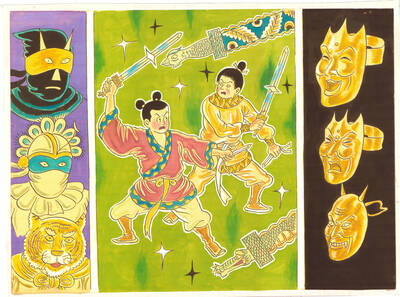
April 22 to April 28 The true identity of the mastermind behind the Demon Gang (魔鬼黨) was undoubtedly on the minds of countless schoolchildren in late 1958. In the days leading up to the big reveal, more than 10,000 guesses were sent to Ta Hwa Publishing Co (大華文化社) for a chance to win prizes. The smash success of the comic series Great Battle Against the Demon Gang (大戰魔鬼黨) came as a surprise to author Yeh Hung-chia (葉宏甲), who had long given up on his dream after being jailed for 10 months in 1947 over political cartoons. Protagonist

Peter Brighton was amazed when he found the giant jackfruit. He had been watching it grow on his farm in far north Queensland, and when it came time to pick it from the tree, it was so heavy it needed two people to do the job. “I was surprised when we cut it off and felt how heavy it was,” he says. “I grabbed it and my wife cut it — couldn’t do it by myself, it took two of us.” Weighing in at 45 kilograms, it is the heaviest jackfruit that Brighton has ever grown on his tropical fruit farm, located


 RSS
RSS