


Histories get lost. That's how life is. Then, when the time is right, they get found. Energy/Experimentation: Black Artists and Abstraction 1964-1980 at the Studio Museum in Harlem, New York, is about such a history, which went something like this.
During one of the most radical periods in 20th-century American politics, the black power era, a group of African-American artists was working with what was, and still is, one of the most radical forms of 20th-century art, abstraction. Radicalism is relative, though, and in this case politics and culture were on different tracks.
At a time of impassioned gestures and hot visions -- raised fists, "the fire next time" -- abstract art appeared cool and noncommittal. It had been conceived as a revolutionary language of color, line, shape. But the 1960s revolution was about bodies and beliefs. Also, abstraction raised authenticity issues. It was widely seen as white art, academic art. Whites viewed black practitioners as copycats; blacks dismissed them as sellouts.
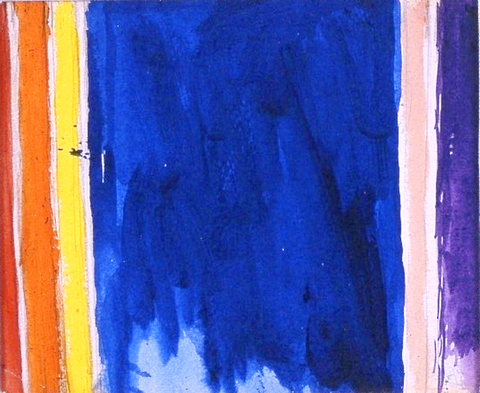
PHOTO: NY TIMES NEWS SERVICE
So, while a few figures like Melvin Edwards, Sam Gilliam and Al Loving (1935-2005) gained visibility, abstraction by African-Americans as a phenomenon faded from view, and its invisibility has persisted. The Guggen-heim Museum's 1996 survey, Abstraction in the 20th Century: Total Risk, Freedom, Discipline, included no artists of color.
But now the relationship between aesthetics and politics is changing. Many young artists see racially defined art as limiting: a problem, not a solution. A return to the story of earlier artists who struggled with that same view is in order, and that's what the Studio Museum exhibition does.
It is not alone. Two years ago, at Franklin and Marshall College in Pennsylvania, the painter Bill Hutson organized Something to Look Forward To, a survey of African-American abstract painters whose careers began in the 1960s. He included nearly two dozen artists, but much of the work was recent, so the show was really about a past continuing in the present. A full-scale historical survey was still needed.
Energy/Experimentation is not that survey. It has only 15 artists. Much of the art is large, and the Studio Museum galleries are fairly small. A multi-venue show, done in partnership with, say, the Bronx Museum of the Arts, or one of the City University of New York campus galleries, might have been a solution.
Although it is by no means complete, the present show, organized by Kellie Jones, an art and cultural historian at Yale University, does many things right. All but one piece dates from the 1960s and 1970s, when a number of black artists -- too few to be a movement, too many to be a circle -- were turning contemporary styles (Pop, Minimalism, Conceptualism), new materials (acrylic paint, plastics, light) and varying degrees of multicultural content to abstract ends.
The artists spanned generations. When Alma Thomas (1891-1978) first started painting her abstract images of gardens in Washington in the 1960s, she was almost 70. When Gilliam had his first career retrospective in that city in 1967, he was in his 30s.
Cosmopolitanism ruled. Frank Bowling was born in Guyana, trained in London and settled in New York. The Americans Ed Clark and Barbara Chase-Riboud emigrated from New York to Paris. Chase-Riboud, who has a splendid 1972 aluminum floor piece in the show -- it's like a Carl Andre spouting green silk creepers -- lives in France still.
The show traces spheres of influence. Haywood Bill Rivers (1922-2002), represented by a florette-pattern picture inspired by quilts and Islamic arabesques, was a mentor to artists like Jack Whitten. In the late 1960s, the superb painter William Williams was instrumental in establishing the artists in residence program at the Studio Museum, which has nurtured major talent.
What's instantly apparent when you enter the galleries is the absence of any binding "look." These artists were a determinedly individualistic bunch. Loving and Williams both did high-color, hard-edge painting early on, but the results are unalike: One favored self-contained forms, the other fragmented compositions pitched at a tilt.
Fragmentation, in fact, was a shared interest: Pindell made ethereal relief paintings from sewn strips of cloth; Tom Lloyd (1921-96) assembled sculptures from colored lights. So was an interplay of weightlessness and gravity. Steel sculptures by Edwards, like Lifted X (1965), were heavy but free-hanging. Joe Overstreet's Saint Expedite A (1971) is a shaped painting that seems to levitate in midair.
Daniel LaRue Johnson's smashing, spacey Homage to Rene d'Harnoncourt floats between categories. It is at once a reclining polychrome sculpture and a painting that hovers horizontally over the floor. Metaphors of floating in space are everywhere in the show. Whitten's paintings look like lunar landscapes. Fred Eversley's plastic-resin sculptures have an otherworldly sheen. A 1972 painting by Thomas of a cloud of red strokes against deep blue ground is titled Mars Dust.
Images of suspension made sense in an age obsessed with aeronautics and mobility. They also had pertinence to the lives of forward-looking artists who found themselves on uncertain ground in relation to the mainstream art world and to the intensifying identity politics of the day.
These politics found their way, however obliquely, into abstraction. Loving, Pindell and Williams were all inspired by traditions of African-American quilt-making and African weaving. Overstreet's piece refers to Native American shelters but is painted in an Africanesque palette of black, red and green.
Bowling, who argued adamantly against the association of art with racial politics, made paintings in the colors of the Guyanese flag. Lloyd's flashing light sculptures have links to the work of Dan Flavin and Bruce Nauman, but also to police cars. The title of Edwards' sculptural series Lynch Fragments speaks for itself.
In short, politics is here if you want it, but it is just one aspect of an art that focuses on extracting something fresh from formal convention and new materials. Only one piece, Pindell's video Free, White and 21, is a direct-address indictment of racism. Made in 1980, it points to a type of confron-tational, non-abstract, activist art that dominated the following decades.
Actually, that dominance was never as monolithic as it is often made out to be. And Pindell herself has consistently blended abstraction, figuration and political content into a single expressive language. Younger contemporaries, like Ellen Gallagher, have done the same in nuanced bodies of work, some more abstract than others. So have still younger figures like Louis Cameron, Arnold Kemp and Annette Lawrence, who are in a show at the museum titled Collection in Context: Gesture that complements Jones' exhibition.
If we were seeing their art someplace other than the Studio Museum in Harlem, would we necessarily read it as African-American at all? And because we know it is by African-American artists, must we automatically mine it for racial and political content? The answer to both questions is no.
Art is about possibility. As Jones' fine show demonstrates, it is capacious; its history is ever-changing; and what is lost is only lost until you see it again.

In late October of 1873 the government of Japan decided against sending a military expedition to Korea to force that nation to open trade relations. Across the government supporters of the expedition resigned immediately. The spectacle of revolt by disaffected samurai began to loom over Japanese politics. In January of 1874 disaffected samurai attacked a senior minister in Tokyo. A month later, a group of pro-Korea expedition and anti-foreign elements from Saga prefecture in Kyushu revolted, driven in part by high food prices stemming from poor harvests. Their leader, according to Edward Drea’s classic Japan’s Imperial Army, was a samurai
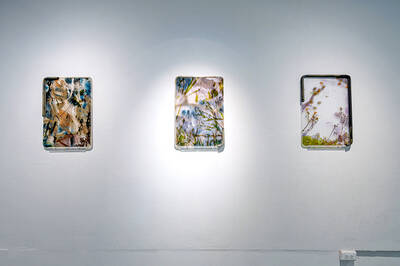
Located down a sideroad in old Wanhua District (萬華區), Waley Art (水谷藝術) has an established reputation for curating some of the more provocative indie art exhibitions in Taipei. And this month is no exception. Beyond the innocuous facade of a shophouse, the full three stories of the gallery space (including the basement) have been taken over by photographs, installation videos and abstract images courtesy of two creatives who hail from the opposite ends of the earth, Taiwan’s Hsu Yi-ting (許懿婷) and Germany’s Benjamin Janzen. “In 2019, I had an art residency in Europe,” Hsu says. “I met Benjamin in the lobby
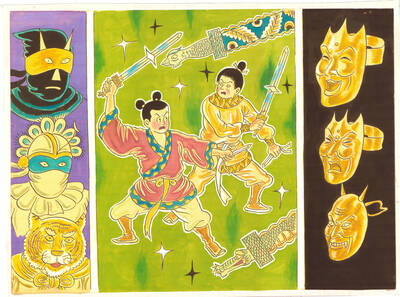
April 22 to April 28 The true identity of the mastermind behind the Demon Gang (魔鬼黨) was undoubtedly on the minds of countless schoolchildren in late 1958. In the days leading up to the big reveal, more than 10,000 guesses were sent to Ta Hwa Publishing Co (大華文化社) for a chance to win prizes. The smash success of the comic series Great Battle Against the Demon Gang (大戰魔鬼黨) came as a surprise to author Yeh Hung-chia (葉宏甲), who had long given up on his dream after being jailed for 10 months in 1947 over political cartoons. Protagonist

Peter Brighton was amazed when he found the giant jackfruit. He had been watching it grow on his farm in far north Queensland, and when it came time to pick it from the tree, it was so heavy it needed two people to do the job. “I was surprised when we cut it off and felt how heavy it was,” he says. “I grabbed it and my wife cut it — couldn’t do it by myself, it took two of us.” Weighing in at 45 kilograms, it is the heaviest jackfruit that Brighton has ever grown on his tropical fruit farm, located


 RSS
RSS