


Her face heavily made-up, Bella Saphira struts a darkened length of cement path along the Krueng Aceh river in Indonesia's Banda Aceh, wearing a loosely flowing dress but no Islamic veil.
Elsewhere in the staunchly-Muslim province of Aceh, which has been gradually implementing Islamic Shariah law, Muslim women are required to cover their heads -- but then, Saphira is not a woman.
She belongs to Banda Aceh's small community of transvestites, who stake their claim on this riverside stretch every weekend after dark in an area where courting couples met before the December 2004 tsunami.

PHOTO: AFP
Tonight about 30 waria -- Indonesian transvestites so named because they have the characteristics of a wanita, or girl, but are born a boy or pria -- congregate and chat. Some are in full drag, others wear men's clothing but wear carefully applied make-up.
Wafts of cheap perfume mix with the pungent odour of Indonesia's clove-flavored cigarettes. Pieces of costume jewelry strategically adorning ears, necks and wrists glint under flashes of headlights from passing cars.
"We're just here to sit and gather together. We're not here to earn money but to get satisfaction," says a smiling Kiki Yohana, whose manly features are barely covered by a thin sheen of foundation.
Kiki, a 23-year-old who works as a waiter on the outskirts of the provincial capital, wears a T-shirt and jeans.
"Kiki likes it this way. If I dress up, I'm afraid I'd run into relatives. I have a lot of relatives here," she said as she explains that the masculine clothes are not because she fears capture by the Shariah police.
The Wilayatul Hisbah regularly patrol the streets of Banda Aceh in search of improperly dressed or unveiled women, as well as gamblers, drunkards or members of the opposite sex being affectionate in public.
More than 200 Acehnese, both men and women, have received public lashings across the province in the past year, paying for infringing the Shariah introduced as part of broad-ranging autonomy handed to the province by Jakarta in 2001. Others are given verbal reprimands.
But no transvestite has been at the receiving end of the lash.
"I am not afraid. We are only sitting together here," said Yohana, who has been detained twice by the Shariah police but released after getting a thorough lecture on morals.
"They came by earlier, but they didn't say anything," said one of the long-haired waria squatting nearby, wearing a woman's Muslim tunic and pants.
Declining to give her name, she said that on busy Saturdays when the weather is pleasant, about 60 men, including some from outside town, gather here.
"They are very daring in offering their services. Even for 5,000 rupiah (US$0.50 cents), they are willing," she said with a giggle.
Yohana said she is here not to earn money "but for pleasure."
From pedicab drivers to police, young and old, she says plenty of local men from many walks of life, frequent the area to pick up the waria -- who are otherwise shunned in every day situations.
A local gang provides protection in return for "donations."
"If anything happens, they protect us, and we donate money to them," Yohana explained.
Each transvestite gives 5,000 rupiah to 10,000 rupiah (about US$0.50 cents to US$1) each night to the gang members but if they are broke, they promise to buy them drinks when they are cashed up, she said.
Mohammed Natsir Ilyas, head of the Islamic Shariah office overseeing the area, said action will eventually be taken against the waria if they are found soliciting for sex.
"We will summon them and provide them with guidance about what they are doing going against Islamic Shariah, the very Islamic Shariah we are trying to uphold here in Aceh," he said, without giving a time frame.
He said the men will be told to stop dressing as women, but added that "we will also listen to them, what they really want. We will take a persuasive approach because they too are citizens."
Saphira, who has remained quiet, drags from her cigarette and joins a group of friends noisily laughing in one of the empty huts serving coffee and food stalls during the day.
"She has implants," Yohana sniffs. "Others only use towels or even balloons."
As she speaks a tall young waria arrives. Despite a broad chest and crew cut, there is nothing manly about Irfanda's walk or talk.
"I just played around with a policeman for about an hour. Ooh, it was good. I really got drunk" [on love], she coos, adding that she wants to go home to get some sleep.

Last week Joseph Nye, the well-known China scholar, wrote on the Australian Strategic Policy Institute’s website about how war over Taiwan might be averted. He noted that years ago he was on a team that met with then-president Chen Shui-bian (陳水扁), “whose previous ‘unofficial’ visit to the US had caused a crisis in which China fired missiles into the sea and the US deployed carriers off the coast of Taiwan.” Yes, that’s right, mighty Chen caused that crisis all by himself. Neither the US nor the People’s Republic of China (PRC) exercised any agency. Nye then nostalgically invoked the comical specter

Relations between Taiwan and the Czech Republic have flourished in recent years. However, not everyone is pleased about the growing friendship between the two countries. Last month, an incident involving a Chinese diplomat tailing the car of vice president-elect Hsiao Bi-khim (蕭美琴) in Prague, drew public attention to the People’s Republic of China’s (PRC) operations to undermine Taiwan overseas. The trip was not Hsiao’s first visit to the Central European country. It was meant to be low-key, a chance to meet with local academics and politicians, until her police escort noticed a car was tailing her through the Czech capital. The
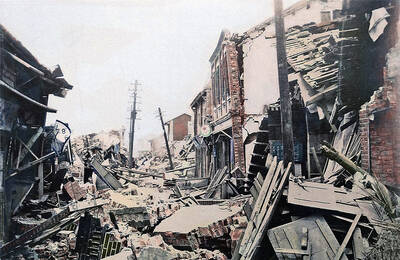
April 15 to April 21 Yang Kui (楊逵) was horrified as he drove past trucks, oxcarts and trolleys loaded with coffins on his way to Tuntzechiao (屯子腳), which he heard had been completely destroyed. The friend he came to check on was safe, but most residents were suffering in the town hit the hardest by the 7.1-magnitude Hsinchu-Taichung Earthquake on April 21, 1935. It remains the deadliest in Taiwan’s recorded history, claiming around 3,300 lives and injuring nearly 12,000. The disaster completely flattened roughly 18,000 houses and damaged countless more. The social activist and

Over the course of former President Ma Ying-jeou’s (馬英九) 11-day trip to China that included a meeting with Chinese Communist Party (CCP) leader Xi Jinping (習近平) a surprising number of people commented that the former president was now “irrelevant.” Upon reflection, it became apparent that these comments were coming from pro-Taiwan, pan-green supporters and they were expressing what they hoped was the case, rather than the reality. Ma’s ideology is so pro-China (read: deep blue) and controversial that many in his own Chinese Nationalist Party (KMT) hope he retires quickly, or at least refrains from speaking on some subjects. Regardless


 RSS
RSS