


A couple of years ago Taiwan novelist and kun opera enthusiast Kenneth Pai (白先勇) brought a highly acclaimed version of Peony Pavilion (牡丹亭) to the stage of the National Theater (國家戲劇院). His version of the classical Chinese love story written by Ming Dynasty master playwright Tang Hsien-tsu (湯顯祖) generated renewed interest in this iconic work, and sparked a number of modern renditions.
Among these is You Yuan by Hong Kong award-winning theater actress and director Olivia Yan (甄詠蓓) of Theatre Ensemble, who puts a female take on this love story at the National Experimental Theater (國家實驗劇場) starting next Thursday.
But if you go to the theater expecting to relive the heart-stirring story of the beautiful daughter of an aristocratic family, Du Li-niang (杜麗娘), dying of lovesickness and being brought back to life by the love of the young scholar Liu Meng-mei (柳夢梅), you will be disappointed. Instead, you will find yourself lost in a modern garden where Yan's solo performance leads the audience through a fragmented poetry of imagery, sound, rhythm, and gesture.
Rather than an adaptation of the Peony Pavilion, You Yuan (遊園) serves as an extension of and a dialogue with the classical work. As Yan pointed out, she is greatly taken by the character of Du and wishes to instill a female sensitivity and point of view into the work by the male author.
To Yan, every woman is Du Li-niang, who sees love as the most important element in life. The characters she plays on stage are the incarnations of women's repressed desires and emotions. "In You Yuan, you can't find Du or any chapter of the original story. But to me, the soul of Du permeates the work," Yan said. "In different eras, people may have different values and idea, but the mental restriction on women remains the same. Women have been and will always live on love and die for love."
In the play, a modern-day female gardener drifts around a mystical space like a ghost as seasons come and go. Like all the shadowy women behind her, she falls in and out of dreams in which the repressed longings and memories turn into monstrous shades that haunt the mind. She crawls in and out of a cave, talking about trees and flowers, insects, birds and fish in swamps and woods.
A woman is born, grows up, gives birth and dies. A woman looks at herself in a mirror, puts on makeup, sprays perfume, smears it all off and does it again and again. Still another woman puts on a pair of high heels, laughing, crying, snoring and chewing the sofa. Through the presentation of different women, the solo performer focuses on the subtle intensity that derives from seemingly trivial yet refined movements and gestures, illuminating the incessant flow of thoughts and emotions. The narrative definitely takes a back seat.
Yan's feminine reveries are neatly woven into her contemplations on life and death, nature and modernization. "To me, the relation between life, death and nature is the essence of Peony Pavilion? . I am not trying to revive the traditional art form, and I don't think I am capable of doing so. I just look into my own cultural tradition and personal background and experiences and search for my own way of expression," Yan said.
To Yan, a great actor should be a total actor, that is, be able to perform without props or sets and still take the audience beyond the confining frame of the stage and into the unlimited realm of the imagination. And that is what she tries to achieve in her theatrical creations.
Coming from a Liyuan opera (梨園劇) family, Yan has familiarized herself with traditional opera forms and went to Europe to study with theater masters such as Monika Pagneux, one of Europe's foremost teachers of movement for the theater. Her works are the expressive synthesis of Western modern theater and Chinese opera, and to her mind, the performers of the traditional performing art can best illustrate the concept and practice of a total actor.
When asked about the challenges a solo performer has to face and overcome, Yan said: "In a solo performance, all the focus, creation, story, expression and imagination is on you. You are all alone. You have to fight against yourself, understand your own limits, but at the same time keep on pushing and expanding. It requires lots of courage and wisdom, but great satisfaction will come."
A scriptwriter, director, actress and teacher, the versatile female artist co-founded the Theatre Ensemble with her husband in 1993. Over the years, the troupe has built up a repertoire of more than 30 pieces.
As Yan explains, "In physical theater,
language is not the dominant expressive element but bodies, and the textures, gestures, and movements of the bodies. All our creations start from the rehearsal room without a fixed script."
In You Yuan, the audience will not only find the stylistic physical theater that pleases the senses, but a sincere and honest attempt from an artist to speak of the concreteness of life and the human condition.
FOR YOUR INFORMATIOIN
● What: You Yuan (遊園) by Theatre Ensemble
● Where: National Experimental Theater (國家實驗劇場) 21-1, Zhongshan S Rd, Taipei (台北市中山南路21-1號)
● When: April 20 and 21 at 7:30pm
April 22 at 2:30pm and 7:30pm
April 23 at 2:30pm
● Tickets: NT$500, available through NTCH ticket outlets or at www.artsticket.com.tw
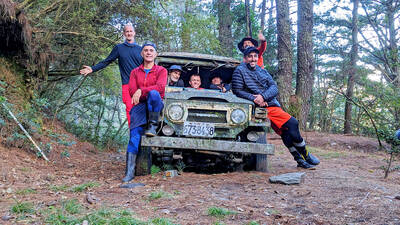
The year was 1991. A Toyota Land Cruiser set out on a 67km journey up the Junda Forest Road (郡大林道) toward an old loggers’ camp, at which point the hikers inside would get out and begin their ascent of Jade Mountain (玉山). Little did they know, they would be the last group of hikers to ever enjoy this shortcut into the mountains. An approaching typhoon soon wiped out the road behind them, trapping the vehicle on the mountain and forever changing the approach to Jade Mountain. THE CONTEMPORARY ROUTE Nowadays, the approach to Jade Mountain from the north side takes an

Last week Joseph Nye, the well-known China scholar, wrote on the Australian Strategic Policy Institute’s website about how war over Taiwan might be averted. He noted that years ago he was on a team that met with then-president Chen Shui-bian (陳水扁), “whose previous ‘unofficial’ visit to the US had caused a crisis in which China fired missiles into the sea and the US deployed carriers off the coast of Taiwan.” Yes, that’s right, mighty Chen caused that crisis all by himself. Neither the US nor the People’s Republic of China (PRC) exercised any agency. Nye then nostalgically invoked the comical specter
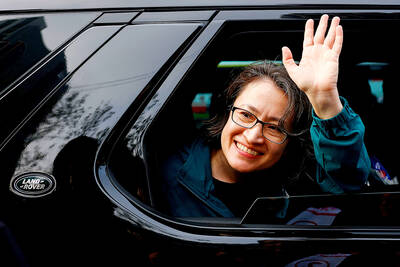
Relations between Taiwan and the Czech Republic have flourished in recent years. However, not everyone is pleased about the growing friendship between the two countries. Last month, an incident involving a Chinese diplomat tailing the car of vice president-elect Hsiao Bi-khim (蕭美琴) in Prague, drew public attention to the People’s Republic of China’s (PRC) operations to undermine Taiwan overseas. The trip was not Hsiao’s first visit to the Central European country. It was meant to be low-key, a chance to meet with local academics and politicians, until her police escort noticed a car was tailing her through the Czech capital. The
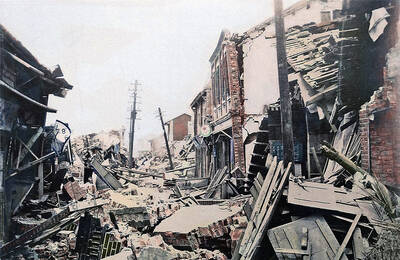
April 15 to April 21 Yang Kui (楊逵) was horrified as he drove past trucks, oxcarts and trolleys loaded with coffins on his way to Tuntzechiao (屯子腳), which he heard had been completely destroyed. The friend he came to check on was safe, but most residents were suffering in the town hit the hardest by the 7.1-magnitude Hsinchu-Taichung Earthquake on April 21, 1935. It remains the deadliest in Taiwan’s recorded history, claiming around 3,300 lives and injuring nearly 12,000. The disaster completely flattened roughly 18,000 houses and damaged countless more. The social activist and


 RSS
RSS