


In the West, after artists move into impoverished neighborhoods to set up studios, gentrification often follows. It happened in Montmartre in the 1880s and New York in the 1980s. But in Taipei, two former Chinese Nationalist Party (KMT) villages have been saved from destruction for urban development and now exist for the benefit of artists and the local community at large.
At the foot of Taipei 101 lies 44 South Village (四四南村), a KMT military settlement built between 1947 and 1949. The long one-story concrete row houses were deemed an eyesore by many and a reminder of a controversial past. Many of these villages (Taipei once had 186) have been bulldozed for urban development. However, two of these villages have been preserved for cultural activities by the Taipei City Cultural Department. Now the pride of the local Xinyi district government, 44 South Village has been renovated and is now a beautiful exhibition space. Its previous tenants have been relocated to nearby housing. It is here that visiting artist Paul Sermon debuts his technical interactive piece titled Headroom which he felt suited the site's paradoxical nature.
Based in Manchester, England, Sermon first came to Taiwan last year as a participating artist for the 25 years of Ars Electronica award-winning work exhibited at the National Taiwan Museum of Fine Arts, Taichung in which he showed his Telematic Dreaming 05, a 1991 Golden Nica prize winner. Impressed by Taiwan, he returned this February as a resident of the Taipei Artist Village.
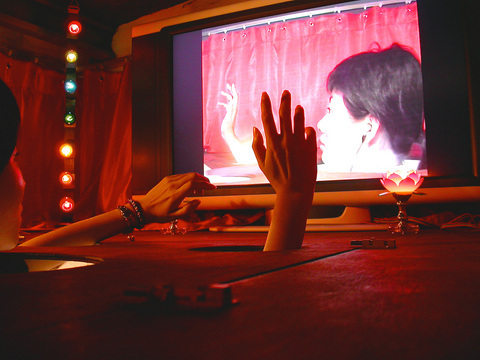
PHOTO COURTESY OF TAIPEI ARTIST VILLAGE
For Headroom, Sermon continues his exploration of how technology can connect us and create intimate spaces while also distorting our experience of physical and emotional space. In this interactive work, one person enters a small furnished room which has a wooden box built directly under the ceiling forcing one to stoop. However, the few drilled holes allow you to put your head and hands into the upper space. A person in another room does the same. Then suddenly both profiles are projected onto a screen, which creates a shocking and sudden intimacy. Even though you are not in the same physical space with the other person, you are in the same virtual space. With the aid of video cameras projecting both profiles on the screens, you are able to virtually touch, whisper to and kiss your partner. The experience is phenomenal as you really forget about your own physical body and instead focus on the body language and facial gestures of yourself and your cyber partner.
In contrast to the pristine 44 South Village, the funky Treasure Hill is an experimental site that brings artists, architects and environmentalists to live and work within a community of residents in an area of favela-type housing. Overlooking the Danshui River, near the National Taiwan University, the ramshackle houses became a permanent home for about 200 families and at one point in the 1990s it was slated to be torn down to make a park, but after the community protested the site was earmarked for collective living and farming. In six months, the site will temporarily be shut for renovations, but for now it is a hubbub of activity and home to artist Yeh Wei-li (
Mina Chin (
For your information:
What: Paul Sermon's Headroom
Where: 44 South Village (四四南村), 50 Songqin Street (松勤街5號), near the intersection of Zhuan
When: Until April 20
To follow the artist's interesting process via an online diary, visit: http://presence.stanford.edu:3455/Collaboratory/500
What: Treasure Hill and Treasure Hive
Where: 3, Alley 16, Lane 230, Dingzhou Rd Sec 3, Taipei (寶藏巖 -- 台北市汀州路三段230巷16弄3號)
When: Ongoing

Last week Joseph Nye, the well-known China scholar, wrote on the Australian Strategic Policy Institute’s website about how war over Taiwan might be averted. He noted that years ago he was on a team that met with then-president Chen Shui-bian (陳水扁), “whose previous ‘unofficial’ visit to the US had caused a crisis in which China fired missiles into the sea and the US deployed carriers off the coast of Taiwan.” Yes, that’s right, mighty Chen caused that crisis all by himself. Neither the US nor the People’s Republic of China (PRC) exercised any agency. Nye then nostalgically invoked the comical specter
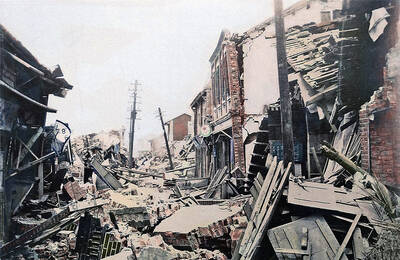
April 15 to April 21 Yang Kui (楊逵) was horrified as he drove past trucks, oxcarts and trolleys loaded with coffins on his way to Tuntzechiao (屯子腳), which he heard had been completely destroyed. The friend he came to check on was safe, but most residents were suffering in the town hit the hardest by the 7.1-magnitude Hsinchu-Taichung Earthquake on April 21, 1935. It remains the deadliest in Taiwan’s recorded history, claiming around 3,300 lives and injuring nearly 12,000. The disaster completely flattened roughly 18,000 houses and damaged countless more. The social activist and

Over the course of former President Ma Ying-jeou’s (馬英九) 11-day trip to China that included a meeting with Chinese Communist Party (CCP) leader Xi Jinping (習近平) a surprising number of people commented that the former president was now “irrelevant.” Upon reflection, it became apparent that these comments were coming from pro-Taiwan, pan-green supporters and they were expressing what they hoped was the case, rather than the reality. Ma’s ideology is so pro-China (read: deep blue) and controversial that many in his own Chinese Nationalist Party (KMT) hope he retires quickly, or at least refrains from speaking on some subjects. Regardless

Approaching her mid-30s, Xiong Yidan reckons that most of her friends are on to their second or even third babies. But Xiong has more than a dozen. There is Lucky, the street dog from Bangkok who jumped into a taxi with her and never left. There is Sophie and Ben, sibling geese, who honk from morning to night. Boop and Pan, both goats, are romantically involved. Dumpling the hedgehog enjoys a belly rub from time to time. The list goes on. Xiong nurtures her brood from her 8,000 square meter farm in Chiang Dao, a mountainous district in northern Thailand’s


 RSS
RSS