


Wherever you go in Taipei, casual is king and even senior government ministers leave the tie behind and turn up for events in slacks, a shirt and sports jacket.
On the street, this attitude is even more pronounced. Distressed is best and street-style rules. Though young people are shopping for labels it's not usually Gucci or Louis Vuitton (LV) but alternative brands such as Energie, A Bathing Ape, Fat, Stussy and Karl Kani.
Local designers like the up-and-coming Destroy are also getting in on the action.
As the number and range of native, Japanese, US and English style magazines attest, fashion is taken seriously by the "strawberry generation" in Taiwan and the main focus is on international styles.
Also, as the growth in the number of fashion outlets indicates, youngsters are buying more clothes than ever before.
Wang Xin-kai (王信凱), 23, and his girlfriend Zhang Yan-chi (張硯淇), 22, were walking around the department store and boutique center of Xinyi District last week. He was in Bathing Ape from his hat down to his denim pants and wore a pair of Nike skateboard-style sneakers. She wore Agnes B, Diesel jeans and All Star shoes. The toy store workers said they spent around NT$10,000 to NT$12,000 a month on clothes.
They said they didn't buy non-brand stuff any more because their friends would joke about it and they would lose face. Asked if they would go out with someone who was not well dressed, she said, "It does matter a little how someone is dressed. If he was dressed strangely I wouldn't go out with him."
He said, "We have money so fashion is important and it's good to have decent-looking clothes to walk around in ... I prefer clothes that are comfortable and have a relaxed mood. Also it affects me if someone I admire is a representative for a label. I will consider buying those clothes."
Lin Jung-chung (林榮春), who calls himself Funky Dog, started his label Taki a year ago and also works at the Bathing Ape store on Kaifeng Street, in Ximending. LV wasn't on young people's shopping lists because it wasn't casual, he said. And the trend toward street fashion and smaller labels wasn't going to change soon.
"Bathing Ape is the best at marketing, that's why it's the market leader."
Lin said over the last 13 years Bathing Ape has become a big name that has retained a cool edge. It uses variants on its name to keep the brand fresh, introduces limited editions and keeps its products reasonably inaccessible to most shoppers, by selling at a premium to style leaders who know where to find it.
The entrance to the store is understated. Inside it's spare and expensive with sweaters from NT$7,000 to NT$10,000, T-shirts are NT$1,500 up. The atmosphere is cultivated cool though its street connections to graffiti and hip hop are obvious.
Lin said he sees his clothes as objects of wearable art. He said the influences behind his label were Japanese ("taki" means waterfall) and Daoist. He comes up with brightly colored designs that bleed and clash at the edges, and adds bling to hats. He has the T-shirts made in Japan because he likes the tailoring and the quality of the cotton that makes them softer.
As for taike, which has ripened over the past year into a cultural phenomenon celebrating Taiwaneseness and an anti-style sensibility, Lin said it was not so important in the fashion world.
"Basically, it has had some influence but not that much. The guy who fixes a motorbike and rolls up his jeans and wears a vest isn't fashionable now and possibly won't be. The music and the idea is important but the look is less so. ... But Hot Dog and Chang Chen-yue (張震嶽) have a hip-hop style that is very cool right now."
Arin Tan (譚之琳) and Yuka founded the local fashion label Destroy three years ago when they were doing post-graduate fashion and graphic design degrees in Birmingham, England. Starting off with a punk-goth sensibility they have evolved a manga comic/skateboard dude/graffiti-inspired line of clothes that is locally-made and has quality and cachet. They recently opened an outlet in Ximending and also sell gear on the Internet, or mail order.
"There are two kinds of people," Yuka said. "The kind who really like brands; and the type who buy them because they don't want to lose face. We think underground culture is important and have a casual style, but are not totally hip hop. Art is a really important part of what we do."
"Here we look at all the main countries in the world and the top brands. Actually, its much the same wherever you go because of the TV and Internet. We can see the new styles and assimilate them quickly," Tan said.
Both said the future of street fashion was toward smaller brands and limited editions. They are planning to premiere a new label, Even Star Rocks, with 100-unit, or less limited runs, that are calculated to sell out within weeks and thereby create demand.
"Everyone wants to be individual and wear clothes no-one else has got," Tan said.
Edmund Huang (黃君豪), who is a DJ and model, said the dongqu or east-side shopping area behind Zhongxiao East Road and between Fuxing and Dunhua roads was "a mixture of styles" and less casual than other sections of the city.
"Zhongxiao is like a fashion parade. So many different kinds of people go there. On Zhongxiao everyone is watching, it could be your parents, your teacher, your boss or your friends. It's no good being too strange or grungy, you wouldn't get a good reaction, unlike Ximending, where its more individual and you have more freedom."
Since the basic street uniform is the same (jeans-and-top) the aim is to be different within these parameters. Pants may be cut asymmetrically or distressed, patched and cut, to emphasize an individual look. T-shirts are preferably one-offs. Simple and elegant is out, complicated patterns are in for shirts. Layers work, but in the heat they will be taken off.
Everyone's going to be wearing camouflage this summer, but usually in bright non-combat colors, even pink or purple. Girls are going for glitter and gold on their camouflage hot pants. Mini skirts have already come back in the Shida area. "Juicy" and other logos on the rear seem to be dying a natural death. The Japanese cosplay image is the new goth look for many young Taiwanese girls in Ximending, who shop till they drop to coordinate their striped tights, frills and accessories.
Baseball hats are being jazzed up with sequins or padded logos. Cargo pants are the new jeans, with their multiple pockets for iPods and phones. Skateboarding may be rare on the streets, but the shoes are ubiquitous and bold colors seem to work best.
Pants are still low slung, so underwear, butt cheeks and lower backs will continue to be exposed, but not as dramatically as last year.
There will be more rolling up the bottoms of pants to give the taike look and there will be a lot of men in oversized
hip-hop-style shorts, with belt and key chain accessories. Metal and combat fatigue belts are back.
Finally, style hounds, pink is coming in for women and men, though Yuka and Tan of Destroy said most Taiwanese men weren't sold yet.
As all these consumers of the hard-to-find avoid the well-known stores they look instead for boutique shops and this attitude brings designers and small labels to the fore, as they supply new ideas.
Nick Chaney, a co-director of the fashion label Bully, who also imports street brands from around the world to Taiwan, said exclusivity and creativity was a significant selling point for customers.
"People are starting to appreciate what's behind the label more.
People now choose a piece of clothing because of the style, the cut, the detailing and not so much the name.

“Taiwan’s Opposition Leader Comes to US With a Message Straight Out of Beijing” read a May 31 headline in the Wall Street Journal. Top US administration officials and members of Congress almost certainly read the WSJ, and if there was a bullet point takeaway that people in Washington should absorb ahead of Chinese Nationalist Party (KMT) Chair Cheng Li-wun’s (鄭麗文) arrival in DC on June 9, that headline is it. The last few columns have discussed this very topic, and the timing is not coincidental. While those top officials likely do not read the Taipei Times, judging by the number

With weighty, anxiety-inducing geopolitical topics dominating the headlines, checking in on the wild and weird state of local politics can take some of the edge off. This November’s elections will determine who will be in charge of fixing potholes in your neighborhood, not the potholes in Taiwan’s complicated geopolitical space. Recently, after an online interview with a Taipei-based journalist, I commented that Taipei journalists never go further than the MRT can take them. He laughed and agreed. Naturally, the Taipei mayoral race is eating up much of the press attention. TAIPEI CITY Democratic Progressive Party (DPP) candidate Puma Shen (沈伯洋) has
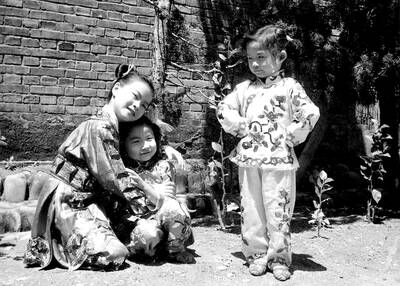
Audiences in Leicester, Cardiff, London and Sheffield will this month gather to watch a series of black-and-white Taiwanese-language films made more than 70 years ago. On the surface, these screenings commemorate the seventieth anniversary of taiyupian (台語片) — Taiwanese-language cinema. Yet the significance of these events extends far beyond nostalgia or film history. They represent a remarkable chapter in Taiwan’s ongoing effort to recover, preserve and reinterpret a cultural heritage that was once thought to have largely disappeared. The centerpiece of the program is the Ho Chi-ming (何基明) directed Xue Pinggui and Wang Baochuan (薛平貴與王寶釧), a film produced in 1955 and
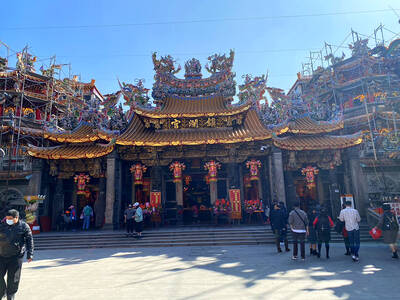
In December of 2008 Lee E-tin (李乙廷), a Miaoli county legislative hopeful, was convicted of vote-buying. Rather than buy votes retail, voter by voter, in the usual manner, Lee had done it wholesale, in a commendably efficient manner: he had visited local temples and made donations to gain their support. Because he did not normally make donations to temples, the court ruled he was attempting to improperly influence voter behavior. The case indicates how important temples are in influencing political life. Both judge and politician appeared to see them in the same way. Beijing sees them that way as well. Democratic Progressive


 RSS
RSS