


he smugglers' trail crosses salt-encrusted plains, scrabbly farmland and hundreds of blossoming poppy fields. Suddenly a fortress-like structure looms. The high-walled mansion belongs to Haji Adam, an opium smuggler, locals say. Tales of his wealth are legion.
"When he became sick he was flown straight to Germany," said a man in the next village, Garmser, speaking on condition of anonymity.
"Even helicopters have landed at his house," said another.
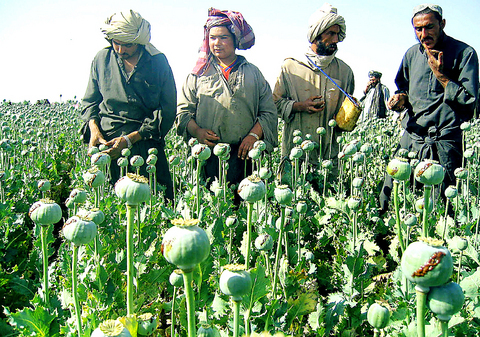
PHOTO: AFP
Yet like every Afghan drugs lord, Haji Adam has little to fear from the law. Since the western-led war on drugs started four years ago only two major smugglers have been arrested -- Haji Baz Muhammad, who was extradited to the US last October, and Bashir Noorzai, who was arrested in New York six months earlier. But the remainder are apparently untouchable.
"Many smugglers don't even bother hiding their wealth," said a British diplomat in Kabul "It's their way of saying `screw you' to authority."
The kingpins are as wealthy as they are indiscreet, the apex of a US$2.7-billion trade that has dominated the Afghan economy, poisoned its politics and employs one in 10 of the workforce. The smugglers are deeply rooted in Afghanistan's tribal society yet operate with the sophistication of a criminal jet set. Some live in fortified rural mansions, defended by anti-aircraft guns and gangs of heavily armed clansmen.
Many strike deals during the annual Muslim pilgrimage to Saudi Arabia. "The Hajj is a good place to do business, we believe," said one western anti-drugs official.
Every year the drug lords effortlessly export 4,000 tons of opium across Afghanistan's borders, plugging into the Turkish, Iranian, Pakistani and Russian gangs that refine the drug into heroin for sale in Europe. But their strongest connections are at home.
Allegations of drug links have persistently dogged some of Afghanistan's most powerful figures, including several governors, ministers and the president's brother, Walid Karzai. At least 17 of the 249 newly elected parliamentarians are smugglers, said analyst Andrew Wilder.
But the most serious charges hover over General Mohammed Daud, the deputy interior minister for counter narcotics. A senior drugs official said he was "99 percent sure" that Daud had a stake in the trade he was supposed to be dismantling. "He frustrates counter-narcotics law enforcement when it suits him," said the official, who spoke on condition of anonymity.
"He moves competent officials from their jobs, locks cases up and generally ensures that nobody he is associated with will get arrested for drugs crime."
Daud has denied the allegations.
Undercover Afghan policemen have tried to infiltrate the smuggling rings, the same diplomat said, but failed to net any "big fish."
The drug lords funnel their profits into construction in Kabul, where mansions and glass-fronted office blocks are springing up, and to Dubai, where US and British anti-drug specialists are cooperating with local authorities to stem the flow of laundered money.
The daunting scale of the drugs war can be best appreciated in Helmand, the remote southern province that is the world's busiest opium smuggling route. At night high-speed convoys laden with narcotics race across the hard-packed desert towards the border with Pakistan. The frontier is effectively controlled by the Baluch, a tribe with long experience of smuggling that regards the British-demarcated border as a technicality. The main smugglers' den is in Baramcha, a rough-and-tumble village along the unmanned border. From Baramcha, about two-thirds of the contraband is spirited south towards Karachi or the more secluded Makran coast. Another third moves west by road into Iran. The final
destination, after being purified into heroin, is often Britain.
The smugglers have been fortified by an informal alliance with the Taliban. Britain hopes to break their stranglehold on Helmand with a deployment of more than 3,000 British troops that starts next month.
Paratroopers will mount a weeklong mission to Baramcha, said Lieutenant Colonel Henry Worsley.
The fledgling Afghan forces are also trying to apply
pressure. Last Monday the Afghan Special Narcotics Force, a British-trained elite paramilitary squad, raided Baramcha. Some small-scale smugglers, one western official said, were angry that Taliban militants did not keep their promise to defend them.
Western efforts are also focused on overhauling the Afghan justice system. A new counter-narcotics law was approved last December and a special drugs court has been set up.
But even when drug criminals are prosecuted, they frequently bribe their way to freedom.

Just after 6am, I walked up to the ticket gate at Taipei Main Station and entered the Taiwan Railway platform without scanning any ticket; instead, I flashed the Sanrio Fun Rail pass on my phone to the gate worker and was admitted. I found my train and prepared to board. My destination? This very same station. I was embarking on a 13-hour journey on one of two round-the-island trains operated by ezTravel. They run each day, one counterclockwise around the island and one clockwise. They differ in a number of ways from an ordinary Taiwan Railway train and can make for
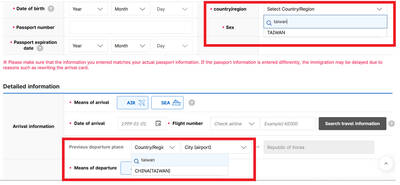
Jason Han says that the e-arrival card spat between South Korea and Taiwan shows that Seoul is signaling adherence to its “one-China” policy, while Taiwan’s response reflects a reciprocal approach. “Attempts to alter the diplomatic status quo often lead to tit-for-tat responses,” the analyst on international affairs tells the Taipei Times, adding that Taiwan may become more cautious in its dealings with South Korea going forward. Taipei has called on Seoul to correct its electronic entry system, which currently lists Taiwan as “China (Taiwan),” warning that reciprocal measures may follow if the wording is not changed before March 31. As of yesterday,
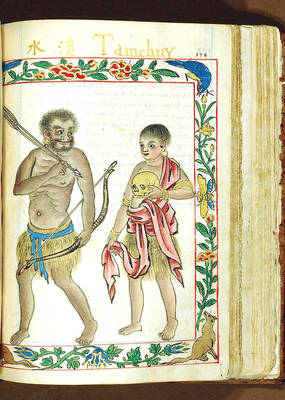
The Portuguese never established a presence on Taiwan, but they must have traded with the indigenous people because later traders reported that the locals referred to parts of deer using Portuguese words. What goods might the Portuguese have offered their indigenous trade partners? Among them must have been slaves, for the Portuguese dealt slaves across Asia. Though we often speak of “Portuguese” ships, imagining them as picturesque vessels manned by pointy-bearded Iberians, in Asia Portuguese shipping between local destinations was crewed by Asian seamen, with a handful of white or Eurasian officers. “Even the great carracks of 1,000-2,000 tons which plied

On Thursday, former Taipei mayor and founder of the Taiwan People’s Party (TPP) Ko Wen-je (柯文哲) was sentenced to 17 years in prison and had his civil rights suspended for six years over corruption, embezzlement and other charges. Seven others related to the case were also handed prison sentences, while two were found not guilty. It has been a bad week for the TPP. On Tuesday, prosecutors charged Chinese immigrant Xu Chunying (徐春鶯) with suspicion of taking part in Beijing-directed election interference. Xu has strong links to the TPP, which once offered her a party list legislator nomination. Tuesday also


 RSS
RSS