


If you are looking for a good dose of outrage at a theater near you, you won't find a better bargain than Enron: The Smartest Guys in the Room, a new documentary directed by Alex Gibney. Documentaries have recently been making up for a shortfall in genuine movie heroes -- those plucky child orthographers Spellbound and the gritty wheelchair jocks of Murderball come to mind -- and Gibney's film is the latest evidence that nonfiction cinema can supply worthy, hissable villains as well.
Anyone who might be in the jury pool for the coming trials of Kenneth Lay and Jeffrey Skilling, the top Enron executives who have yet to face justice, should probably stay away, since the movie makes the case against them with prosecutorial vigor. Based on the best-selling book by the Fortune magazine reporters Bethany McLean and Peter Elkind, Enron is a tight, fascinating chronicle of arrogance and greed. Interweaving Peter Coyote's sober, ever-so-slightly sarcastic voice-over narration with interviews and video clips (as well as one ill-advised and unnecessary re-enactment) and accompanied by an anthology of well-chosen pop songs, it manages to be both informative and entertaining.
Much of the entertainment value comes from the undeniable pleasure of feeling morally superior to many of the people on screen, a nice antidote to the envy they might have inspired when they were riding high. Gibney uses video from Congressional hearings and financial chat-show appearances to damning effect; in the era before CSPAN and CNBC, the case against Enron might have been much harder to make.
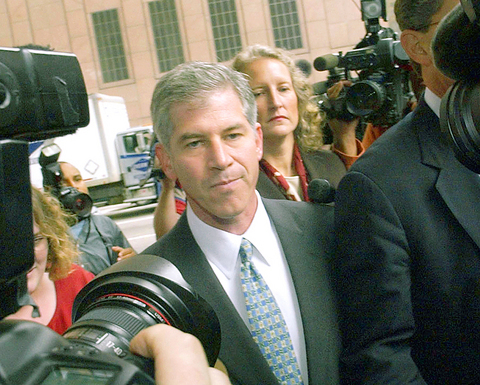
PHOTO COURTESY OF JOINT ENTERTAINMENT
He has also obtained in-house video from company meetings, in which Skilling and Lay, in their very different styles, strut and brag through the company's boom years. Lay is a bit like a classic Texas football coach -- gruff, tough but also possessing a measure of courtly charm. Skilling is more tightly wound, supremely confident of his intellect and abilities, with a chillier demeanor than his boss. When their enterprise starts to collapse, Skilling, expressing no remorse and accepting no responsibility, abruptly quits. Lay, rallying his troops, indulges in one of the most dismaying appropriations of the Sept. 11 attacks ever recorded, declaring to employees in the autumn of 2001 that, just like the US, Enron is under attack.
Among its tormentors were members of Congress from both parties, and also Elkind and McLean, who had the temerity, in the spring of 2001, to write a gently skeptical article called "Is Enron Overvalued?" What eventually became clear was that the company had been concocting value out of thin air, thanks not to the trading strategies it promoted as visionary but to financial games that turned a once-solid natural-gas distributor into the most notorious debacle in the era of corporate scandals. At times, the movie's explanation of Enron's business practices is hard to follow -- and the practices themselves seem to have been deliberately made complex to the point of opacity -- but the gist is clear enough.
When boilerplate fails, many of the film's interview subjects resort to metaphor. The Titanic comes up more than once. Jonestown, the Lusitania and earthquakes are also mentioned. A Houston minister whose congre-gation includes many former Enron employees likens the company to "a house of cards built over a pool of gasoline." Appropriately enough, Gibney's quick, fluid editing gives his film the suspenseful, queasy fasci-nation of a disaster flick, even -- or perhaps especially -- because you know exactly where it's headed. As the story moves forward, keep your eye on the bottom of the screen, where the stock price is periodically shown. Watch it soar, and then watch it plummet.
Of course, the consequences of Enron's foray into funny money were quite serious, and Enron: The Smartest Guys in the Room does not forget the real costs of this catastrophe. While it notes the friendship between Lay and the Bush family, and details Enron's role in the California energy crisis and the political destruction of Gray Davis, the film is for the most part too journa-listically scrupulous to indulge in anything that might smack of conspiracy theorizing.
Which is not to say that its scope is narrow or the implications of its story confined to one reckless Texas company. While the audience's contempt for Lay and Skilling feels good and is duly earned, Gibney does not encourage undue smugness. Without spelling too much out, Enron suggests a widespread moral deficit underlying Enron's eventual bankruptcy. Accountants held no one to account, governments abandoned their regulatory functions, the media turned cheaters into stars and a culture of self-righteous mendacity was allowed to flourish as long as the stock prices were high.
The smart guys at Enron were clever -- and amoral -- enough to profit from those circumstances. In all likelihood, they regard themselves as scapegoats, even as the public views them as villains. It's not impossible that they are, to some extent, both.

Last week Joseph Nye, the well-known China scholar, wrote on the Australian Strategic Policy Institute’s website about how war over Taiwan might be averted. He noted that years ago he was on a team that met with then-president Chen Shui-bian (陳水扁), “whose previous ‘unofficial’ visit to the US had caused a crisis in which China fired missiles into the sea and the US deployed carriers off the coast of Taiwan.” Yes, that’s right, mighty Chen caused that crisis all by himself. Neither the US nor the People’s Republic of China (PRC) exercised any agency. Nye then nostalgically invoked the comical specter
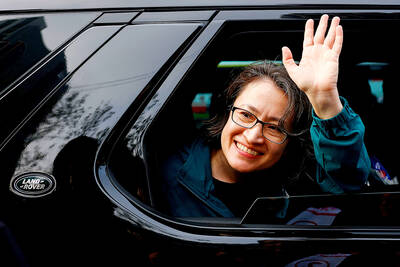
Relations between Taiwan and the Czech Republic have flourished in recent years. However, not everyone is pleased about the growing friendship between the two countries. Last month, an incident involving a Chinese diplomat tailing the car of vice president-elect Hsiao Bi-khim (蕭美琴) in Prague, drew public attention to the People’s Republic of China’s (PRC) operations to undermine Taiwan overseas. The trip was not Hsiao’s first visit to the Central European country. It was meant to be low-key, a chance to meet with local academics and politicians, until her police escort noticed a car was tailing her through the Czech capital. The
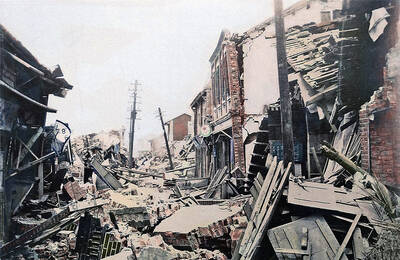
April 15 to April 21 Yang Kui (楊逵) was horrified as he drove past trucks, oxcarts and trolleys loaded with coffins on his way to Tuntzechiao (屯子腳), which he heard had been completely destroyed. The friend he came to check on was safe, but most residents were suffering in the town hit the hardest by the 7.1-magnitude Hsinchu-Taichung Earthquake on April 21, 1935. It remains the deadliest in Taiwan’s recorded history, claiming around 3,300 lives and injuring nearly 12,000. The disaster completely flattened roughly 18,000 houses and damaged countless more. The social activist and

Over the course of former President Ma Ying-jeou’s (馬英九) 11-day trip to China that included a meeting with Chinese Communist Party (CCP) leader Xi Jinping (習近平) a surprising number of people commented that the former president was now “irrelevant.” Upon reflection, it became apparent that these comments were coming from pro-Taiwan, pan-green supporters and they were expressing what they hoped was the case, rather than the reality. Ma’s ideology is so pro-China (read: deep blue) and controversial that many in his own Chinese Nationalist Party (KMT) hope he retires quickly, or at least refrains from speaking on some subjects. Regardless


 RSS
RSS