


The Neo-Classic Dance Company (
The Neo-Classic Dance Company, now in its 30th year, first performed Carmina Burana in 1992. The National Culture and Arts Foundation came up with the idea of celebrating the best performances of the past 50 years by asking six companies to restage one of their classic productions. This weekend it is the Neo-Classic's turn at the National Theater.
Lin said she recreated her Carmina based on a videotape of the original production and her memory, since less than a handful of the 23 dancers in the company were performing back in 1992.

PHOTO COURTESY OF NEO-CLASSICAL
German composer Carl Orff's 1937 Carmina Burana or "Songs of Beuran" was based on a collection of more than 1,000 poems and songs about love, life and liquor written early in the 13th century by wondering poets and young priests or theologians, who obviously had more than religion on their minds.
Orff took selections from this medieval manuscript and set them to music as a "scenic cantata." His pulsating score was composed for a large orchestra, chorus and soloists, with some sections purely instrumental and others for solo voices.
The O Fortuna sections that open and close the five-section cantata have become well-known over the years even to those who are not fans of classical music or dance as they have frequently been excerpted for use in movie scores and TV commercials.
The American choreographer John Butler was the first to choreograph Carmina Burana for a ballet, which he staged for the New York City Opera in 1959. In the 1960s and 1970s both Butler's version and those by other choreographers became a favorite of dance companies both in the US and other countries, while the cantata remained popular as a concert hall offering as well.
Lin has taken this medieval European paean to hedonism and given it an Eastern flavor. Although there is not really a story for Carmina, she said she made a simple narrative line.
"It's about a group of hermits who still haven't put the world completely behind. They break out of their monastery and experience the real world, but eventually they return to their lives as hermits," Lin said in a telephone interview on Wednesday.
"The music has a lot of tension," she said. "It fits my personality; it's very dynamic." She said no props are used, so the dancers must use their bodies and mime to convey the story.
"The body is the only expressive tool... the hair of the dancers is used to represent spring, their skirts represent flowers," she said. "There are hoods attached to their costumes -- when they throw them off it represents the casting away of the core of their lives, their religious life. When they decide to return to their lives [as hermits] they put the hoods back on."
For this weekend's performances, the Neo-Classic company will be accompanied by the YinQi Orchestra (
Performance notes:
What: Neo-Classic Dance Company
Where: National Theater of the CKS Memorial Hall, 21-1, Zhongshan S Rd, Taipei?
When: TTonight and tomorrow night at 7:30; Sunday afternoon at 2:30pm
Tickets: NT$300, NT$500, NT$700, NT$900, NT$1,500; available at the National Theater box office

Last week Joseph Nye, the well-known China scholar, wrote on the Australian Strategic Policy Institute’s website about how war over Taiwan might be averted. He noted that years ago he was on a team that met with then-president Chen Shui-bian (陳水扁), “whose previous ‘unofficial’ visit to the US had caused a crisis in which China fired missiles into the sea and the US deployed carriers off the coast of Taiwan.” Yes, that’s right, mighty Chen caused that crisis all by himself. Neither the US nor the People’s Republic of China (PRC) exercised any agency. Nye then nostalgically invoked the comical specter

Relations between Taiwan and the Czech Republic have flourished in recent years. However, not everyone is pleased about the growing friendship between the two countries. Last month, an incident involving a Chinese diplomat tailing the car of vice president-elect Hsiao Bi-khim (蕭美琴) in Prague, drew public attention to the People’s Republic of China’s (PRC) operations to undermine Taiwan overseas. The trip was not Hsiao’s first visit to the Central European country. It was meant to be low-key, a chance to meet with local academics and politicians, until her police escort noticed a car was tailing her through the Czech capital. The
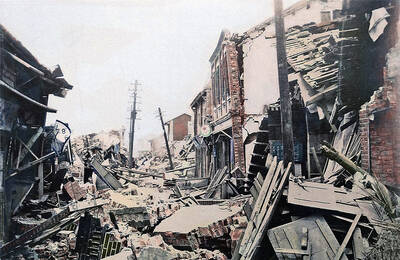
April 15 to April 21 Yang Kui (楊逵) was horrified as he drove past trucks, oxcarts and trolleys loaded with coffins on his way to Tuntzechiao (屯子腳), which he heard had been completely destroyed. The friend he came to check on was safe, but most residents were suffering in the town hit the hardest by the 7.1-magnitude Hsinchu-Taichung Earthquake on April 21, 1935. It remains the deadliest in Taiwan’s recorded history, claiming around 3,300 lives and injuring nearly 12,000. The disaster completely flattened roughly 18,000 houses and damaged countless more. The social activist and

Over the course of former President Ma Ying-jeou’s (馬英九) 11-day trip to China that included a meeting with Chinese Communist Party (CCP) leader Xi Jinping (習近平) a surprising number of people commented that the former president was now “irrelevant.” Upon reflection, it became apparent that these comments were coming from pro-Taiwan, pan-green supporters and they were expressing what they hoped was the case, rather than the reality. Ma’s ideology is so pro-China (read: deep blue) and controversial that many in his own Chinese Nationalist Party (KMT) hope he retires quickly, or at least refrains from speaking on some subjects. Regardless


 RSS
RSS