


Thirty years after two wide-eyed pioneers launched a company to sell computer kits to their fellow geeks, Apple Computer is still pushing the boundaries of technology.
The iconic Silicon Valley firm was founded on April 1, 1976 by Steve Wozniak and Steve Jobs. Wozniak was the archetypal nerdy tinkerer who sold his beloved calculator to buy the parts he needed to build the Apple I. Jobs was the fiery visionary who sold his Volkswagen bus to raise the marketing funds.
Apple faithful around the world are flocking to Web sites to mark the auspicious occasion. But their dearest wish is for the company to roll out some cool new products, like the full-screen video iPod that is said to be in the pipeline or an Intel-based iBook laptop.

GRAPHIC: TT
Comparing those devices to Apple's original product shows the astounding technological advances that Apple has led over the past 30 years, even as it prepares to take another leap forward.
The original Apple was a 1 MHz computer that cost US$666 and was actually only a circuit board for which consumers had to build their own cases.
But it was followed a year later by the Apple II, the company's first mass-produced computer that sold for US$1,298. This time the circuit board was encased in molded plastic and the product pioneered the era of the personal computer and turned Apple into a multimillion dollar company.
Apple's history since then has been an amalgam of virtuoso technological and marketing feats, interspersed with management struggles, design failures and ill-conceived strategies.
There was the brilliant Macintosh, which in 1984 introduced the world to the mouse and the graphical user interface that allows you to click on icons rather than type lines of code to get the computer to perform tasks.
But there was also the decision to prevent other manufacturers from making clones of the Macs or licensing other companies to use the Mac operating system on other computers.
That decision allowed Microsoft to step in with its Windows oper-ating system, which now dominates 90 percent of the world's personal computers, while Apple wallows at between two and five percent.
MIT economist Lester Thurow once estimated that Apple gave up half a trillion US dollars in profit when it allowed the PC market to slip through its fingers.
Yet except for a 12-year period in which Jobs was forced out of the company in a corporate power struggle, Apple has remained true to its famous slogan, "Think Different" and upheld its reputation as the coolest counterculture computer brand on the planet.
Now analysts agree that as it enters middle age, Apple finally stands on the brink of fulfilling the potential that its constant innovation has always promised.
Ironically, this success will come not from the computers that are at the core of the company's heritage, but as an outgrowth of the iPod.
The handheld player not only became the company's top seller, it sent Apple's stock price from around US$9.50 in 2001 to US$60, giving the company a market capitalization of US$50 billion and launching a digital revolution that could finally see an Apple in every living room.
But that Apple may not be a traditional computer, or even an iPod. Many industry analysts believe it is only a matter of time before Apple launches an iPhone or an iTV.
"Apple is really turning more into a digital entertainment company than anything," says Shaw Wu an analyst at American Technology Research.
Simply speaking, the idea is to create a technology ecosystem that allows users to choose and manage all their media across different devices. The company has already shown how to do this with music.
Just a couple of clicks gives you all the music you want on your iPod or iBook, and the recent introduction of the video iPod could do the same for all kinds of video content, not to mention e-mails, video conferencing and phone calls.
Jobs may be the perfect man to achieve that vision of a connected world. Not only is he widely revered for Apple's pioneering designs.
His record on iTunes and at his second job as the founder and CEO of animated film shop Pixar have made him one of the most powerful men in the entertainment world.
Jobs will likely increase his influence even further, as he takes a seat on the Disney board following its January purchase of Pixar for some US$7.4 billion.
But don't write off Apple's computers either. The company recently switched to Intel chips, which also run most Windows PCs. Hackers have already succeeded in getting Windows to run on Apple computers, and it would be relatively simple for Apple to tweak its highly-regarded operating system to make it PC compatible.

In late October of 1873 the government of Japan decided against sending a military expedition to Korea to force that nation to open trade relations. Across the government supporters of the expedition resigned immediately. The spectacle of revolt by disaffected samurai began to loom over Japanese politics. In January of 1874 disaffected samurai attacked a senior minister in Tokyo. A month later, a group of pro-Korea expedition and anti-foreign elements from Saga prefecture in Kyushu revolted, driven in part by high food prices stemming from poor harvests. Their leader, according to Edward Drea’s classic Japan’s Imperial Army, was a samurai

The following three paragraphs are just some of what the local Chinese-language press is reporting on breathlessly and following every twist and turn with the eagerness of a soap opera fan. For many English-language readers, it probably comes across as incomprehensibly opaque, so bear with me briefly dear reader: To the surprise of many, former pop singer and Democratic Progressive Party (DPP) ex-lawmaker Yu Tien (余天) of the Taiwan Normal Country Promotion Association (TNCPA) at the last minute dropped out of the running for committee chair of the DPP’s New Taipei City chapter, paving the way for DPP legislator Su
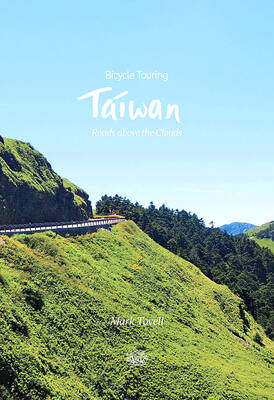
It’s hard to know where to begin with Mark Tovell’s Taiwan: Roads Above the Clouds. Having published a travelogue myself, as well as having contributed to several guidebooks, at first glance Tovell’s book appears to inhabit a middle ground — the kind of hard-to-sell nowheresville publishers detest. Leaf through the pages and you’ll find them suffuse with the purple prose best associated with travel literature: “When the sun is low on a warm, clear morning, and with the heat already rising, we stand at the riverside bike path leading south from Sanxia’s old cobble streets.” Hardly the stuff of your
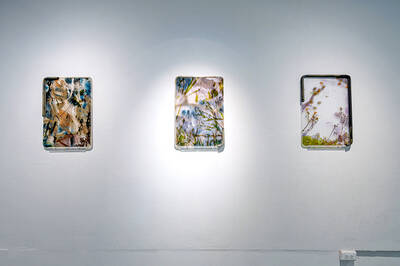
Located down a sideroad in old Wanhua District (萬華區), Waley Art (水谷藝術) has an established reputation for curating some of the more provocative indie art exhibitions in Taipei. And this month is no exception. Beyond the innocuous facade of a shophouse, the full three stories of the gallery space (including the basement) have been taken over by photographs, installation videos and abstract images courtesy of two creatives who hail from the opposite ends of the earth, Taiwan’s Hsu Yi-ting (許懿婷) and Germany’s Benjamin Janzen. “In 2019, I had an art residency in Europe,” Hsu says. “I met Benjamin in the lobby


 RSS
RSS