


Japan is under quasi-emergency rule as millions of Japanese citizens storm parks and gardens this time of year.
They all have one thing in common: to secure themselves a picnic space under cherry trees.
The country is enchanted by the blooming of the sakura, the cherry blossoms, which, year after year, cover the Japanese archipelago in a faint pink veil.
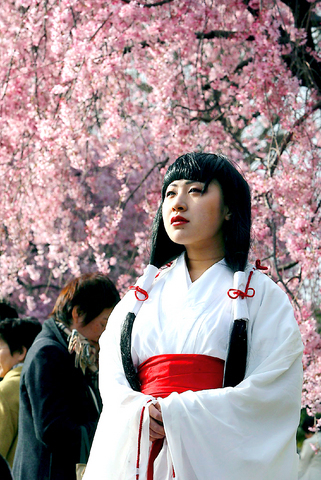
PHOTO: DPA
As soon as the first flowers appear, there is no holding back for most Japanese.
Reports appear on radio and television and in newspapers and Web sites to track the blossoms, which have excited the Japanese for more than a millennium.
The Far Eastern nation follows with fascination the development of the so-called sakura front, which starts in the southern island of Kyushu and then gradually extends northward.
Japan's weather office doesn't limit its forecasts to the rain and sun but extends them this time of year also to the delicate buds and reports to the smallest detail when and where they do finally open.
Web sites are dedicated solely to displaying photos of the cherry blossoms, which sakura lovers all over the country can download onto their mobile phones.
One Web site, the Sakura Project, for example, allows users to act as regional monitors, report on the blossoms from their respective locations and download photos. Each registered Web site member then has the option to comment on the development of blossoms on particular trees.
Magazines, meanwhile, print special editions on the best places to view the hanami, or "flower show," which more often than not develops into alcohol-drenched parties under the blossoming cherry trees.
Parks and even narrow strips along main roads where there is hardly a cherry tree to see become places where groups of happy revellers gather and drink, eat and gossip late into the night.
Competitions also regularly erupt over securing prime viewing space. Companies that plan to treat their staff to a hanami evening, for instance, often send new employees to the designated area during working hours to claim a particular spot.
On weekends, millions of families, friends, students and work colleagues pass sake bottles under the canopy of the cherry flowers as barbecue grills sizzle with chicken legs and calamari.
Karaoke competitions are also high on the agenda, but the parties' collective drunkenness does not always end in bliss.
Some new company staff might find themselves forced to perform the dangerous ikki ritual, which means emptying their drink to the last drop instantly and without delay. No sipping. The ritual sometimes ends in hospital for the respective participant.
According to the Asahi Shimbun newspaper, within 18 days during the 2004 hanami season in Tokyo alone, 152 individuals were admitted to hospitals because of acute alcohol intoxication.
The cherry blossom period lasts for only about two weeks, but for the Japanese, the lure of this season lies exactly in its short-lived nature.
During the Middle Ages, Japan's samurai warriors particularly identified themselves with the fleeting beauty and fragility of the sakura as a symbol of their own lives.
Kamikaze pilots during World War II adorned themselves with sakura flowers before they plunged their bomb-laden planes onto Allied warships in suicide attacks.
The lives of the cherry blossoms can, likewise, be brief. It only takes a brief spring rain to cause the flowers to drop to the ground and wilt.
However, the mountains of garbage left over from the festival are more unsightly.
During last year's season, when 1.7 million revelers turned out in Tokyo's Ueno Park, city authorities had to clear about 158 tonnes of garbage from under the cherry trees there.
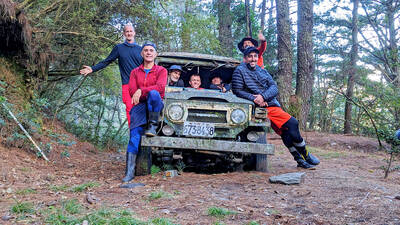
The year was 1991. A Toyota Land Cruiser set out on a 67km journey up the Junda Forest Road (郡大林道) toward an old loggers’ camp, at which point the hikers inside would get out and begin their ascent of Jade Mountain (玉山). Little did they know, they would be the last group of hikers to ever enjoy this shortcut into the mountains. An approaching typhoon soon wiped out the road behind them, trapping the vehicle on the mountain and forever changing the approach to Jade Mountain. THE CONTEMPORARY ROUTE Nowadays, the approach to Jade Mountain from the north side takes an

Last week Joseph Nye, the well-known China scholar, wrote on the Australian Strategic Policy Institute’s website about how war over Taiwan might be averted. He noted that years ago he was on a team that met with then-president Chen Shui-bian (陳水扁), “whose previous ‘unofficial’ visit to the US had caused a crisis in which China fired missiles into the sea and the US deployed carriers off the coast of Taiwan.” Yes, that’s right, mighty Chen caused that crisis all by himself. Neither the US nor the People’s Republic of China (PRC) exercised any agency. Nye then nostalgically invoked the comical specter

Relations between Taiwan and the Czech Republic have flourished in recent years. However, not everyone is pleased about the growing friendship between the two countries. Last month, an incident involving a Chinese diplomat tailing the car of vice president-elect Hsiao Bi-khim (蕭美琴) in Prague, drew public attention to the People’s Republic of China’s (PRC) operations to undermine Taiwan overseas. The trip was not Hsiao’s first visit to the Central European country. It was meant to be low-key, a chance to meet with local academics and politicians, until her police escort noticed a car was tailing her through the Czech capital. The
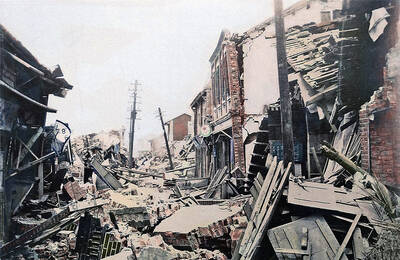
April 15 to April 21 Yang Kui (楊逵) was horrified as he drove past trucks, oxcarts and trolleys loaded with coffins on his way to Tuntzechiao (屯子腳), which he heard had been completely destroyed. The friend he came to check on was safe, but most residents were suffering in the town hit the hardest by the 7.1-magnitude Hsinchu-Taichung Earthquake on April 21, 1935. It remains the deadliest in Taiwan’s recorded history, claiming around 3,300 lives and injuring nearly 12,000. The disaster completely flattened roughly 18,000 houses and damaged countless more. The social activist and


 RSS
RSS