


It was a time of big hair and bad taste, the end of the Beatles and the birth of disco, the era of Donny and Marie, Mork and Mindy, Tony Orlando and Dawn; a "kidney stone of a decade," in the words of a Doonesbury character, that's remembered now for pet rocks, shag rugs, mood rings, leisure suits, water beds, beanbag chairs, smiley faces, avocado-colored refri-gerators, mirrored sunglasses, black light posters, wide ties and even wider lapels.
Two new books look beyond the image of the 1970s promoted by That 70's Show and other exercises in nostalgia to focus on far darker undercurrents running beneath that decade's tacky, polyester surface.
In Decade of Nightmares, the scholar Philip Jenkins argues that the late 1970s ushered in an era in which the liberal and libertarian ideas of the 1960s were succeeded by "a more pessimistic, more threatening interpretation of human behavior" and "more sinister visions of the enemies facing Americans and their nation." He argues that economic woes, gas shortages, "steeply rising rates of violent crime" and sensationalistic reports of serial murders and cult atrocities contributed to a "sense of pervasive national malaise, decadence and social failure," which in turn created a reservoir of fear and anxiety that fed a conservative counter-revolution, even as the Iran hostage crisis and post-Vietnam worries about the US' declining status in the world were fueling calls for a more aggressive foreign policy.

The cultural historian Andreas Killen similarly argues in 1973 Nervous Breakdown that the 1970s have "entered the historical lexicon as a virtual synonym for weakness, confusion, and malaise," adding that by the end of 1973 (a year that witnessed the unraveling of the Watergate cover-up, the Arab oil embargo and the Paris Peace Accords, ending US involvement in Vietnam), "the institutional failures of American society routinely evoked expressions of systemic, perhaps irreparable crisis."
By the early 1970s, Killen goes on, "much of the New Left had either degenerated into self-parody" or turned to lifestyle experiments, and its critique of US society had given way, in the wake of Watergate, to conspiracy theory and "pop paranoia." In 1973, he writes, former US President Richard Nixon "began dismantling many of the social programs launched during the Johnson administration's War on Poverty," and "a new punitive, neoconservative mood descended over the country" with the passage of the Rockefeller drug laws and calls for the reinstatement of the death penalty by the Nixon administration.
Both of these books look at how many of the ideas and ideals of the 1960s petered out in the 1970s, and how a yearning for more traditional, moralistic values during that decade laid the groundwork for the election of former US President Ronald Reagan in 1980. The authors' approaches, however, could not be more different. Killen has focused less on politics per se than on pop culture reflections of the national zeitgeist, giving us an impression-istic volume that deconstructs leitmotifs from the year 1973: like the idea of parricide, which rippled beneath calls for the impeachment of Nixon and informed movies like Badlands; or the mood of paranoia, which wafted through the post-Watergate US and through Thomas Pynchon's classic novel, Gravity's Rainbow.

Killen's free-associative book is smart and insightful, but at times succumbs to grandiosity, trying too hard to turn disparate phenomena into representative tropes. He argues that "the preoccupation with air travel and its risks that overtook the nation in 1973 reflected anxieties about the larger catastrophes overtaking the American ship of state." He contends that Watergate (and Nixon's White House tapes) and America's first reality show An American Family (starring the Louds) "aroused anxieties about the hollowing out of private space" and "sounded the alarm about the break-down of traditional authority."
As for Decade of Nightmares, it is a much more ponderous production, dutifully sifting the many events, foreign and domestic, that helped shape the disappointing US presidency of Jimmy Carter, and dutifully looking at the many factors (demographic, social and religious) that helped set the stage for the ascendancy of Ronald Reagan and Republican conservatism. Unfortunately, the book is peppered with gross generalizations and hyperbolic
assertions that undermine Jenkins' more considered assessments.
For instance, he writes almost hysterically of growing worries in the 1970s about serial murderers, child abuse, pornography and Satanism: "The generation that came of age in the late 1960s was now prepared to believe that America was under assault from armies of faceless nightmare figures."
What both Decade of Nightmares and 1973 Nervous Breakdown very clearly do is leave the reader with a palpable sense of how the legacy of the 1970s reverberates to this day in the US.
Killen reminds us that today's media-mediated, celebrity-centric culture was anticipated by Andy Warhol and the campy, self-conscious art that was created during the 1970s in reaction to the values of sincerity and authenticity enshrined by the 1960s Jenkins not only emphasizes similarities "between the economic situation then and the one that exists now" -- namely, serious deficits, lax fiscal discipline, rising energy prices and high spending on defense and national security -- but also underscores similarities in the Manichean language employed by both the Reagan and US President George W. Bush administrations.
Such observations point up the long shadow cast by the 1970s and defy the wishful thinking of the Doonesbury character who said of that "kidney stone of a decade": "This, too, will pass."

The year was 1991. A Toyota Land Cruiser set out on a 67km journey up the Junda Forest Road (郡大林道) toward an old loggers’ camp, at which point the hikers inside would get out and begin their ascent of Jade Mountain (玉山). Little did they know, they would be the last group of hikers to ever enjoy this shortcut into the mountains. An approaching typhoon soon wiped out the road behind them, trapping the vehicle on the mountain and forever changing the approach to Jade Mountain. THE CONTEMPORARY ROUTE Nowadays, the approach to Jade Mountain from the north side takes an

Relations between Taiwan and the Czech Republic have flourished in recent years. However, not everyone is pleased about the growing friendship between the two countries. Last month, an incident involving a Chinese diplomat tailing the car of vice president-elect Hsiao Bi-khim (蕭美琴) in Prague, drew public attention to the People’s Republic of China’s (PRC) operations to undermine Taiwan overseas. The trip was not Hsiao’s first visit to the Central European country. It was meant to be low-key, a chance to meet with local academics and politicians, until her police escort noticed a car was tailing her through the Czech capital. The

Last week Joseph Nye, the well-known China scholar, wrote on the Australian Strategic Policy Institute’s website about how war over Taiwan might be averted. He noted that years ago he was on a team that met with then-president Chen Shui-bian (陳水扁), “whose previous ‘unofficial’ visit to the US had caused a crisis in which China fired missiles into the sea and the US deployed carriers off the coast of Taiwan.” Yes, that’s right, mighty Chen caused that crisis all by himself. Neither the US nor the People’s Republic of China (PRC) exercised any agency. Nye then nostalgically invoked the comical specter
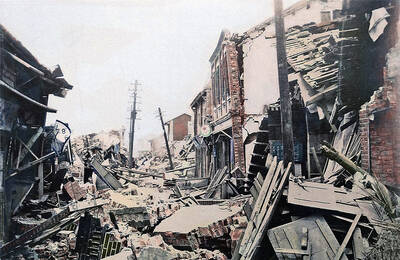
April 15 to April 21 Yang Kui (楊逵) was horrified as he drove past trucks, oxcarts and trolleys loaded with coffins on his way to Tuntzechiao (屯子腳), which he heard had been completely destroyed. The friend he came to check on was safe, but most residents were suffering in the town hit the hardest by the 7.1-magnitude Hsinchu-Taichung Earthquake on April 21, 1935. It remains the deadliest in Taiwan’s recorded history, claiming around 3,300 lives and injuring nearly 12,000. The disaster completely flattened roughly 18,000 houses and damaged countless more. The social activist and


 RSS
RSS