


"How you see something," said Nigel Parsons, the managing director of al-Jazeera International, "depends very much on where you're sitting."
Those words could well serve as the manifesto for the channel, the English-language offspring of the polarizing pan-Arab network, which will make its debut in more than 40 million households in late May.
Addressing hundreds of journalists and academics who had come to Doha, Qatar, for the second al-Jazeera Forum, Parsons promised that the new channel -- with its headquarters there and broadcast centers in Washington, London and Kuala Lumpur -- will cover the stories and people that the Western-owned news media overlook. "We're not going to be another CNN, BBC or Sky," he told the attendees on the last day of January. "If we were, there'd be no point." But, he added, "It's not our position to tell viewers what to think."

PHOTO: NY TIMES NEWS SERVICE
During a freewheeling question-and-answer session, the audience pressed him for details. With costs already surpassing a billion dollars, al-Jazeera is the most ambitious television network startup in recent years. Will it be the first network to crack the Western monopoly on delivering news and opinion to a global audience? Will it provide an Arab and Muslim point of view to the rest of the world?
Many at the forum hoped it would. But its top management is British, and its high-profile hires -- like the smooth interviewer David Frost and the former Nightline correspondent Dave Marash -- are hardly representative of the developing world. Will it then, the journalists wanted to know, just be colonialism in more modern garb?
Outside of that crowded conference room, the pressure is just as great. In the Arab world, al-Jazeera has a reputation for tackling thorny issues. But in the US, where it is best known for showing tapes of Osama bin Laden's tirades, one person's fearless reporting can quickly become another's dangerous propaganda. And the more widely it is viewed as a terrorist mouthpiece, the harder a time the channel will have getting a spot on the already-crowded US cable line-ups.

PHOTO: AFP
An oasis of modernization
Parsons understands the need to reassure new viewers in the West without disappointing old ones in the Arab world. "Essentially, it's about getting the balance right," he said.
A little more than five minutes from the 1980s-era opulence of the vast Sheraton on the Doha's corniche -- if the traffic-clogged roundabouts thoughtfully bequeathed by the British do not double the commute time -- lies the head-quarters of the Al-Jazeera networks. To describe the exterior as nondescript would be giving the dusty compound of squat buildings and satellite transponders too much credit. But inside, another story unfolds.

PHOTO: AFP
The Arabic-channel's new newsroom, which opened last year, is an airy space filled with Aeron chairs, slick flat-screen monitors and on-air sets whose color scheme (orangey green) morphs through the day.
Employees at al-Jazeera International boast of having one of the largest plasma screens of any newsroom in the world. From the newsroom on the first floor, a glass spiral staircase will lead to a mezzanine of open-plan news desks for the Web site and glass-walled offices, a rarity in the Arab world, where executive suites are more often clubby, private affairs. A fiber-optic network will connect Doha to its broadcast centers and other bureaus. There will also be a prayer room, as is customary in Qatari workplaces. Overall, it's a far cry from the tiny newsroom of the channel's early years, the one that prompted the Egyptian leader Hosni Mubarak to marvel during a 2000 visit, "All this trouble from a matchbox like this."
Al-Jazeera's rapid growth over the last decade is primarily the doing of one man, the emir of Qatar, Sheik Hamad bin Khalifa al-Thani. Since bloodlessly overthrowing his father in 1995, Thani has overseen the vast natural gas reserves of his country, a sandy spit of land about the size of Connecticut and Rhode Island combined that juts out of Saudi Arabia into the Persian Gulf.

PHOTO: AFP
But those reserves will not last forever, so he has used the profits to diversify. In 1996, he issued a decree establishing al-Jazeera, and then bankrolled its first five years with a grant of US$137 million. He is still footing the bulk of the channel's annual budget.
"He's thinking long-term," said Hugh Miles, the author of Al-Jazeera: The Inside Story of the Arab News Channel That Is Challenging the West (Grove Press). In a rough neighborhood, he wants to build "an Arab version of Switzerland -- rich, neutral and secure," Miles said.
Mahmud Shammam, the Washington bureau chief of al-Watan newspaper and Newsweek in Arabic, as well as the emir's latest addition to al-Jazeera's board of directors, said Thani hoped the network would be a countervailing force to some of the political and social trends in the Middle East. "He wants al-Jazeera to be a force for democracy and modern-ization in the Arab world," Shammam said.
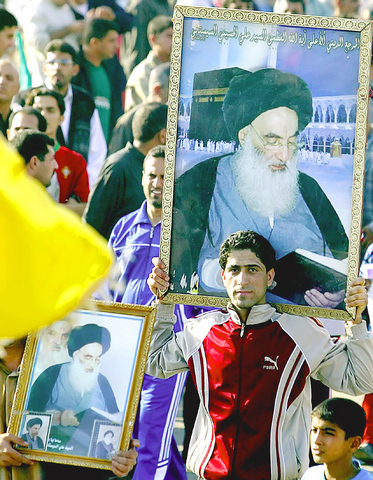
PHOTO: AFP
Certainly the region has not been a haven for the free press. Owned or controlled by the state, the television channels in the region are often filled with dreary state receptions and handshakes of smiling kings and autocratic generals, breaking-news bulletins of the queen's latest ribbon cutting, and an avoidance of anything remotely controversial.
But since its debut in November 1996, al-Jazeera has offended multitudes with news and commentary that do not necessarily conform to the views of mullahs or kings. To the outrage of social conservatives, the host of a religion show said the Koran did not forbid fellatio. Guests have questioned the right of the Saud family to rule Saudi Arabia. At some time or another, nearly every country in the Middle East -- save Israel -- has banned or curtailed its reporters.
Meanwhile US Defense Secretary Donald Rumsfeld has accused the network of "vicious lies" and of promoting an anti-American worldview. (An al-Jazeera journalist in Spain was sentenced last year in that country to seven years in prison for collaborating with al-Qaeda -- al-Jazeera is appealing the verdict.)
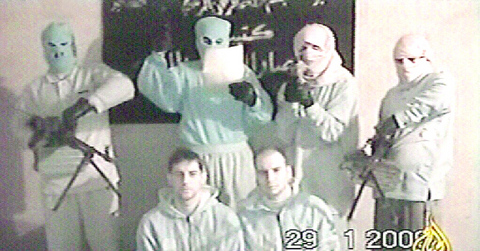
PHOTO: EPA
showing the other side
The reality of what is on the channel is more nuanced. Just as the emir and Qatar play host to the US military while offering asylum to Saddam Hussein's wife, al-Jazeera offers a showcase for dissenting views -- like Wafa Sultan, an Arab-American psychiatrist who recently denounced some Muslims for what she called their backwardness -- but a definite worldview dominates, one that is pro-Palestinian and skeptical of the West's intentions, particularly the US' intentions, post Sept. 11. Recently the administration has chosen to engage more with the channel. US officials, like Condoleezza Rice, have occasionally appeared as guests.
"Al-Jazeera has played a very important role in creating foundations for democracy and pluralism in the Middle East," said Marc Lynch, an associate professor of political science at Williams College and the author of Voices of a New Arab Public: Iraq, al-Jazeera and Middle East Politics Today (Columbia University Press). "It can also fan the flame of populism and anti-Americanism. And there's an ongoing struggle between these two forces."
Dealing with that struggle falls to Parsons, as he sets out to convince cable and satellite operators, politicians and curious prospective viewers that al-Jazeera International will not be biased against the West, but will nonetheless offer a needed alternative to CNN International and BBC World.
The son of a British military officer, Parsons, 54, grew up in countries like Singapore and Malaysia, and has spent 30 years working for news outlets ranging from BBC Radio to Associated Press Television News. When he was first approached about the position at al-Jazeera International, he was frustrated with the tenor of most English-language news. "Especially the coverage of the Iraqi invasion," he said. "Somehow it seemed to me that the Fourth Estate had got into bed with the third estate and the rest of us had been left outside the bedroom. So when this came along, it was a blank sheet of paper and a chance to make a difference, and to do things differently."
The new English-language channel will have all of the standard accouterments: interview programs, panels of political experts and critiques of the news media. Frost Over the World, for example, will showcase Frost's one-on-one skills with global newsmakers each Friday.
But al-Jazeera's main business program has the far-from-Wall-Street title People and Power, and its host, a former Economist correspondent, Shereen El Feki, pledges to cover the "grassroots" along with the executive suites.
And though al-Jazeera International's competitors have also laid claim to the think globally, act locally mentality (and dispute that Western ownership leads to Western-centric newscasts), the new channel is turning the idea into a physical reality. Its broadcasting day is expected to begin in Kuala Lumpur, 9am local time, and over the next four hours the journalists there will drive the report. The following 11 hours will come out of Doha, before the London broadcast center takes the reins for five. Then, for four hours beginning at 4pm on the East Coast of the US, Washington will gain its measure of control.
`the real arab world'
This setup, al-Jazeera International executives say, will differentiate the channel from its more centralized competitors and ensure that important regional stories do not get overlooked -- as Bangladesh's deadly typhoons did in the aftermath of Hurricane Rita, said Steve Clark, a former Sky News executive who is the new channel's director of news.
So do not expect much coverage of the World Economic Forum in Davos, Switzerland, the annual winter home for privileged white men (and Angelina Jolie) that is much adored by the Western news media. "I don't think we'd have even gone there," Parsons said. Just how willingly an international audience will flock to this alternative news channel -- and whether that migration will reward the emir's huge wager -- is unclear. "People are far more interested in the price of petrol at their local petrol station than they are in probably what's happening in Sudan," Parsons said. "That's just a fact. But there is a hunger for international news. If you do it through human interest, people will always relate."
The fact that al-Jazeera International's target audience -- Arab and Asian expatriates, non Arabic-speaking Muslims and news hounds -- is so geographically diffuse only complicates matters. Al-Jazeera also faces the same squeeze in the US as other fledgling cable channels not backed by a media conglomerate: no room at the inn.
Executives do not want the channel relegated to a premium tier, as the Arabic-language channel is in this country, available only to subscribers of the Dish Network willing to pay an extra US$26 to US$40 a month. But mainstream tiers are already crowded, and newer channels devoted to murder mysteries and conspicuous consumption can be much more lucrative. And there's another competitor looming: BBC World has said it plans to bring its 24-hour news channel to the US and is working with Discovery Communications.
So far, al-Jazeera International has not found a cable or satellite provider. The search continues.
The perception that despite the Middle Eastern base, Westerners once again are dictating the news could ultimately pose a much bigger threat to the channel. At the al-Jazeera forum in Doha, some employees of the Arabic-language channel joined the grumbling about the Western tilt in the top ranks.
The English-language channel has been filling out its staff with Arab and Muslim journalists, but even so, the complaints continue. "Does the emir know," asked one post on the Friends of al-Jazeera blog, "his money is being shared around a group of television people who would make Fox News proud? Fellow Arabs in Doha are not amused."
Any eventual success of al-Jazeera International will probably not be measured on the bottom line, but on the international battlefield of ideas. "It has a chance of shifting slightly the agenda-setting decisions made by the media in New York, London and Atlanta," said Daoud Kuttab, the director of the Institute of Modern Media at al-Quds University in Ramallah.
For the emir of a tiny country striving to show the West "the real Arab world, the real Muslim world," in the words of Shammam, that may be victory enough.

Last week Joseph Nye, the well-known China scholar, wrote on the Australian Strategic Policy Institute’s website about how war over Taiwan might be averted. He noted that years ago he was on a team that met with then-president Chen Shui-bian (陳水扁), “whose previous ‘unofficial’ visit to the US had caused a crisis in which China fired missiles into the sea and the US deployed carriers off the coast of Taiwan.” Yes, that’s right, mighty Chen caused that crisis all by himself. Neither the US nor the People’s Republic of China (PRC) exercised any agency. Nye then nostalgically invoked the comical specter
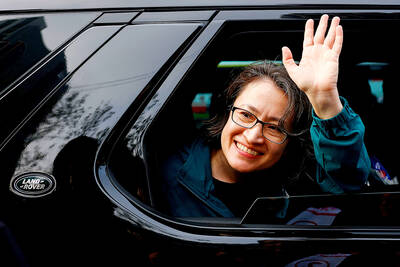
Relations between Taiwan and the Czech Republic have flourished in recent years. However, not everyone is pleased about the growing friendship between the two countries. Last month, an incident involving a Chinese diplomat tailing the car of vice president-elect Hsiao Bi-khim (蕭美琴) in Prague, drew public attention to the People’s Republic of China’s (PRC) operations to undermine Taiwan overseas. The trip was not Hsiao’s first visit to the Central European country. It was meant to be low-key, a chance to meet with local academics and politicians, until her police escort noticed a car was tailing her through the Czech capital. The
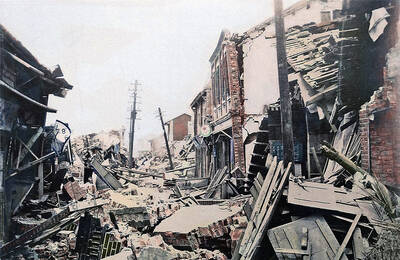
April 15 to April 21 Yang Kui (楊逵) was horrified as he drove past trucks, oxcarts and trolleys loaded with coffins on his way to Tuntzechiao (屯子腳), which he heard had been completely destroyed. The friend he came to check on was safe, but most residents were suffering in the town hit the hardest by the 7.1-magnitude Hsinchu-Taichung Earthquake on April 21, 1935. It remains the deadliest in Taiwan’s recorded history, claiming around 3,300 lives and injuring nearly 12,000. The disaster completely flattened roughly 18,000 houses and damaged countless more. The social activist and

Over the course of former President Ma Ying-jeou’s (馬英九) 11-day trip to China that included a meeting with Chinese Communist Party (CCP) leader Xi Jinping (習近平) a surprising number of people commented that the former president was now “irrelevant.” Upon reflection, it became apparent that these comments were coming from pro-Taiwan, pan-green supporters and they were expressing what they hoped was the case, rather than the reality. Ma’s ideology is so pro-China (read: deep blue) and controversial that many in his own Chinese Nationalist Party (KMT) hope he retires quickly, or at least refrains from speaking on some subjects. Regardless


 RSS
RSS