


Maya Widmaier-Picasso, a daughter of Picasso who authenticates works attributed to him, said last week in Paris that a US$40,000 drawing purchased by a California man through Costco last year was a fake.
Widmaier-Picasso, 70, was asked to view a digital image of the 1970 drawing three days after she pronounced two other Picassos inauthentic that had been offered by the same US dealer who sold the drawing.
Those two works, photographs of which were shown to her by The New York Times, were offered by the dealer with certificates in French saying that Widmaier-Picasso had authenticated them. Pointing to anomalies in the certificates -- grammatical errors, wording that departed from her style, handwriting that did not match hers and the placement of words on the page -- the artist's daughter said both documents were forgeries.
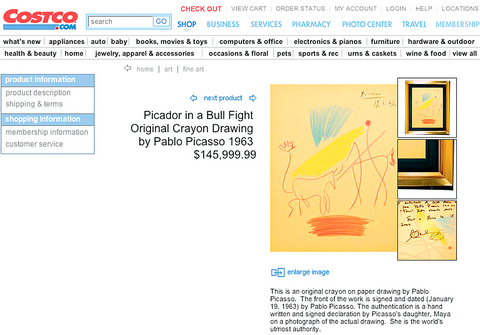
PHOTO: NY TIMES NEWS SERVICE
One of the sketches, a 1963 drawing of a bullfight that was being offered through Costco for US$146,000, was removed from the company's retail Web site, www.costco.com, after The Times informed Costco of Widmaier-Picasso's contention. Since then, Costco has been bombarded with inquiries about how it screens the fine art offered through its Web site and at "special events" at its store outlets. As the company investigates Widmaier-Picasso's assertions, it has emphasized that any of its merchandise can be returned.
The other drawing that Widmaier-Picasso examined on Tuesday was presented to her in error. The drawing's supplier, Jim Tutwiler of Boca Raton, Florida, had provided it to The Times and misidentified it as the one sold through Costco to the California man, Louis Knickerbocker of Newport Beach.
Friday, upon viewing the correct image of the work that Knickerbocker owns -- a crayon drawing of a face dated 1970 -- Widmaier-Picasso said immediately, "Ah yes, Arias, my father's barber."
After inspecting it rapidly, the artist's daughter, a stocky, ebullient 70-year-old who strongly resembles her father, declared the work to be a fake -- a copy of a genuine Picasso.
She arose, went into another room and returned with a catalog depicting works from the Eugenio Arias Collection, which resides in the permanent collection of the Picasso Museum of Buitrago del Lozoya, a town near Madrid. The museum was founded in 1985, three years after Arias, the artist's longtime barber and a native of Buitrago, donated his small Picasso collection -- "lots of little things given to him by my father," Widmaier-Picasso said.
She turned to a catalog page with a sketch of Arias' face that closely resembled the one sold to Knickerbocker. It bore the same date: Nov. 29, 1970. She explained that Picasso sketched the barber's face on the title page of a short play he had written, The Burial of the Count of Orgaz, a copy of which he dedicated to Arias.
Picasso's handwriting was markedly different from the writing on the work sold through Costco, Widmaier-Picasso pointed out -- especially the way he formed the R and the S in Arias. In the sketch reproduced in the catalog, she noted, the R had a loop, and the S was rounded; in Knickerbocker's drawing, the letters are not articulated as clearly. And in the date, Picasso's 9 had a full circle at the top of the vertical line, she noted, whereas the circle in the image shown was open.
Throughout the works in the catalog, the lettering of every Arias was consistent -- and unlike the Arias scrawled on Knickerbocker's drawing.
Told of Widmaier-Picasso's finding by telephone, Costco's senior vice president for e-commerce, Ginnie Roeglin, abruptly ended the conversation.
Later she released a statement saying: "To the best of our knowledge, Maya Picasso has not reviewed the certificates of authenticity bearing her signature for two Picasso pieces that we have sold. Our sources continue to assure us that the certificates as well as the art are genuine."
It was not clear exactly what Picassos Roeglin was referring to -- the ones viewed by the artist's daughter on Tuesday and Friday, or others sold through Costco. Calls to her later were not returned.
Her statement said that Costco was still investigating "to resolve the questions" raised by Widmaier-Picasso's remarks and that any Picassos sold by the store chain could be returned for a full refund.
Calls to Jim Sinegal, Costco's chief executive, were not returned Friday.
Widmaier-Picasso, who has authenticated works for Sotheby's and Christie's, says she keeps a detailed record on every photographic certificate she issues. She staples a sticker to the back of each one, marked with one or more of her fingerprints, she says, and keeps a record of which fingers were used in each case.
Art scholars have occasionally dissented from her attributions and deattributions, although rarely publicly. But in any case, Widmaier-Picasso has challenged certificates of authenticity bearing her name that she was shown this week in digital form.
She has not seen a photograph of the one provided to Knickerbocker. Costco declined again Friday to provide an image of the certificate, and Knickerbocker did not return phone calls. Repeated knocks on the door of his Spanish-style house in Newport Beach went unanswered late Friday morning.
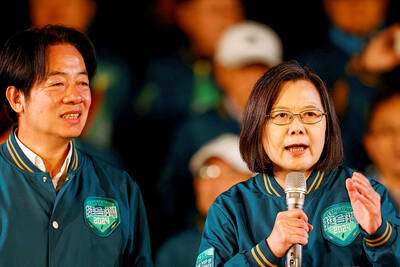
Last week Joseph Nye, the well-known China scholar, wrote on the Australian Strategic Policy Institute’s website about how war over Taiwan might be averted. He noted that years ago he was on a team that met with then-president Chen Shui-bian (陳水扁), “whose previous ‘unofficial’ visit to the US had caused a crisis in which China fired missiles into the sea and the US deployed carriers off the coast of Taiwan.” Yes, that’s right, mighty Chen caused that crisis all by himself. Neither the US nor the People’s Republic of China (PRC) exercised any agency. Nye then nostalgically invoked the comical specter
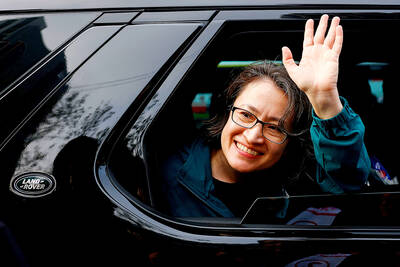
Relations between Taiwan and the Czech Republic have flourished in recent years. However, not everyone is pleased about the growing friendship between the two countries. Last month, an incident involving a Chinese diplomat tailing the car of vice president-elect Hsiao Bi-khim (蕭美琴) in Prague, drew public attention to the People’s Republic of China’s (PRC) operations to undermine Taiwan overseas. The trip was not Hsiao’s first visit to the Central European country. It was meant to be low-key, a chance to meet with local academics and politicians, until her police escort noticed a car was tailing her through the Czech capital. The
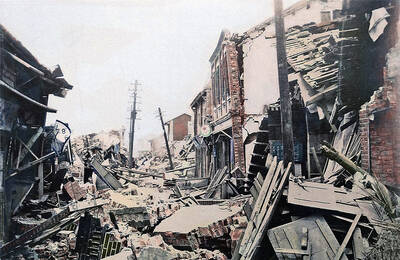
April 15 to April 21 Yang Kui (楊逵) was horrified as he drove past trucks, oxcarts and trolleys loaded with coffins on his way to Tuntzechiao (屯子腳), which he heard had been completely destroyed. The friend he came to check on was safe, but most residents were suffering in the town hit the hardest by the 7.1-magnitude Hsinchu-Taichung Earthquake on April 21, 1935. It remains the deadliest in Taiwan’s recorded history, claiming around 3,300 lives and injuring nearly 12,000. The disaster completely flattened roughly 18,000 houses and damaged countless more. The social activist and

Over the course of former President Ma Ying-jeou’s (馬英九) 11-day trip to China that included a meeting with Chinese Communist Party (CCP) leader Xi Jinping (習近平) a surprising number of people commented that the former president was now “irrelevant.” Upon reflection, it became apparent that these comments were coming from pro-Taiwan, pan-green supporters and they were expressing what they hoped was the case, rather than the reality. Ma’s ideology is so pro-China (read: deep blue) and controversial that many in his own Chinese Nationalist Party (KMT) hope he retires quickly, or at least refrains from speaking on some subjects. Regardless


 RSS
RSS