


Maureen Stapleton, who created a gallery of pugnacious, sometimes profane but always vulnerable heroines on Broadway, in films and on television and who won an Academy Award for her fiery performance as the anarchist Emma Goldman in Reds, died on Monday at her home in Lenox, Mass. She was 80.
The cause was chronic pulmonary disease, said her son, Daniel Allentuck.
Stapleton had one of the most honored acting careers of her generation. Her Academy Award for Reds, Warren Beatty's 1981 epic about the Russian Revolution, came on her fourth Oscar nomination. She also won two Tony Awards and an Emmy among many nominations.
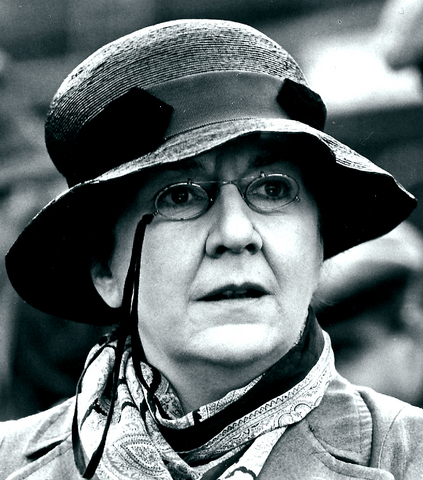
Stapleton's story embodied the classic theatrical cliche. A small-town girl nurtured on long afternoons at the movies, she came to New York in 1943 with dreams of becoming a star in the theater. She worked at a variety of jobs salesgirl, hotel clerk, artists' model while attending acting school. Then, not long after her theatrical baptism in summer stock and a few small roles on Broadway, fortune smiled.
It was 1950. Tennessee Williams had written a play called The Rose Tattoo, and he wanted the renowned Italian actress Anna Magnani to play the lead role, that of Serafina Delle Rose, an earthy Sicilian-American widow looking for love. But Magnani declined, fearing that her English was inadequate for Broadway. Other actresses were auditioned, without success. Harold Clurman, who had directed Stapleton earlier that year in Arthur Laurents' Bird Cage, suggested to the producers that they audition her. After repeated callbacks, she was told she had the part.
The Rose Tattoo opened at the Martin Beck Theater in February 1951. Brooks Atkinson, writing in The New York Times, called the performance "triumphant" and praised her ability to convey not only the coarseness of the plainspoken Serafina but also her moments of exaltation. The play ran for 300 performances then toured for six months.
The Rose Tattoo fulfilled Stapleton's childhood dream of becoming a star and also earned her a Tony Award. But the stress of her first major role also brought her face to face with the demons that would pursue her throughout her career. She began to drink, though she always maintained that she drank only after a performance. (She routinely vomited before curtain time.) She also became convinced that someday, someone in the audience was going to kill her.
Stapleton's growing paranoia led her to seek out a psychotherapist after the show ended its tour, but a cure for her ills she also had a lifelong fear of elevators and airplanes proved elusive. One therapist was to treat her for 14 years. Despite her problems with alcohol and bouts of anxiety, her life seemed to be on a positive track. She married Max Allentuck, general manager for the producer Kermit Bloomgarden. They had a son, Daniel, and a daughter, Katherine. When word came that Williams was ready with a new play, Orpheus Descending, she was told once again that he wanted Magnani to play the heroine, a frustrated Italian-American storekeeper in a small Southern town whose world is torn apart by the arrival of a handsome newcomer. But Magnani declined again, and the role went to Stapleton.
The play opened on Broadway in March 1957 and drew mixed reviews, but Stapleton won raves in the lead role of Lady Torrance, Williams's gritty, sex-starved heroine.
Then Hollywood beckoned, and in her very first film, an adaptation of Nathaniel West's Miss Lonelyhearts (1959), she was nominated for an Academy Award for best supporting actress, playing a deceitful man-eater. In 1959, she and Allentuck were divorced, and she began a relationship with the playwright David Rayfiel, whom she eventually married. But guilt and anxiety over her divorce, she said, drove her further into alcoholism and indulgence. Her weight ballooned. Liquor, like theatrical makeup, was a fixture in her dressing room.
Once established on Broadway and in films and television, she was rarely idle. She appeared on Broadway with Jason Robards in Lillian Hellman's Toys in the Attic in 1960 and in the film version of Orpheus, retitled The Fugitive Kind. Williams got his wish, however, and Anna Magnani played Lady Torrance onscreen while Stapleton had to settle for a lesser role. Stapleton had an earlier disappointment when Magnani won an Academy Award for best actress as the earthy Serafina in the 1955 film version of The Rose Tattoo.
By this time, she was married again, to Rayfiel, but her drinking was out of control. She was hospitalized for detoxification, after which she voluntarily entered a psychiatric facility. Her second marriage lasted three years. A few months after her divorce, she returned to the role that had made her a star, appearing as Serafina opposite Harry Guardino in a revival of The Rose Tattoo at the City Center.
In 1967, she won an Emmy for her television work in Among the Paths to Eden, an adaptation of a Truman Capote story about a spinster and a widower.
A year later, she was cast opposite George Scott in Neil Simon's comedy Plaza Suite, staged by Mike Nichols. She and Scott played three different warring couples to hilarious effect, and her performance won her another Tony nomination. The awards and nominations kept coming. She was nominated for an Oscar as best supporting actress for Airport (1970); she won a best-actress Tony that same year for her portrayal of an alcoholic down-and-out singer in Simon's laughing-through-tears drama The Gingerbread Lady she and her co-star, Charles Durning, received Emmy nominations for Queen of the Stardust Ballroom (1975), in which they played a couple who warm to romance when they meet at a dance hall.
Another Oscar nomination, for supporting actress, followed her work in Woody Allen's 1978 drama, Interiors. In 1981, she was nominated for a Tony for The Little Foxes, in which she played the battered Aunt Birdie opposite Elizabeth Taylor in the lead role, Regina. It turned out to be her last appearance on Broadway.
But her movie career continued, perhaps most memorably as the revolutionary Goldman in Reds. The performance won her the Oscar for best supporting actress. Her film credits also included Cocoon (1985) and its sequel, in which she plays one of a group of Florida retirees rejuvenated by extraterrestrials, and Nuts (1987), in which she plays the mother of a high-priced call girl (Barbra Streisand).
When her grandchildren were born, Stapleton moved to Lenox to be near family members and continued to accept the occasional role, playing a woman dying of ovarian cancer in the television drama Last Wish(1992) and appearing opposite Armin Mueller-Stahl in the 1994 film The Last Good Time.
She also wrote her autobiography, A Hell of a Life, with Jane Scovell in 1995, in which she looked back on a life in the theater with a few regrets but a lot of satisfaction.

The year was 1991. A Toyota Land Cruiser set out on a 67km journey up the Junda Forest Road (郡大林道) toward an old loggers’ camp, at which point the hikers inside would get out and begin their ascent of Jade Mountain (玉山). Little did they know, they would be the last group of hikers to ever enjoy this shortcut into the mountains. An approaching typhoon soon wiped out the road behind them, trapping the vehicle on the mountain and forever changing the approach to Jade Mountain. THE CONTEMPORARY ROUTE Nowadays, the approach to Jade Mountain from the north side takes an

Last week Joseph Nye, the well-known China scholar, wrote on the Australian Strategic Policy Institute’s website about how war over Taiwan might be averted. He noted that years ago he was on a team that met with then-president Chen Shui-bian (陳水扁), “whose previous ‘unofficial’ visit to the US had caused a crisis in which China fired missiles into the sea and the US deployed carriers off the coast of Taiwan.” Yes, that’s right, mighty Chen caused that crisis all by himself. Neither the US nor the People’s Republic of China (PRC) exercised any agency. Nye then nostalgically invoked the comical specter

Relations between Taiwan and the Czech Republic have flourished in recent years. However, not everyone is pleased about the growing friendship between the two countries. Last month, an incident involving a Chinese diplomat tailing the car of vice president-elect Hsiao Bi-khim (蕭美琴) in Prague, drew public attention to the People’s Republic of China’s (PRC) operations to undermine Taiwan overseas. The trip was not Hsiao’s first visit to the Central European country. It was meant to be low-key, a chance to meet with local academics and politicians, until her police escort noticed a car was tailing her through the Czech capital. The

April 15 to April 21 Yang Kui (楊逵) was horrified as he drove past trucks, oxcarts and trolleys loaded with coffins on his way to Tuntzechiao (屯子腳), which he heard had been completely destroyed. The friend he came to check on was safe, but most residents were suffering in the town hit the hardest by the 7.1-magnitude Hsinchu-Taichung Earthquake on April 21, 1935. It remains the deadliest in Taiwan’s recorded history, claiming around 3,300 lives and injuring nearly 12,000. The disaster completely flattened roughly 18,000 houses and damaged countless more. The social activist and


 RSS
RSS