


It darts out of the chute and bucks its way around the ring, yelping out of control. It looks shaggy, desperate and annoyed. Then it charges right at all of us cowering behind the wooden barrier at the edge of the ring, kicking up dust and ramming those two nubby horns into the chipped-up wood.
No. Way. No way. I am not going out there and taunting this huffy 136kg animal, not with this fake wooden sword and swath of red flannel cloth.
But the ring's steel doors are closed. The stone walls are too high to jump over. If only I could reason with it -- I won't hurt you if you won't hurt me, promise -- then maybe I'd get to fly home without a hoof print between the eyes.
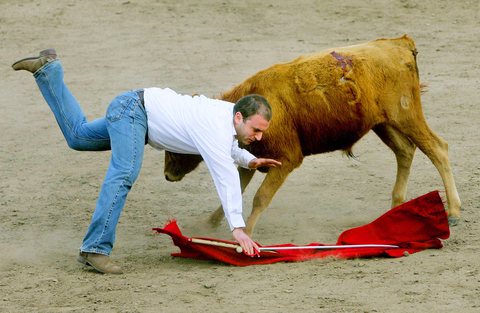
PHOTO: NY TIMES NEWS SERVICE
Then I am out there, alone with the cape. She is staring right at me -- true, this is a young female, just a training animal, not a real bull. Still, she does not look pleased.
"Dude, she's so good right now -- walk right at her closer." The voice is that of Coleman Cooney, my bullfighting mentor. "Closer," he insists. "Now toque!"
A toque is a shake of a matador's cape, and Cooney is the owner and founder of the California Academy of Tauromaquia, one of the very few bullfighting schools in the US. When his students have advanced past learning a few basic moves, or passes, he takes them to this working ranch in Valle de las Palmas, Baja California, about 40km south of the border town of Tecate, to practice on real animals.
At my level of expertise, the aim is not to kill or harm anything, but to try out moves and get some idea what matadors are up against when they dance around in that bullring.
School starts in the gravel driveway of Cooney's ranch in Alpine, California, a mountain village about 40km east of San Diego. Last year some 175 students signed up to learn the tricky and controversial art of toreo. Cooney, 48, now a screen-writer, lived the expatriate life in Spain for nearly a decade, picking grapes in vineyards and becoming an aficionado practico (or serious bullfighting fan) by learning a matador's cape maneuvers on bull ranches. Back in the US, he founded his school nine years ago.
While bullfighting is illegal in the US (except for nonlethal "bloodless" events in some states), and California also bars promoting or advertising bullfights, it is not illegal to teach the moves and traditions. Cooney stages the live-animal component of his class work in Mexico. Advanced students can even pay extra for the opportunity to kill a bull there.
Over the years, humane societies have launched campaigns to shut him down. Animal rights groups have sent spies with video cameras. Wayne Pacelle, president of the Humane Society of the US, said Cooney's school is a "stepping stone" to animal cruelty. "This is not an activity that any school should promote or provide training for," Pacelle said. "We want them to stop engaging in this nonsense."
Cooney contends that the opposition has only made the experience more attractive to thrill seekers. "I think our students are tired of all the fingers wagging in their faces," he told me a few days before I arrived at his place for a weekend class in January. "The idea of something so contrarian as bullfighting becomes appealing."
Students cannot, of course, begin by challenging one of the gigantic bulls that carry more than 454kg of rippled muscle and charge at matadors in the corrida with a full rack of razor-sharp horns. The animal I faced was a vaquilla, a young female genetically predisposed to aggressiveness from the stock used by breeders to produce brave and lucrative fighting bulls. Practice runs like mine help determine which cows have the most promise for producing aggressive sons.
Training began on a Friday night. I arrived at an empty baseball field behind my no-frills motel to collect my gear: a hot pink and yellow cape, a smaller blood-red one called a muleta and a pair of bull horns used to simulate the movements of a live bull.
`therapy'
Santiago Gonzalez, 38, our instructor, was amiable and graceful with the capes. A painting contractor in San Diego, he was one of the first students at Cooney's academy and now fights bulls as an amateur torero in Mexico. "Think of this as therapy," he told me. Everyone seemed to be at bullfighting school for a different reason. Jerry Roach, 62, a former nightclub owner, said he had started coming to the academy in 2001. "This keeps me young," he said.
Aleco Bravo, 38, an actor, said he was connecting to a father he never had a chance to spend any time with: Jaime Bravo, a famous and flam-boyant Mexican matador who died in a car wreck in 1970. "I guess you might say I'm trying to transmit," Bravo said.
Mark Finguerra, 37, a Yale graduate and screenwriter from New York, had been hooked while researching a movie script about the close-knit fraternity of bullfight junkies in the US and now hoped to become an amateur bullfighter. On this trip, he would be trying to kill his first bull. He admitted to a certain nervousness. "Outside the insect species," he said, "I've never killed anything in my life."
Gonzalez lit a cigarette and talked about the proper stance of a matador -- chest proud, hips back, groin thrust out -- symbolic of a matador's machismo. The animals, he said, exploit weak souls. Gonzalez charged at us with a set of horns, making snorting noises, while Bravo bent over behind him, clutching his belt loops, imitating the imaginary animal's rear end.
The next morning we took a scenic two-hour drive through the rocky coastal hills and dust-choked valleys of the Laguna mountain range to Valle de las Palmas, the location of the Santa Alicia bull ranch.
My forearms were stiff and sore. Practice had been exhausting. The muleta is as heavy as a wet towel and not easy to wield. Gripping the palillo, the wooden dowel that holds it, and the helper sword that keeps it flat, called the ayuda, felt like gripping car keys, a cellphone and an iPod all in one hand.
There were steps to remember, too many: right forehand passes; low backhand passes; and long, finishing backhand passes. Inside the ring, we quickly took our posts behind the wooden protectors, or burladeros. The sky was clear and the sun was high and strong.
Gonzalez's friend Jorge Guerra began strumming flamenco songs on his classical guitar.
My heifer was No. 44. I panicked. I didn't want to move. Then I felt Gonzalez push me out to meet her. Any sudden movements, and you become the target, so I tried to keep my nervous steps still and send her a mental message: "I won't hurt you if you won't me."
She wasn't listening.
I tossed the muleta forward, trying to bait the trap for her. She didn't budge.
"Closer."
Again, forward some more. Nothing.
"Go right at her."
Two meters away, perhaps, I gave the mulet another toque and her ears twitched. Whoa. She was ready.
I remember only parts of what happened next: the animal's head dipping low and charging directly at my lap (I stuck the cape out there at the last minute, and she plowed through the cloth, not me). Trying so hard not to move or run. Sticking that muleta out as far away from my waist as possible.
When at last I scampered away, there was some token applause. It might have been Gonzalez who yelled out, "Que bien! Que bien!" I blushed and grinned. The entire thing lasted a minute, maybe less.
It felt, strangely, fulfilling. So fulfilling that I probably don't ever need to do it again.
The day's finale came moments after. Finguerra's bull was cream-colored, weighed about 227kg and rocked the chute's steel doors with horns about 25cm long.
dead and done
Finguerra was dressed up in boots he had had made in Spain for this occasion and a freshly starched shirt. After only a few passes, spots on his shirt were caked in dirt and blood. The bull had taken over, stepping on the muleta and tearing it from Finguerra's hand. Without the cape to go for, the bull went for him, thumping him into the ground, stepping on top of him and digging at his body with his horns. Again and again, Finguerra dusted himself off. At last he dropped the wooden sword, and picked up the estoque. Soon the bull lay dead.
That night Finguerra cooked filets from his bull on Cooney's grill and said that eating the animal's tender meat and knowing he needed the experience erased any guilt he might have felt. If he wanted to be a torero, he would have to stick swords into more bulls, many more -- and at a price because, as a hobby, bull-fighting is not cheap. For this first killing, he had paid the rancher a fee of $US600.
He had no trouble justifying his purchase, considering all the other expensive hobbies he might have taken up. "I figure it costs about US$500 to play a round at Pebble Beach," he said.

In late October of 1873 the government of Japan decided against sending a military expedition to Korea to force that nation to open trade relations. Across the government supporters of the expedition resigned immediately. The spectacle of revolt by disaffected samurai began to loom over Japanese politics. In January of 1874 disaffected samurai attacked a senior minister in Tokyo. A month later, a group of pro-Korea expedition and anti-foreign elements from Saga prefecture in Kyushu revolted, driven in part by high food prices stemming from poor harvests. Their leader, according to Edward Drea’s classic Japan’s Imperial Army, was a samurai

Located down a sideroad in old Wanhua District (萬華區), Waley Art (水谷藝術) has an established reputation for curating some of the more provocative indie art exhibitions in Taipei. And this month is no exception. Beyond the innocuous facade of a shophouse, the full three stories of the gallery space (including the basement) have been taken over by photographs, installation videos and abstract images courtesy of two creatives who hail from the opposite ends of the earth, Taiwan’s Hsu Yi-ting (許懿婷) and Germany’s Benjamin Janzen. “In 2019, I had an art residency in Europe,” Hsu says. “I met Benjamin in the lobby

April 22 to April 28 The true identity of the mastermind behind the Demon Gang (魔鬼黨) was undoubtedly on the minds of countless schoolchildren in late 1958. In the days leading up to the big reveal, more than 10,000 guesses were sent to Ta Hwa Publishing Co (大華文化社) for a chance to win prizes. The smash success of the comic series Great Battle Against the Demon Gang (大戰魔鬼黨) came as a surprise to author Yeh Hung-chia (葉宏甲), who had long given up on his dream after being jailed for 10 months in 1947 over political cartoons. Protagonist

The following three paragraphs are just some of what the local Chinese-language press is reporting on breathlessly and following every twist and turn with the eagerness of a soap opera fan. For many English-language readers, it probably comes across as incomprehensibly opaque, so bear with me briefly dear reader: To the surprise of many, former pop singer and Democratic Progressive Party (DPP) ex-lawmaker Yu Tien (余天) of the Taiwan Normal Country Promotion Association (TNCPA) at the last minute dropped out of the running for committee chair of the DPP’s New Taipei City chapter, paving the way for DPP legislator Su


 RSS
RSS