


Before he commissioned the overblown confection that became Hearst Castle, the newspaper mogul William Randolph Hearst and his family would travel to that same spot on the Big Sur coast of California for a vacation in more modest lodgings -- a series of tents. The arrangements were rustic but stylish: striped fabric walls, wooden floors, writing desks, rugs and even separate tents for entertainment.
Hearst's setup, back when that corner of San Simeon was unassumingly known as Camp Hil, was a harbinger of the simple, elegant structures at the new Treebones Resort, about 33km up the rugged coast. Opened about a year, the 16 yurts perched along the ridge above Highway 1 embody the natural beauty and off-the-grid living that have long characterized Big Sur. Not much has changed in the physical landscape since the Hearsts "roughed it" -- California land trusts, conservation easements and local coastal programs have prevented rampant development.
Even today, you can spend a couple of hours winding along the treacherous, two-lane Highway 1, sandwiched between the Santa Lucia Mountains and the wild Pacific Coast, without anything impeding the view. Along with the Los Padres National Forest, a string of wilderness areas, state parks and reserves along the coast make for challenging hiking; in the winter, you can trek even the most popular trails and see nary a soul. It's an extraordinary piece of America that remains as Henry Miller described it in 1957 -- a meeting of extremes, "a region where one is always conscious of weather, of space, of grandeur and of eloquent silence."
PHOTOS: NY TIMES NEWS SERVICE
Because of the very land-use restrictions that keep Big Sur beautiful, it's tough to find a place to stay in the area that fits in the category between campground and exclusive luxury resort. (A stay at the Post Ranch Inn will run upward of US$525 a night.)
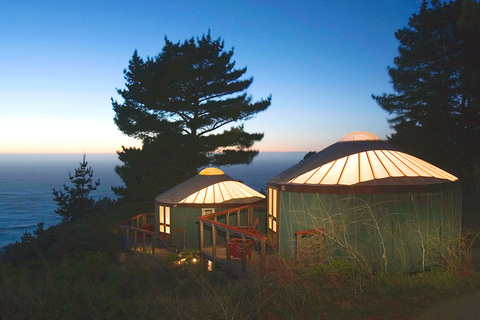
It took 20 years for John and Corinne Handy to secure the permits and capital to build Treebones -- named for an old lumber mill at the site -- but the result is a comfortable yet unobtrusive way to enjoy the stunning seascape. The yurts, circular tentlike structures similar to those used by Central Asian nomads, are updated here with modern amenities, including polished pine floors, French doors, reading lamps, colorful quilts, pillow top mattresses and clear domed roofs for sunlight by day and stargazing by night.
The resort has its own well, and everything is powered by propane-fueled turbines; the heat produced in the process is used to warm water and some of the yurts. Several have gas fireplaces.
A main lodge, less than a minute's walk up a gravel trail from even the farthest yurt, has a great-room with couches, a fireplace and tables for dining (complimentary waffle breakfasts are included; barbecue dinners are extra). There's also an outdoor deck with a heated pool and a small hot tub.
The restrooms and showers are also at the lodge -- the yurts have no private bathrooms, though all have vanity sinks. It's a bit of a pain to navigate the way to the bathroom in the middle of the night, but in practice it's a good excuse to enjoy the brilliant star canopy above.
Winter is the time to appreciate the scenery in all its drama, when thousands of gray whales migrate past Cape St. Martin, the rocky point where Treebones is perched. During a recent visit to the resort, an oceanview yurt was just adjacent to a spot known as Whale Watch Ridge, complete with a little wooden bench for optimal viewing. And there were hundreds of blowholes spouting throughout the day.
Joyce Nichelini, a longtime resident of Oakland, California, was visiting Big Sur with her daughter, Joanie, who was in from Colorado. "Her visit was a great reason to come down here," said Nichelini, 74, who had read about the yurts in the local paper. "She has the Rocky Mountains, which are spectacular, but nothing like this -- the Pacific, the wide-open views. Yesterday, we saw two whales passing right there in front of the yurts. I think this really makes her miss California."
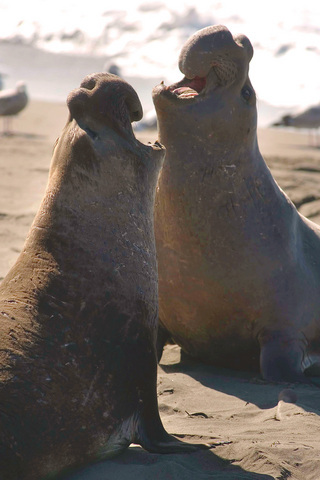
Winter is also the best season to spot elephant seals -- or as the case may be, to hear them. "Thirty minutes south of here, near San Simeon, is the best beach to see elephant seals pupping," said Bill Brown, the innkeeper at Treebones. "But we can hear them all night long here. There's a group of them just over the cliff, out of sight."
If you've ever heard elephant seals, you know that they are extremely vocal and hardly melodious. The massive adult males bellow from their distinctive snouts, while the babies sound like a hundred irate Miss Piggys screeching at Kermit. (Waves crashing and wind blowing keeps it all to a dull roar, but you may want to bring earplugs.)
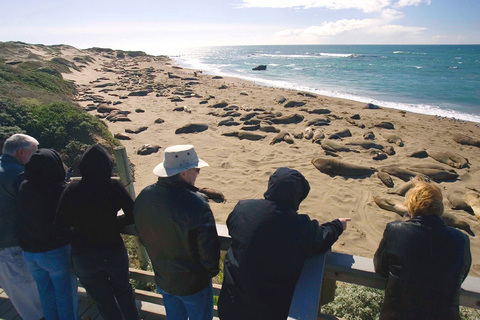
If you want to see these honking animals in all their blubbery glory, then do so from December through March, when thousands of elephant seals lumber ashore, give birth and mate again before heading back out to sea. Visitors are educated on the animals' living habits by Friends of the Elephant Seal, a nonprofit organization based in San Simeon.
"The ladies have a tough life in the harem," said Greg Glaze, a volunteer docent, pointing out a two-tonne male seal surrounded by a dozen females, all of them lazily flicking sand to cover up against the sun. "Those males just throw a fin on 'em and roll on over."
Two tiny seal pups wriggled closer to their mother for protection as the crowd oohed and aahed. For proximity, "there's no better place in the world to see this than here," Glaze said.
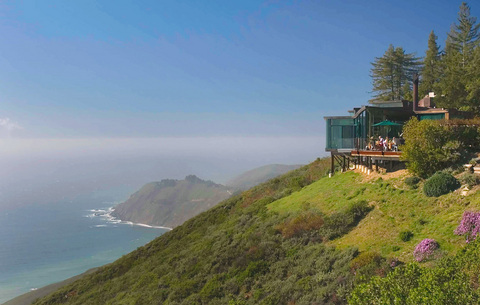
Once the sun sets in Big Sur the natural focus shifts from the sea to the sky. The Post Ranch Inn holds special stargazing sessions on its outdoor deck -- complete with astronomer and fancy telescope. The experience was enthralling: Under the tutelage of James Barrow, you can examine Saturn's rings, identified constellations (Orion taking aim at Taurus) and watch meteors blaze across the sky. After checking out the fiery red surface of Mars, you can take a decadent four-course meal at the Post Ranch's award-winning Sierra Mar restaurant. A hedonistic procession of salmon-wrapped scallops, star-anise duck consomme, Niman Ranch pork loin and macaroons with marzipan mousse. But the dinner was not cheap: US$85 a person, without wine.
The next day, a massage in yurt No.9, with the late-afternoon sun streaming in, cost about the same as dinner. But you could hear the elephant seals laughing and the wind whistling and it was obvious which experience felt richer and truer to Big Sur country. And in such a place, you can think again about a certain Mr. Hearst, enjoying the comforts of his tented encampment. His brand of roughing it is all the luxury you need.
Watching nature take its course
More than 20,000 gray whales make their home in the Pacific. From December to February, the main population comes close to the California coast as it moves from Alaska to its winter residence in the warm waters off Baja California. Beginning in March, the whales start their return leg, often bringing along their newborns. Among the best vantage points is the Treebones Resort at Cape St. Martin (www.treebonesresort.com; yurts start at US$129). Five campsites are also available for two guests each.
Elephant seals make their presence known on the beaches of Piedras Blancas, just north of San Simeon. Witness pups being born and harems being formed at the Elephant Seal vista point (Mile Marker 63, Highway 1). For more information, contact the Friends of the Elephant Seal (www.elephantseal.org).
Clear skies also dominate and there's no better tool for seeking out stars and planets than the powerful GPS telescope at the Post Ranch Inn (Highway 1, Big Sur, www.postranchinn.com; doubles from US$525). There are nightly stargazing sessions with local astronomers from 8pm to 9pm, weather permitting. Pair the
experience with an US$85 four-course dinner at Sierra Mar.
At the permanent exhibition at the visitor center at Hearst Castle (750 Hearst Castle Road, San Simeon; www.hearstcastle.org, tickets from US$20), you can see photos of the family tents at Camp Hill and examine more characteristically over-the-top Hearst
memorabilia.
At a picturesque spot on the Big Sur coast, Orson Welles and Rita Hayworth bought a little cabin in 1947. Later, they sold it to the Fassett family, who opened a sun-splashed restaurant, Nepenthe, with excellent views (Highway 1, Big Sur, www.nepenthebigsur.com, lunch for two US$40).

Last week Joseph Nye, the well-known China scholar, wrote on the Australian Strategic Policy Institute’s website about how war over Taiwan might be averted. He noted that years ago he was on a team that met with then-president Chen Shui-bian (陳水扁), “whose previous ‘unofficial’ visit to the US had caused a crisis in which China fired missiles into the sea and the US deployed carriers off the coast of Taiwan.” Yes, that’s right, mighty Chen caused that crisis all by himself. Neither the US nor the People’s Republic of China (PRC) exercised any agency. Nye then nostalgically invoked the comical specter

April 15 to April 21 Yang Kui (楊逵) was horrified as he drove past trucks, oxcarts and trolleys loaded with coffins on his way to Tuntzechiao (屯子腳), which he heard had been completely destroyed. The friend he came to check on was safe, but most residents were suffering in the town hit the hardest by the 7.1-magnitude Hsinchu-Taichung Earthquake on April 21, 1935. It remains the deadliest in Taiwan’s recorded history, claiming around 3,300 lives and injuring nearly 12,000. The disaster completely flattened roughly 18,000 houses and damaged countless more. The social activist and

Over the course of former President Ma Ying-jeou’s (馬英九) 11-day trip to China that included a meeting with Chinese Communist Party (CCP) leader Xi Jinping (習近平) a surprising number of people commented that the former president was now “irrelevant.” Upon reflection, it became apparent that these comments were coming from pro-Taiwan, pan-green supporters and they were expressing what they hoped was the case, rather than the reality. Ma’s ideology is so pro-China (read: deep blue) and controversial that many in his own Chinese Nationalist Party (KMT) hope he retires quickly, or at least refrains from speaking on some subjects. Regardless

Approaching her mid-30s, Xiong Yidan reckons that most of her friends are on to their second or even third babies. But Xiong has more than a dozen. There is Lucky, the street dog from Bangkok who jumped into a taxi with her and never left. There is Sophie and Ben, sibling geese, who honk from morning to night. Boop and Pan, both goats, are romantically involved. Dumpling the hedgehog enjoys a belly rub from time to time. The list goes on. Xiong nurtures her brood from her 8,000 square meter farm in Chiang Dao, a mountainous district in northern Thailand’s


 RSS
RSS