


The first time I arrived in Kingston, Jamaica, I was prepared for disappointment. It was 1996, and the city could hardly be expected to look as it had in The Harder They Come, the classic reggae film of the early 1970s. Jimmy Cliff had played a young country boy who arrives on a bus with dreams of making a hit record. He is robbed within minutes and his mother, taken in by a cruel and licentious preacher, ripped off by a record-company boss, and drawn into the ganja trade in the ghettoes, before getting a gun and going on the run, shooting and singing his way to fame.
I arrived with my boyfriend, to stay with his Jamaican mother not far from the bus stop where the opening scenes of the film were shot.
It felt as if we'd walked right on to the set. We reached her house through a dusty commotion of buses and handcarts, potholes and goats. And, as she greeted us with folded arms, I took in our surroundings.
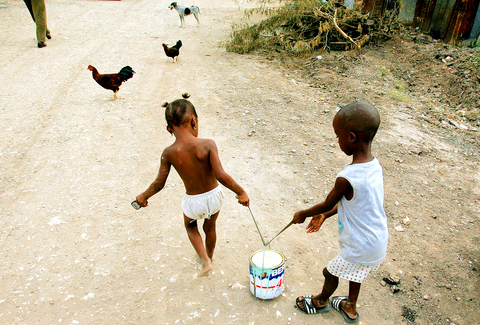
PHOTO: AP
Biblical quotations had been daubed in big red letters all over the walls and between them were dotted various examples of really quite hardcore pornography. That evening, his mother took us to an open-air church ceremony where, amid the confusion of people speaking in tongues, somebody managed to sell us drugs.
Kingston has changed a bit in the decade since then, but it is still recognizable today from The Harder They Come. Many tourists are put off by its violent reputation, but the capital is actually no more dangerous for foreigners than anywhere else in Jamaica, and in countless visits I've never encountered trouble. It isn't a beautiful city, but tourists who head straight for the resorts miss all the entertaining chaos of its color, history, drama and, above all, its music.
The best place to begin is Strawberry Hill, an 18th-century colonial house perched high above the city in the Blue Mountains belonging to Chris Blackwell, the record producer who discovered Bob Marley and founded Island Records. Marley convalesced here after being shot in 1976 and it is now an extravagantly elegant hotel, the cool mountain air as pure as its crisp white linen and polished mahogany floors.
The 12 Georgian-style cottages scattered around the Great House look out over velvety emerald peaks rearing and dipping in 360
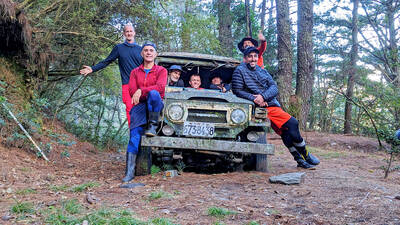
The year was 1991. A Toyota Land Cruiser set out on a 67km journey up the Junda Forest Road (郡大林道) toward an old loggers’ camp, at which point the hikers inside would get out and begin their ascent of Jade Mountain (玉山). Little did they know, they would be the last group of hikers to ever enjoy this shortcut into the mountains. An approaching typhoon soon wiped out the road behind them, trapping the vehicle on the mountain and forever changing the approach to Jade Mountain. THE CONTEMPORARY ROUTE Nowadays, the approach to Jade Mountain from the north side takes an

Last week Joseph Nye, the well-known China scholar, wrote on the Australian Strategic Policy Institute’s website about how war over Taiwan might be averted. He noted that years ago he was on a team that met with then-president Chen Shui-bian (陳水扁), “whose previous ‘unofficial’ visit to the US had caused a crisis in which China fired missiles into the sea and the US deployed carriers off the coast of Taiwan.” Yes, that’s right, mighty Chen caused that crisis all by himself. Neither the US nor the People’s Republic of China (PRC) exercised any agency. Nye then nostalgically invoked the comical specter

Relations between Taiwan and the Czech Republic have flourished in recent years. However, not everyone is pleased about the growing friendship between the two countries. Last month, an incident involving a Chinese diplomat tailing the car of vice president-elect Hsiao Bi-khim (蕭美琴) in Prague, drew public attention to the People’s Republic of China’s (PRC) operations to undermine Taiwan overseas. The trip was not Hsiao’s first visit to the Central European country. It was meant to be low-key, a chance to meet with local academics and politicians, until her police escort noticed a car was tailing her through the Czech capital. The
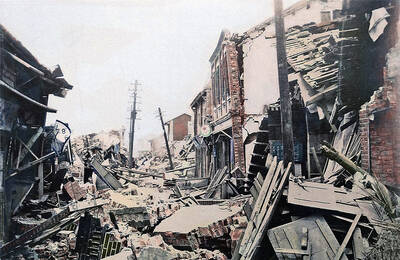
April 15 to April 21 Yang Kui (楊逵) was horrified as he drove past trucks, oxcarts and trolleys loaded with coffins on his way to Tuntzechiao (屯子腳), which he heard had been completely destroyed. The friend he came to check on was safe, but most residents were suffering in the town hit the hardest by the 7.1-magnitude Hsinchu-Taichung Earthquake on April 21, 1935. It remains the deadliest in Taiwan’s recorded history, claiming around 3,300 lives and injuring nearly 12,000. The disaster completely flattened roughly 18,000 houses and damaged countless more. The social activist and


 RSS
RSS