


It was a misty, rainy afternoon in Sonoma County, California. As we sipped hot chocolate beneath a thatched roof, our midday reverie was punctured by the sounds of Radar and Momma, two black-and-white ruffed lemurs who were having a hissy fit somewhere between the bathroom painted in rhino motifs and the cage holding Buba, the African serval cat, who was pacing and marking his territory with urine.
To those who have spent time in the real African bush, the one without the gift store selling giraffe visors and the "5k adventure trail run" that lets you "run wild through the Serengeti without leaving California," a weekend at Safari West, one of the country's half-dozen or so overnight safari lodges, is bizarre indeed. Over here is Delilah, the resident great Indian hornbill with clipped wings and an enormous banana-yellow beak, who hops around like a pogo-sticking prima donna while seriously entertaining having your pinky for dinner. Over there is a flotilla of open-air safari vehicles -- some with eBay stickers -- the guide an ebullient 25-year-old part-time student nurse who explains that "ostriches are, like, needy -- they're like little wild children."
Philosophically, of course, there are some profound problems with simulating Africa, a wild place where animals roam free, encounter predators and kill each other (and potentially you). But if you are willing to click your heels three times and suspend rational judgment, the experience of spending the nighten famille in a tented cabin and the day rumbling through muddy puddles to observe wildlife from an open-air jeep has a certain weird, campy charm.

The sight of safari guides wearing khaki, a couple of them speaking Afrikaans while readying Desert Storm-colored vehicles, was almost Kiplingesque. "We can pretend we're 19th-century aristocrats!" said our 14-year-old son Jacob, shortly before learning about the slobber on giraffes' tongues.
Essentially a private zoo, Safari West has 50 species on a 400-acre former sheep ranch. It is the verdant, funkily aromatic province of Peter Lang, 64, a former cattle rancher, builder, contractor and developer. His father, Otto Lang, who died last week, was the director of The Man from U.N.C.L.E.,Sea Hunt and most notably Daktari, the 1960s television series about a veterinarian in Africa. Lang and his wife, Nancy, a former curator of ornithology at the San Francisco Zoo, who live on the premises, started their Isak Dinesen fantasy with three eland and graduated to other animals, opening it to the public in 1991.
Like others of its ilk, including the Fossil Rim Wildlife Center in Glen Rose, Texas, and the Vision Quest Safari bed-and-breakfast in Salinas, California, Safari West, they say, is intended to be educational -- a place where animals, born either there or in zoos, have the acreage to follow their bliss in a more natural way than in a zoo.
Our guide, Kelly Baker, cautioned us to watch out for low-hanging branches as our open-air safari vehicle passed Bongo the giraffe, who has a passion for wallowing in mud, and then a group of eland, the largest antelope in Africa, which Baker called "super-buff."
She told us about the "big five" -- the five most dangerous animals to hunt in Africa, though the only big cats here are two cheetahs, which are kept separately in a wire enclosure and taken out for special US$150 photo-ops. (They are held by handlers while guests pose and "learn about the plight of the wild cheetah," with 10 percent of the proceeds said to go to cheetah conservation organizations.)
Besides Bender, a lone arthritic white rhino who was kept away from visitors in a pen, the big five are represented by Cape buffalo, fearsome beasts with horns upturned in the fashion of a Connie Francis hairstyle who share a 100-acre pasture. Their domain expanded after a tragic incident involving a camel. (The animals, though, are fenced off from visitors, Delilah excluded.)

Over hills, through puddles and down rutted trails we drove, leaning to the left to avoid tipping over while witnessing strange juxtapositions, like Canada geese flying over the waterbuck, which have gorgeous white rings encircling their backsides. A large herd of wildebeest ran full throttle down a hill to escape our view, a bit of realism not likely to be encountered in a zoo.
Midway through our three-and-a-half-hour safari, Baker lingered beside a group of Watusi cattle, which have massive prowlike horns and are considered sacred by the Masai. She explained that dried cattle dung is used to make bricks and floors and that on special occasions, a special drink is made from curdled milk, blood and urine. "It sounds kind of yucky," she said. "But if you were a Masai it would be yummy. It would taste like Fruity Pebbles."
After that astonishing tidbit the rest was a letdown -- except the ride itself, through gaping mud holes that elicited numerous "whoo-hoos" from the under-10 crowd.
"How many miles do you get per gallon?" inquired Gabe, our 11-year-oldCar and Driver subscriber.
"I couldn't tell you exactly," Baker said cheerfully while attempting to whip the steering wheel of the huge vehicle into submission. "All the gauges are broken!"
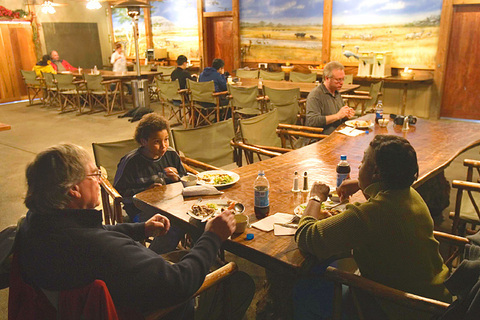
At dinner, held in a clamorous canvas building with canvas chairs and a fire pit at its entrance, we communed with fellow adventurers, in part to stave off our annoyance that the US$86 meal for four did not include seconds on the sliced sausage appetizers. The mass migration when the casserole lids on the buffet table were lifted might have fascinated Jane Goodall.
Amazingly, the overnight guests -- you can sign up for the safari ride a la carte -- included grown-ups who were not there with families, even though the atmosphere was about as romantic as a two-year-old's clown birthday party. Among them were Bernard Bowden, a 49-year-old longshoreman, and Cathy Copperud, 52, a nurse in San Jose. "I've always wanted to go to Africa, but I can't afford it," said Bowden, a self-described National Geographic freak. "I've always wanted to try sleeping in one of those tents."
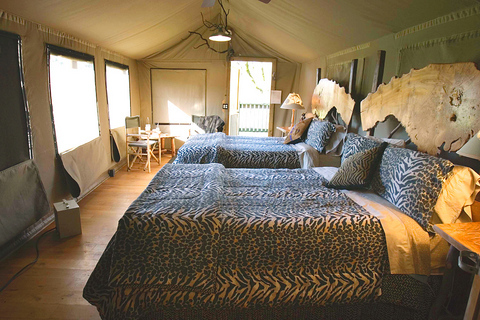
As the night blackened, we grabbed our map and flashlights and trekked past Giraffe Alley and up Wildebeest Hill Road to our tented cabin, raised on stilts with Velcroed plastic windows and a ceiling lantern and toilet paper holder chicly suspended from decorative twigs. The unheated, freezing-cold bathroom, with a netted roof, added to the atmosphere. The big draw -- besides the satisfying ripping sound of opening the Velcro-fastened windows -- was a king-sized bed with zebra-patterned sheets and an electric blanket to supplement the space heater. The four of us huddled together with our books, feeling like the lemurs in a hollowed-out heated log.
Come daybreak, we ripped open the windows and spotted a group of Barbary sheep, an African species, grazing on the nearby hillside. We strode bleary-eyed to breakfast, lured by the sound of shrieking macaws. As if in a dream, we spotted Milton Rieback, the lodge's khaki-clad 32-year-old director of education, who is also a South African herpetologist with a specialty in the cobra species.
Rieback, who worked at the Mabula Game Reserve in South Africa and whose wife is American, said the most authentic aspect of this make-believe African preserve was that "there's no script, and the animals are not strictly confined, so you see species interacting with each other." Hang around awhile, he said (an expensive proposition at US$225 a night, plus US$25 for each child), and you can watch males establishing dominance, females coming into estrus and complex social hierarchies. Even so, ieback calls the camp "a Club Med for animals."
Like many zoos, the lodge is involved in a captive breeding program that it says promotes genetic diversity. Animal rights activists take a dim view.
"Despite zoos' claims that their breeding programs have an intent to save species," said Lisa Wathne, the captive exotic animals specialist of People for the Ethical Treatment of Animals, "the fact is zoos breed animals because baby animals bring paying visitors to the gate."
Still, the place isn't Hemingway. This was brought home at the gift shop -- which Baker suggested we visit to cap off our safari -- especially by its mesmerizing assortment of Turkana seed fertility dolls ("makes a very unique wedding gift!" at US$39.95) and, most notably, Lucky Dudu animal charms said to be filled with impala dung.
It was very difficult to pull our boys away. So we established dominance. Our family left Safari West embracing the way of the wild, our familial hierarchy intact as we reaffirmed our social bonds.
Checking the beasts
Safari parks -- attractions where exotic animals are gathered in a protected setting that human observers can drive or walk through -- are fairly common in the US, but only a few offer family overnight experiences. Here is a sampling:
* Safari West (Santa Rosa, California, www.safariwest.com). Tents and cottages are rented for family overnights; rates start at US$225 for two people.
* Fossil Rim Wildlife Center (www.fossilrim.com). Tent cabins overlook a watering hole for its exotic animals and a lodge near its pastures. Overnight rates start at US$175.
* Vision Quest Ranch (400 River Road, Salinas, California, www.wildthingsinc.com). A bed-and-breakfast offers tent-style bungalows starting at US$195 in winter and US$225 in summer.
* Lion Country Safari (www.lioncountrysafari.com). A campground next to a drive-through theme park.
* Disney's Animal Kingdom Lodge (disneyworld.disneygo.com). This 10-month-old six-story hotel at Walt Disney World in Florida advertises "savannah view" rooms, starting at US$285, which overlook an artificial savanna that is home to some of the 200 animals in Disney's Animal Kingdom.

In late October of 1873 the government of Japan decided against sending a military expedition to Korea to force that nation to open trade relations. Across the government supporters of the expedition resigned immediately. The spectacle of revolt by disaffected samurai began to loom over Japanese politics. In January of 1874 disaffected samurai attacked a senior minister in Tokyo. A month later, a group of pro-Korea expedition and anti-foreign elements from Saga prefecture in Kyushu revolted, driven in part by high food prices stemming from poor harvests. Their leader, according to Edward Drea’s classic Japan’s Imperial Army, was a samurai

The following three paragraphs are just some of what the local Chinese-language press is reporting on breathlessly and following every twist and turn with the eagerness of a soap opera fan. For many English-language readers, it probably comes across as incomprehensibly opaque, so bear with me briefly dear reader: To the surprise of many, former pop singer and Democratic Progressive Party (DPP) ex-lawmaker Yu Tien (余天) of the Taiwan Normal Country Promotion Association (TNCPA) at the last minute dropped out of the running for committee chair of the DPP’s New Taipei City chapter, paving the way for DPP legislator Su
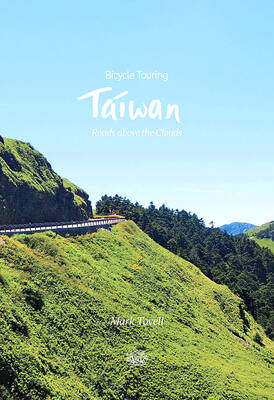
It’s hard to know where to begin with Mark Tovell’s Taiwan: Roads Above the Clouds. Having published a travelogue myself, as well as having contributed to several guidebooks, at first glance Tovell’s book appears to inhabit a middle ground — the kind of hard-to-sell nowheresville publishers detest. Leaf through the pages and you’ll find them suffuse with the purple prose best associated with travel literature: “When the sun is low on a warm, clear morning, and with the heat already rising, we stand at the riverside bike path leading south from Sanxia’s old cobble streets.” Hardly the stuff of your

Located down a sideroad in old Wanhua District (萬華區), Waley Art (水谷藝術) has an established reputation for curating some of the more provocative indie art exhibitions in Taipei. And this month is no exception. Beyond the innocuous facade of a shophouse, the full three stories of the gallery space (including the basement) have been taken over by photographs, installation videos and abstract images courtesy of two creatives who hail from the opposite ends of the earth, Taiwan’s Hsu Yi-ting (許懿婷) and Germany’s Benjamin Janzen. “In 2019, I had an art residency in Europe,” Hsu says. “I met Benjamin in the lobby


 RSS
RSS