


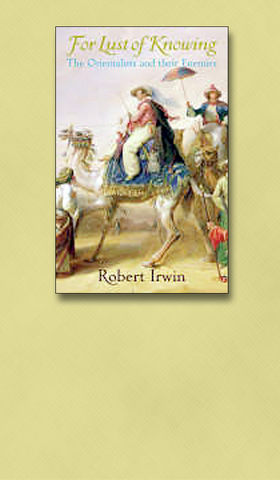
Readable, learned, enthusiastic, this is three books in one: a polemic, a catalogue and a narrative. The polemic is a counter-attack against the late Edward Said's denunciation of orientalism. Said, the doyen of Arab-American intellectuals, argued that orient-alism -- referring to the Middle East and India and largely ignoring China and Japan -- was "a poli-tical doctrine willed over the Orient because the Orient was weaker than the West."
For Said, orientalism was the lackey of imperialism and racism. Irwin stands for the orthodox view that it is what it claims to be -- the study, as objective as possible, of eastern languages, history, culture and so on.
I must declare an interest. I am, like Irwin, a "living fossil," having been taught Latin and Greek the old way, a way "certainly much closer to that practised in the 17th and 18th centuries than to the system which prevails in the 21st century." From these disciplines I followed a well-trodden path to oriental studies, and I was the pupil of some of the orientalists sketched in his book. I owe them everything both as teachers and as friends, "mentors" to use one classical word that has been reborn in management-speak. Like Irwin I would be flattered if anyone wanted to call me an orientalist.
Much of my professional life as a diplomat was concerned with disputes in which I had to take a neutral position -- Palestine, Cyprus, Northern Ireland. I feel like the man of whom it was said that he sat on the fence so long that the iron entered into his soul.
But when Irwin lays into Said's oeuvre -- "phantasmagorical," "slippery," a "labyrinth of false turns," a "work of malignant charla-tanry" -- I know which side I am on. Damning with faint praise, Irwin adds that he agrees by and large with what Said has written about Palestine, Israel, Kipling's Kim or Glenn Gould's piano playing. I'm not sure I could go that far, if only because reading Said's prose is like walking across a wet ploughed field.
Irwin scores some hits, although it isn't easy to knock out somebody who ducks and dives as skilfully as Said. To take one example, Said refused to acknowledge that there is such a thing as an Indo-Aryan family of languages and criticized a German orientalist who held that Sanskrit, Persian, Greek and German had more in common with each other than with Semitic or other language groups. Yet Irwin cannot quite pin Said down. Said was not a flat-earther -- he merely insinuated that we can scarcely trust a German who uses the word Aryan in the same sentence as the word Semitic.
So much for the polemic: Irwin admits that his book would not have been written if Said had never written Orientalism. It's knock-about, as is the tradition of orientalist scholarship. One 17th-century scholar quoted by Irwin said of another that he "doth not understand common sense in his own language, and therefore I cannot conceive how he can make sense of anything that is writ in another."
Irwin's catalogue of orientalists, far from being for specialists only, is a good deal more entertaining than some of the lists that have become a modish Christmas present in recent years.
He selects as the father of orientalism the 16th-century French scholar Guillaume Postel, a child prodigy who occupied the first professorial chair of Arabic in Paris at the age of 29. He became the disciple of a lady called Johanna, the New Eve and Mater Mundi, who claimed X-ray vision and that she could see Satan sitting at the center of the Earth. His writings eventually got him into trouble with the Inqui-sition, who "in an unusually benign frame of mind" decided that he was not a heretic, merely insane. Imprisoned on and off for the last 20 years or so of his life, he continued to command enormous respect for his erudition and his amiable personality.
There are plenty more. The 17th-century Jesuit scholar Athanasius Kircher specialized in ancient Egyptian and Coptic, alongside his main interest in Hebrew. As well as writing about obelisks, mummies, papyrus and Chinese ideograms, his books dealt with codes and code-breaking, music, Atlantis, birdsong, Noah's ark, magic lanterns, volcanoes, mathematics and pyramidology. Closer to our own day, we have one Oxford University professor who was described by his Italian maid as "Questo bel animal feroce!" and another, one of my own mentors, who cycled naked through the town pursued by the police and escaped by abandoning his bicycle and swimming across a nearby river.
Irwin passes quickly through the ancient and medieval periods, and in more detail through the last four centuries during which orientalism has been a recognized discipline, dedicated in Irwin's words to "getting things right."
Today the headlines rarely fail to have some Middle Eastern news in them, and there was a period in the 16th century when those who knew were seriously disturbed about the Turkish military threat. But most people most of the time have had other things to think about. Never-theless Irwin quotes some fascin-ating exceptions -- for example the fact that Columbus took an Arabic interpreter with him to the new world to help him communicate with people in the East Indies.
Irwin explains that many orientalists came to their scientific researches with dubious motives: Christians who saw Mohammed as a heretic, Protestants or Catholics who attacked Islam as a pretext for attacking each other, free-thinkers (like Voltaire) who praised Islam as a covert way of attacking Christianity. Today some universities seek to exclude Jews from Arabic departments, while others (such as Harvard) have had scruples about pursuing Islamic studies for fear of being accused of anti-semitism. These problems are touched on but not explored in depth, as is the difficult issue, given the fundamentalist nature of Islamic faith, of applying rigorous academic standards to the study of Islam and its history without incurring the wrath of the faithful.
Oliver Miles is a former British ambassador to Libya, Luxembourg and Greece.

Last week Joseph Nye, the well-known China scholar, wrote on the Australian Strategic Policy Institute’s website about how war over Taiwan might be averted. He noted that years ago he was on a team that met with then-president Chen Shui-bian (陳水扁), “whose previous ‘unofficial’ visit to the US had caused a crisis in which China fired missiles into the sea and the US deployed carriers off the coast of Taiwan.” Yes, that’s right, mighty Chen caused that crisis all by himself. Neither the US nor the People’s Republic of China (PRC) exercised any agency. Nye then nostalgically invoked the comical specter

Relations between Taiwan and the Czech Republic have flourished in recent years. However, not everyone is pleased about the growing friendship between the two countries. Last month, an incident involving a Chinese diplomat tailing the car of vice president-elect Hsiao Bi-khim (蕭美琴) in Prague, drew public attention to the People’s Republic of China’s (PRC) operations to undermine Taiwan overseas. The trip was not Hsiao’s first visit to the Central European country. It was meant to be low-key, a chance to meet with local academics and politicians, until her police escort noticed a car was tailing her through the Czech capital. The
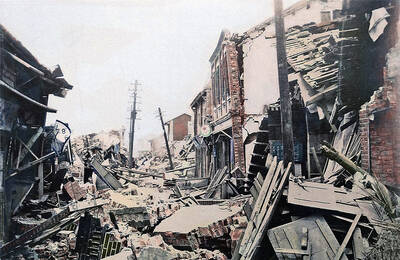
April 15 to April 21 Yang Kui (楊逵) was horrified as he drove past trucks, oxcarts and trolleys loaded with coffins on his way to Tuntzechiao (屯子腳), which he heard had been completely destroyed. The friend he came to check on was safe, but most residents were suffering in the town hit the hardest by the 7.1-magnitude Hsinchu-Taichung Earthquake on April 21, 1935. It remains the deadliest in Taiwan’s recorded history, claiming around 3,300 lives and injuring nearly 12,000. The disaster completely flattened roughly 18,000 houses and damaged countless more. The social activist and

Over the course of former President Ma Ying-jeou’s (馬英九) 11-day trip to China that included a meeting with Chinese Communist Party (CCP) leader Xi Jinping (習近平) a surprising number of people commented that the former president was now “irrelevant.” Upon reflection, it became apparent that these comments were coming from pro-Taiwan, pan-green supporters and they were expressing what they hoped was the case, rather than the reality. Ma’s ideology is so pro-China (read: deep blue) and controversial that many in his own Chinese Nationalist Party (KMT) hope he retires quickly, or at least refrains from speaking on some subjects. Regardless


 RSS
RSS