


Movies based on the lives of popular musicians constitute a durable genre in Hollywood, and also a fairly safe one. While not many of them rise to the level of greatness -- Coal Miner's Daughter, Michael Apted's life of Loretta Lynn, comes closer than most -- there are very few that manage to be completely unwatchable, though De-Lovely certainly tried.
Walk the Line, James Mangold's movie about Johnny Cash, settles down in the fat middle of the bell curve, providing, if nothing else, an excuse to go out and buy some CD's. Well cast, competently written (by Mangold and Gill Dennis) and carefully costumed, it adheres to a familiar "Behind the Music" formula, following its subject through childhood trauma, marriage and divorce, alter-nating off-stage melodrama with recreated performances that remind us why we should care about this guy in the first place.
Comparisons with Taylor Hackford's Ray, which opened around this time last year, are inevitable. Both pictures place on the shoulders of their relatively young stars -- Jamie Foxx and, in this case, Joaquin Phoenix -- the burden of impersonating characters whose real voices, faces and mannerisms could hardly be better known. (For good measure, Walk the Line also gives us brief glimpses of actors playing Elvis Presley, Roy Orbison, Waylon Jennings and Jerry Lee Lewis.)
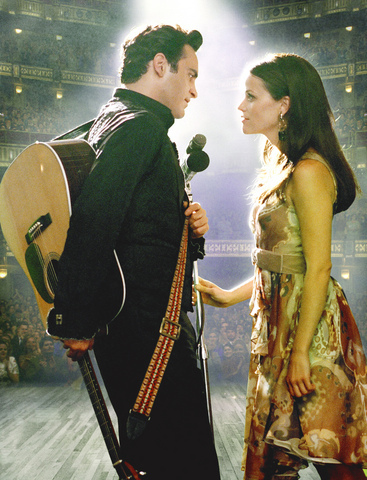
PHOTO: AP
There are, moreover, some striking biographical similarities between Johnny Cash and Ray Charles, both of whom worked with the filmmakers telling their stories, though neither lived to see the final product. Like Ray, Walk the Line tells the tale of a poor Southerner, born in the early years of the Great Depression, whose childhood was marked by the death of a beloved brother. Between the humble beginnings and the eventual immortality come events that seem almost interchangeable, more like stock situations than lived experiences. Vintage tour buses rumble down nighttime back roads. Drug habits are acquired -- heroin for Charles, prescription pills for Cash -- leading to trouble with the law and painful scenes of withdrawal. The houses and the record labels get bigger (Charles moved from Atlantic to ABC, Cash from Sun to Columbia), the groupies come and go, and the long-suffering wives and girlfriends occasionally burst into angry tears.
The crucial difference, and the main reason that Walk the Line proves to be the lesser film, lies in the way the movies deal with the music that is, after all, their reason for existing. Hackford structured his film around Ray Charles' creative life, inviting us to understand how he fused various elements of the American musical vernacular into a new and distinctive sound. While Johnny Cash achieved something comparable, Mangold's film offers more tribute than insight. As he leaves home for the Air Force, Johnny's mother (Shelby Lynne) presses her book of hymns into his hands, and before long we see him, while stationed in Germany, working on what will become Folsom Prison Blues. (Later, June Carter makes notes for Ring of Fire, though in the film's chronology she appears to be doing so several years after the song was first recorded.)
When Cash and his combo audition at Sun Records, Sam Phillips (Dallas Roberts) stops them in the middle of a pallid gospel tune and harangues Cash about the importance of honest, raw emotion, advice that elicits Folsom Prison Blues and a recording contract. The most popular version of this story is a lot punchier than what is on screen. "Go home and sin," Phillips is supposed to have said, "and then come back with a song I can sell."
A great many songs and recordings followed, of course, of a richness and variety that very few US artists have equaled. Cash's bottomless voice and the steady, churning rhythms stayed constant, but the sheer range of material is staggering: murder ballads, love songs, novelty numbers, pop covers, gospel standards, all sung with mean wit and heartbreaking sincerity.
There is no way a feature-length movie could do justice to such bounty, and Walk the Line settles for the minimum. The religious conviction and social conscience that informed some of Cash's most enduring songs are all but erased, as the picture dwells mainly on the most accessible, least provocative aspects of his musical legacy -- the early, rockabilly-tinged Sun sides, the early-1960's hits and, of course, the duets with June Carter, played by Reese Witherspoon.
Cash and Carter's long infatuation, tumultuous partnership and eventual marriage provide the film with an emotional core. Johnny's first wife, Vivian (Ginnifer Goodwin), aspires above all to middle-class normalcy and material comfort, and while the filmmakers try to show her some sympathy, she doesn't stand much of a chance next to June. Witherspoon's lively, smart performance suggests a mixture of warmth and brisk professionalism, qualities the actress and the singer clearly share. But most of June's own drama -- the collapse of her two marriages before she finally said yes to Johnny, the pressures of growing up in a show-business family -- takes place off screen, which makes the character feel a bit incomplete.
Then again, so does Johnny himself, in spite of Phoenix's sweating, quivery intensity. The premise of his performance seems to be that Cash, a shy, diffident, almost inarticulate fellow in daily life, found his rage, humor and charisma onstage, and Phoenix does a good job of conveying this transformation. Even though his singing voice doesn't match the original -- how could it? -- he is most convincing in concert, when his shoulders tighten and he cocks his head to one side. Otherwise, he seems stuck in the kind of off-the-rack psychological straitjacket in which Hollywood likes to confine troubled geniuses.
Johnny's father, Ray (Robert Patrick), is cold and critical, compounding the feelings of guilt and inadequacy that arose from the death of Johnny's older brother, Jack (Lucas Till), in a sawmill accident. But as is often true in narratives like this, the childhood hardships and psychological scars explain both too much and too little. Emoting plus music does not add up to art, and Phoenix's Johnny Cash, after more than two hours, remains stranded in the no man's land between cliche and enigma.
The decision to make new versions of Cash's songs rather than have the actors lip-sync over existing recordings (as Foxx did in Ray) was a risky one. The results are respectable, if rarely transporting. There are only two moments likely to raise goose bumps: Witherspoon singing the Carter Family staple Wildwood Flower, accompanying herself on autoharp, and Phoenix lurching into an out-of-control rendition of I Got Stripes that ends in drug-fueled collapse. Otherwise, you have to wait until the final credits to be reminded of what Johnny Cash and June Carter really sounded like. Their disembodied voices carry more presence, more humor and hurt, than anything in the movie itself, which honors them without quite capturing who they were.

In late October of 1873 the government of Japan decided against sending a military expedition to Korea to force that nation to open trade relations. Across the government supporters of the expedition resigned immediately. The spectacle of revolt by disaffected samurai began to loom over Japanese politics. In January of 1874 disaffected samurai attacked a senior minister in Tokyo. A month later, a group of pro-Korea expedition and anti-foreign elements from Saga prefecture in Kyushu revolted, driven in part by high food prices stemming from poor harvests. Their leader, according to Edward Drea’s classic Japan’s Imperial Army, was a samurai

The following three paragraphs are just some of what the local Chinese-language press is reporting on breathlessly and following every twist and turn with the eagerness of a soap opera fan. For many English-language readers, it probably comes across as incomprehensibly opaque, so bear with me briefly dear reader: To the surprise of many, former pop singer and Democratic Progressive Party (DPP) ex-lawmaker Yu Tien (余天) of the Taiwan Normal Country Promotion Association (TNCPA) at the last minute dropped out of the running for committee chair of the DPP’s New Taipei City chapter, paving the way for DPP legislator Su

Located down a sideroad in old Wanhua District (萬華區), Waley Art (水谷藝術) has an established reputation for curating some of the more provocative indie art exhibitions in Taipei. And this month is no exception. Beyond the innocuous facade of a shophouse, the full three stories of the gallery space (including the basement) have been taken over by photographs, installation videos and abstract images courtesy of two creatives who hail from the opposite ends of the earth, Taiwan’s Hsu Yi-ting (許懿婷) and Germany’s Benjamin Janzen. “In 2019, I had an art residency in Europe,” Hsu says. “I met Benjamin in the lobby

It’s hard to know where to begin with Mark Tovell’s Taiwan: Roads Above the Clouds. Having published a travelogue myself, as well as having contributed to several guidebooks, at first glance Tovell’s book appears to inhabit a middle ground — the kind of hard-to-sell nowheresville publishers detest. Leaf through the pages and you’ll find them suffuse with the purple prose best associated with travel literature: “When the sun is low on a warm, clear morning, and with the heat already rising, we stand at the riverside bike path leading south from Sanxia’s old cobble streets.” Hardly the stuff of your


 RSS
RSS