


In this centennial year of the great 1906 earthquake, San Francisco has tectonic shifts on the brain. Among the planned commemorations of the event are Symphony No. 1: The Earthquake, to be played by the Contra Costa Wind Symphony, an "Earthquake Walking Tour of San Francisco" by the Northern California Geological Society and a tour of campus retrofit projects at the University of California, Berkeley.
But the loopiest ode to the unpredictable layers beneath the city's surface may well be Earthquake -- a luminous, quivering rendering of the Twin Peaks neighborhood composed of nearly a thousand translucent Jell-O cubes.
Inspired by liquefaction, which causes water-saturated soil to flow like water, the work, created by Liz Hickok, a 32-year-old artist, combines two Bay Area obsessions: food and earthquakes.

PHOTO: NY TIMES NEWS SERVICE
Hickok's cityscape is the latest in her "San Francisco in Jell-O" series, which has also included likenesses of Telegraph Hill and City Hall. It was on display last week on a "shake table" at the Exploratorium, a popular museum of art and science.
Jiggling jewels of Jell-O substituted for the city's Victorian houses, while a Tupperware container filled with dry ice simulated fog.
Jell-O, explained the artist -- who was raised in Wilmington, Delaware, on her grandmother's lime-green Jell-O mold with maraschino cherries and whipped cream -- is an apt metaphor for San Francisco. "It makes us aware of the temporary nature of it all," Hickok said. "We're sitting on fragile ground."
Her one-night tableau was constructed by pouring Jell-O mix into molds and then carving the cubes to create roofs, doors and windows. The hilly topography, executed in gelatin, was adapted from a contour map procured from the city's public works department.
The mini city spent the night in pieces in a refrigerator. Hickok will reconstruct it at the museum on April 1 to kick off the month-long exhibit Magnitude X: Earthquake Science and Survival.
Wobbling ominously and exuding a fruity bouquet, the Jell-O city offered food for thought, said Eric Muller, one of the museum's science educators.
"Jell-O is the ideal resonant medium," Muller said, referring to the ability of structures to respond to vibration. "It's a cool way to bring up structural engineering issues and earthquake awareness."
The museum, fittingly perhaps, is in the Marina District, which had heavy structural damage because of lique-fying soil in the 1989 Loma Prieta earthquake.
Nick Cain, a 33-year-old writer, said that he found the display "strangely compelling."
"Like San Francisco," Cain said, "it's delicious but potentially unstable."
The city's capacity for cultural shifts and physical dislocation arguably makes Jell-O an ideal artistic medium. "I like making light of something scary," Hickok said. "It makes it easier to handle our fear."

In late October of 1873 the government of Japan decided against sending a military expedition to Korea to force that nation to open trade relations. Across the government supporters of the expedition resigned immediately. The spectacle of revolt by disaffected samurai began to loom over Japanese politics. In January of 1874 disaffected samurai attacked a senior minister in Tokyo. A month later, a group of pro-Korea expedition and anti-foreign elements from Saga prefecture in Kyushu revolted, driven in part by high food prices stemming from poor harvests. Their leader, according to Edward Drea’s classic Japan’s Imperial Army, was a samurai
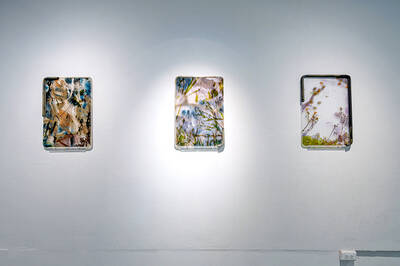
Located down a sideroad in old Wanhua District (萬華區), Waley Art (水谷藝術) has an established reputation for curating some of the more provocative indie art exhibitions in Taipei. And this month is no exception. Beyond the innocuous facade of a shophouse, the full three stories of the gallery space (including the basement) have been taken over by photographs, installation videos and abstract images courtesy of two creatives who hail from the opposite ends of the earth, Taiwan’s Hsu Yi-ting (許懿婷) and Germany’s Benjamin Janzen. “In 2019, I had an art residency in Europe,” Hsu says. “I met Benjamin in the lobby
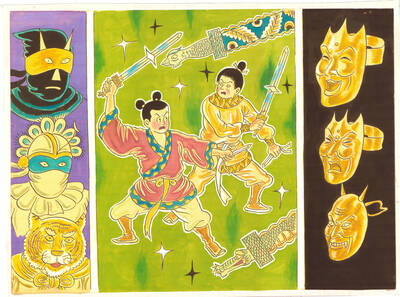
April 22 to April 28 The true identity of the mastermind behind the Demon Gang (魔鬼黨) was undoubtedly on the minds of countless schoolchildren in late 1958. In the days leading up to the big reveal, more than 10,000 guesses were sent to Ta Hwa Publishing Co (大華文化社) for a chance to win prizes. The smash success of the comic series Great Battle Against the Demon Gang (大戰魔鬼黨) came as a surprise to author Yeh Hung-chia (葉宏甲), who had long given up on his dream after being jailed for 10 months in 1947 over political cartoons. Protagonist

Peter Brighton was amazed when he found the giant jackfruit. He had been watching it grow on his farm in far north Queensland, and when it came time to pick it from the tree, it was so heavy it needed two people to do the job. “I was surprised when we cut it off and felt how heavy it was,” he says. “I grabbed it and my wife cut it — couldn’t do it by myself, it took two of us.” Weighing in at 45 kilograms, it is the heaviest jackfruit that Brighton has ever grown on his tropical fruit farm, located


 RSS
RSS