


It's fight night at Rajadamnoen kickboxing stadium in downtown Bangkok, but if promoter Pariyakorn Ratanasuban's fighters win, she won't be able to climb into the ring to present them with the winner's belts.
"Because of Thai traditions, people still think that women should not do sport like this," the 25-year-old explains in a boardroom near the ring, where women are barred from entering when men compete.
"Some people think that women should be in the house to be housewives, not doing strong sports like this."
For the last two years, Pariyakorn has run muay Thai fights, as this brand of kickboxing is called in Thailand, and muay ying, the women's version.
Although the fights are usually on the same bill, the men fight first. Women are allowed into the arena to watch, but they are forbidden to enter the ring of two main stadiums in Bangkok.
Ultimately Pariyakorn wants to shake-up the system so that women can make careers from one of the country's biggest sports, both as fighters and as promoters.
If anyone has the credentials to transform one of the most macho parts of Thai society, Pariyakorn does.
She was born into a muay Thai dynasty as the daughter of Songchai Ratanasuban -- Thailand's answer to Don King -- who has dominated the sport for 27 years.
Sport savvy
But she also brings the marketing and media savvy of modern corporate Thailand to a sport steeped in the country's ancient traditions.
Before joining the family business, Pariyakorn received a bachelor's degree in social administration. Then she took a job as an account executive with Thai petrochemical giant PTT, because she wanted to learn how major companies worked so she could apply those methods to her business.
She then studied at night for a master's in general administration.
Those lessons led her to computerize the business, creating a database of the more than 5,000 fighters nationwide Pariyakorn represents, and improving the company's Web site.
She also expanded video sales of famous fights. The company now ships some 8,000 video compact discs a month, mostly overseas to France and Australia. DVDs are planned from February.
Her father still heads the company, although in practice she runs about 80 percent of the business while her mother Saowanee does the accounting and her brother Siraphop handles the international side.
Yet all her talent has not been enough to overcome media and sponsor skepticism over whether women belong inside boxing rings. Men's sports like football and golf dominate Thai media, with some coverage of women's golf and tennis.
Women's fight
Some of the roughly 1,000 female boxers represented by the OneSongchai company have appeared on television as talk show guests and helped increase the sport's exposure, but not as fighters during prime time slots.
"We have on occasions carried items on women's kick-boxing, but more for novelty value than anything else," Bangkok Post sports editor Roger Crutchley says.
Pariyakorn says she meets similar reluctance from sponsors, who aren't sure who would watch muay ying.
"I also would like to give a chance to female boxers," she says.
Muay Thai is frequently a route out of poverty for male fighters, many of whom leave their impoverished villages for Bangkok, where they earn at least 10,000 baht (about US$250) per fight -- more than the average monthly salary back home.
Male boxers start out about eight years of age and their career lasts an average 20 years, fighting about five or six times a year. National men's champions can earn at least US$765 a fight.
For women, the stakes are much lower: The total prize money for the inaugural Queen's Cup women's tournament in 2004 was US$250. They fight an average of just three times a year.
Pariyakorn believes women fighters should be able to find a career in the ring that would help support their families back home.
She hopes to begin that change with a new series of women's fights to be held every three months, starting with a tournament next month to coincide with International Women's Day on March 8, which she hopes will be broadcast on cable television.
But tonight she is working with men, in another one of the crowded, messy and smelly stadiums where it feels like she has spent her whole life.
She's used to the pungent smells of oils and creams applied to warm up muscles.
"Women don't like the smell and it stains shirts," she says from inside a locker room, showing her company's new brand of herbal oil she hopes women fighters will take to using.
In muay Thai, each fight lasts around 25 minutes, broken into five rounds of three minutes each,
followed by two-minute breaks, when fighters return to their corners to sit on small stools inside large metal trays.
These catch their sweat, spit and water as their managers pour drink bottles over their heads and rinse their mouth guards.
When the fight is over, Pariyakorn's father will present the prizes to winners.
Even though she's not allowed in the ring, she walks purposefully through the stadium amid the commotion as young fighters are rubbed down, their hands taped by trainers and gloves forced on.
She disappears into crowds of Thais and puzzled foreign tourists who clutch tickets and stand at attention as the royal anthem plays.
Then two boys spring into the ring, perform traditional bowing rituals, and ready for the first bout of the night.

Last week Joseph Nye, the well-known China scholar, wrote on the Australian Strategic Policy Institute’s website about how war over Taiwan might be averted. He noted that years ago he was on a team that met with then-president Chen Shui-bian (陳水扁), “whose previous ‘unofficial’ visit to the US had caused a crisis in which China fired missiles into the sea and the US deployed carriers off the coast of Taiwan.” Yes, that’s right, mighty Chen caused that crisis all by himself. Neither the US nor the People’s Republic of China (PRC) exercised any agency. Nye then nostalgically invoked the comical specter

Relations between Taiwan and the Czech Republic have flourished in recent years. However, not everyone is pleased about the growing friendship between the two countries. Last month, an incident involving a Chinese diplomat tailing the car of vice president-elect Hsiao Bi-khim (蕭美琴) in Prague, drew public attention to the People’s Republic of China’s (PRC) operations to undermine Taiwan overseas. The trip was not Hsiao’s first visit to the Central European country. It was meant to be low-key, a chance to meet with local academics and politicians, until her police escort noticed a car was tailing her through the Czech capital. The
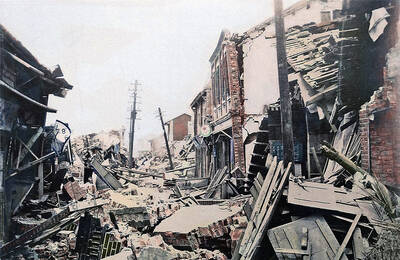
April 15 to April 21 Yang Kui (楊逵) was horrified as he drove past trucks, oxcarts and trolleys loaded with coffins on his way to Tuntzechiao (屯子腳), which he heard had been completely destroyed. The friend he came to check on was safe, but most residents were suffering in the town hit the hardest by the 7.1-magnitude Hsinchu-Taichung Earthquake on April 21, 1935. It remains the deadliest in Taiwan’s recorded history, claiming around 3,300 lives and injuring nearly 12,000. The disaster completely flattened roughly 18,000 houses and damaged countless more. The social activist and

Over the course of former President Ma Ying-jeou’s (馬英九) 11-day trip to China that included a meeting with Chinese Communist Party (CCP) leader Xi Jinping (習近平) a surprising number of people commented that the former president was now “irrelevant.” Upon reflection, it became apparent that these comments were coming from pro-Taiwan, pan-green supporters and they were expressing what they hoped was the case, rather than the reality. Ma’s ideology is so pro-China (read: deep blue) and controversial that many in his own Chinese Nationalist Party (KMT) hope he retires quickly, or at least refrains from speaking on some subjects. Regardless


 RSS
RSS