


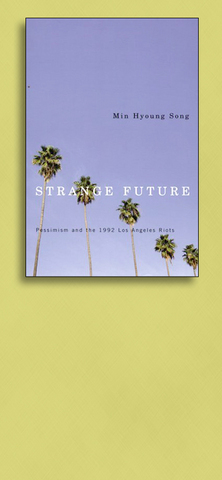
This book looks at the 1992 riots in Los Angeles in which Korean businesses were frequently the targets of angry crowds, many of them consisting of African-Americans incensed by the "not guilty" verdict on the police officers filmed the previous year beating Rodney King (who had himself attempted to rob a Korean-owned store).
Korean immigration to the US increased dramatically following the passing of the Hart-Celler Immigration and Nationality Act in 1965. This abolished earlier laws that had restricted immigration by criteria of race and ethnicity, establishing instead generous quotas for Eastern Hemisphere countries (20,000 persons annually per country). In addition, new arrivals with family members already in the US could immigrate independently of these quotas. Special preference was also given to potential immigrants with needed skills.
Korean immigration peaked between 1985 and 1987, with some 35,000 individuals arriving annually. Many were able to claim family relation to brides of US servicemen who fought in the Korean War, or others who had come to the US as college students. Korea quickly became the third largest sender nation after Mexico and the Philippines.
A significant proportion of these immigrants settled in largely black inner-city neighborhoods, opening small businesses, frequently stores selling, among other things, alcohol. These in their turn became the targets of late-night robbers, and characteristically installed iron bars round the cash desks as a precaution against such assaults.
It's an interesting question as to whether the hostility that built up against these newly-arrived Korean store-owners was one of an often unemployed urban proletariat against hard-working small-scale entrepreneurs (who were enviously said to have mysterious access to capital from back home), or whether it was simply a matter of locations where money was stored inevitably attracting assailants.
The popular image, fostered by some sections of the press, of unemployed blacks and self-employed Asians was clearly an over-simplification at best, and a racist slur at worst. Even so, the fact of Korean diligence (plus a quickly noted success at college level, especially in the sciences, as was the case with so many other East Asian immigrants) led to an upwardly-mobile social group of relatively recent arrivals. With that new wealth derived, so it appeared, from deprived inner-city areas, fuel for resentment was there almost from the start.
Strange Future considers a variety of cultural products that reflect those troubled times. One is the much-praised novel Native Speaker by the Korean-American writer Lee Chang-rae. Lee was only 29 when this debut work came out in 1995 (incidentally the 50th anniversary of Korean independence from Japanese rule). His subsequent novel, A Gesture Life, a sensitive and sophisticated treatment of the subject of Korean "comfort women" during World War II, was reviewed in Taipei Times on Jan. 14, 2001.
Another item discussed is Dai Sil Kim-Gibson's Sa-I-Gu: From Korean Women's Perspective, a 1993 documentary that interviewed many Korean immigrant women dispossessed by the riots. In this chapter the important fact emerges that only 10 percent of Korean- American merchants in Los Angeles at the time served primarily African American customers.
Next comes the commercial film Strange Days, from which this book clearly derives its title. This film was prompted by the Rodney King beating (which left him with a shattered eye-socket, a fractured cheek-bone and a broken leg). It controversially contains a scene in which a serial-killer rapes a victim who has been wired up so that she experiences her rapist's emotions rather than her own during the assault.
The author also considers Twilight: Los Angeles, a one-women play written and performed by Anna Deavere Smith. Smith interviewed over 200 people involved in the 1992 riots and progressively incorporated material thus garnered into her play in successive performances, culminating in a series at New York's Public Theater in 1994. She herself acted the roles of all her selected interviewees.
Although Strange Future is an academic work, it suffers less than most others in its category from a self-referring, jargon-laden style. It's clearly written, and openly considers the author's own position as a Korean-American as part of the overall analysis. This accessibility is all the more important considering the author's claim that the academic critical approach should be defended against a populism that decries all written products that "anyone" cannot understand.
The book has to have some over-riding themes nonetheless. The main one is the idea of decline -- that the US is no longer the happy place it was even a generation ago. As for the Los Angeles locations where the 1992 violence took place, they are today still only half-alive, characterized by "burned-out empty lots enclosed by metal fences ... hardly anyone walking outside ... no shade because the trees have been chopped down ... grass ... where the buildings once stood."
At one point Song Min-hyoung states what could be his position -- though he calls it "one strategy" -- in a passage of startling directness.
"Do we have an ethical responsibility to address the wrongs we find in our adopted workplaces?" he asks. Korean Americans are in this analysis "... racial scapegoats, innocents who have come from elsewhere and have, through no fault of our own, found ourselves caught between age-old rivalries." (Here he refers to Korean immigrants as substitute whites in a black-white antagonism). "We position ourselves as claimants to an American dream that promises upward mobility through hard work, the proper enthusiasm, and a high regard for the law ... But when a crisis strikes, as it did in 1992, we find that the state upon which we have pegged our claims ... is not interested in coming to our aid."
Living in hard-working Taiwan, it's hard not to sympathize with that.
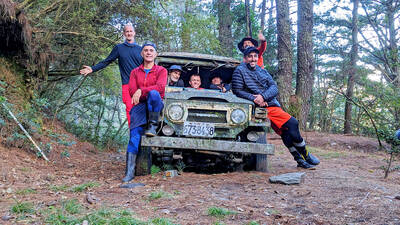
The year was 1991. A Toyota Land Cruiser set out on a 67km journey up the Junda Forest Road (郡大林道) toward an old loggers’ camp, at which point the hikers inside would get out and begin their ascent of Jade Mountain (玉山). Little did they know, they would be the last group of hikers to ever enjoy this shortcut into the mountains. An approaching typhoon soon wiped out the road behind them, trapping the vehicle on the mountain and forever changing the approach to Jade Mountain. THE CONTEMPORARY ROUTE Nowadays, the approach to Jade Mountain from the north side takes an
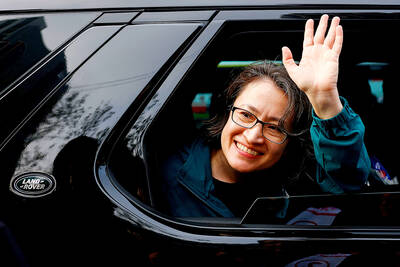
Relations between Taiwan and the Czech Republic have flourished in recent years. However, not everyone is pleased about the growing friendship between the two countries. Last month, an incident involving a Chinese diplomat tailing the car of vice president-elect Hsiao Bi-khim (蕭美琴) in Prague, drew public attention to the People’s Republic of China’s (PRC) operations to undermine Taiwan overseas. The trip was not Hsiao’s first visit to the Central European country. It was meant to be low-key, a chance to meet with local academics and politicians, until her police escort noticed a car was tailing her through the Czech capital. The

Last week Joseph Nye, the well-known China scholar, wrote on the Australian Strategic Policy Institute’s website about how war over Taiwan might be averted. He noted that years ago he was on a team that met with then-president Chen Shui-bian (陳水扁), “whose previous ‘unofficial’ visit to the US had caused a crisis in which China fired missiles into the sea and the US deployed carriers off the coast of Taiwan.” Yes, that’s right, mighty Chen caused that crisis all by himself. Neither the US nor the People’s Republic of China (PRC) exercised any agency. Nye then nostalgically invoked the comical specter
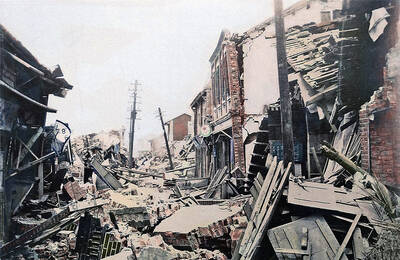
April 15 to April 21 Yang Kui (楊逵) was horrified as he drove past trucks, oxcarts and trolleys loaded with coffins on his way to Tuntzechiao (屯子腳), which he heard had been completely destroyed. The friend he came to check on was safe, but most residents were suffering in the town hit the hardest by the 7.1-magnitude Hsinchu-Taichung Earthquake on April 21, 1935. It remains the deadliest in Taiwan’s recorded history, claiming around 3,300 lives and injuring nearly 12,000. The disaster completely flattened roughly 18,000 houses and damaged countless more. The social activist and


 RSS
RSS