


With a motion no more forceful than my 9m cast on a trout stream, Ed Jaworowski, the fly-casting theorist and recently retired Latin professor, let fly 30.5m of fly line. The secret, or at least part of the secret, to his surprisingly effortless achievement lay in his mastery of the precise timing and coordination required for fly-fishing's long-distance cast: the double haul.
In modern fly-fishing -- especially on salt water, where longer casts are the norm -- the double haul is a requirement for successful angling. Though necessary, it is little understood, which is why I arranged to meet with Jaworowski, whose book, The Cast, elegantly sets forth the theory and practice (lots and lots of practice) of the fly-cast.
On a frigid gray morning, I met Jaworowski at Betty and Nick's Bait and Tackle in Seaside Park, New Jersey. It is one of those places dear to all anglers where one can buy every necessity, whether a dozen bloodworms, a 23cm Rapala lure, lead sinkers or a breakfast of eggs, bacon, home fries and toast. A phalanx of four-wheel-drive vehicles, bristling with rod racks and fish coolers, filled nearly every parking spot.
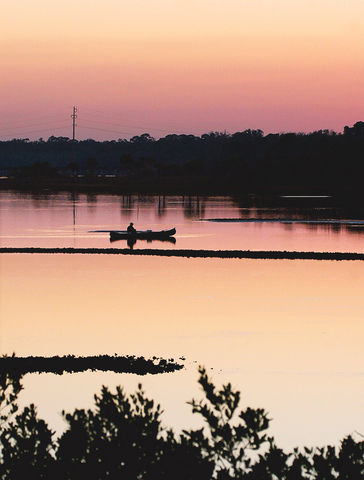
PHOTO: AP
Inside, the steam from hot coffee and conversation fogged the windows. The clatter of breakfast dishes filled the air, as did the conversation of a few dozen flannel-shirted fishermen who saw no reason to leave the warmth of their hangout absent a promising fishing report.
Jaworowski sat at a booth explaining the double haul to a rapt audience. He drew a diagram on a paper napkin. It depicted the motion of a rod as it flexes and springs forward to deliver the fly. I was struck by how much it resembled a rudimentary drawing that Sandy Koufax had sketched to illustrate proper form in delivering a pitch. In both cases, the principles of the lever and catapult come into play: the objective being maximum force with minimum expenditure of energy.
But one cannot learn to throw or cast simply from studying a drawing on a napkin. To perfect the double haul, one must pick up rod and reel, which is what we did next on the protected lee shore of Seaside Park.
The first thing one notices about Jaworowski's casting motion is how little there is to it. With the lightest of grips on the rod and a motion that looked more like a symphony conductor's lilting gesture than the full windup and extension that most of us use to get distance, Jaworowski took one false cast and shot the whole line.
"There is no such thing as one single `right cast,'" he said. "Whatever your style, though, the key is acceleration: a gentle speed-up and a quick stop. It is all a question of physics: using speed and the lever action of the line to load the rod by deepening the bend."
To grasp his point, imagine bending a willow switch and then releasing it. Bend the switch more and it springs back with even greater force and speed.
Jaworowski and I waded waist deep in the water. "The double haul is not a magic bullet that makes a bad cast good, but it can make a good cast better," he said. "Before you even attempt it, you must refine your short cast. For most people, the benefit of this is that it will cut your effort in half or more."
He directed me to cast to some pilings about 15m away. I felt the line slap against the reel, which, to me, evidenced a good cast.
"That slap," he said, "is an indication that you have applied more energy to the cast than is required. Try it again. Only this time, use less force."
After a few tries, each time dialing back my effort, I found that I could reach the piling with much less force.
"Now you are ready for the double haul," Jaworowski said as he demonstrated. "With your line hand, you add in a fast crisp pull as you begin your back cast and then pull once again on the forward cast. The goal is acceleration and then a sudden stop. While the motion of your rod hand serves to flex the rod, pulling down on the line with your other hand puts pressure on the rod tip and bends it even more."
With the thumb and forefinger of his line hand pressed together and his pinkie raised, Jaworowski released a thrillingly long cast. In seeming defiance of gravity, the coiled line flew through the guides. And it was all done with a relaxed and easy motion. "If you are doing it right, you should never need more than one false cast," he added.
I parroted his motion and, sure enough, less was more. My style is similar to Jaworowski's -- I favor a three-quarter motion rather than coming over the top, which is the traditional but mechanically less efficient method of fly-casting.
For any experienced caster, the difficulty is not learning to haul. Rather, it is learning economy of force. A lot of histrionic straining and gymnastics only means that you are wasting motion and energy in a misapplication of physics, and, as Jaworowski might have put it to his students at Villanova, Omnino physicus iactus muscarius -- or, "All fly-casting is physics."
Fishy facts
* The best time for fishing in Taiwan is from November to March
* Common varieties of fish include the drummer, the bream and the whitespotted rabbitfish
* Boat fishing and trolling are popular
* Spring and summer are most suitable for beach fishing for small fish such as spotted sandborers and thornfish
* Most large fresh water fish, like the Formosan Salmon, are endangered species
* Some reservoirs and large lakes have fish, even large fish
* Many fishing enthusiasts visit the offshore islands that have abundant clean waters and excellent fishing spots
* FreshTreks (www.freshtreks.com) organizes deep sea boating trips
Sources: Fisheries Agency, Council of Agriculture and Tourism Bureau
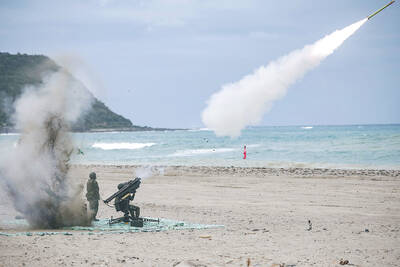
In late October of 1873 the government of Japan decided against sending a military expedition to Korea to force that nation to open trade relations. Across the government supporters of the expedition resigned immediately. The spectacle of revolt by disaffected samurai began to loom over Japanese politics. In January of 1874 disaffected samurai attacked a senior minister in Tokyo. A month later, a group of pro-Korea expedition and anti-foreign elements from Saga prefecture in Kyushu revolted, driven in part by high food prices stemming from poor harvests. Their leader, according to Edward Drea’s classic Japan’s Imperial Army, was a samurai
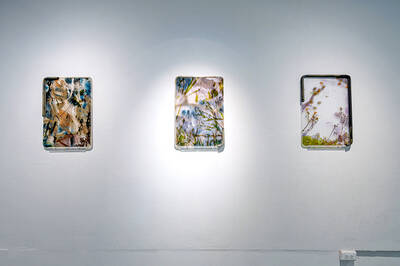
Located down a sideroad in old Wanhua District (萬華區), Waley Art (水谷藝術) has an established reputation for curating some of the more provocative indie art exhibitions in Taipei. And this month is no exception. Beyond the innocuous facade of a shophouse, the full three stories of the gallery space (including the basement) have been taken over by photographs, installation videos and abstract images courtesy of two creatives who hail from the opposite ends of the earth, Taiwan’s Hsu Yi-ting (許懿婷) and Germany’s Benjamin Janzen. “In 2019, I had an art residency in Europe,” Hsu says. “I met Benjamin in the lobby

April 22 to April 28 The true identity of the mastermind behind the Demon Gang (魔鬼黨) was undoubtedly on the minds of countless schoolchildren in late 1958. In the days leading up to the big reveal, more than 10,000 guesses were sent to Ta Hwa Publishing Co (大華文化社) for a chance to win prizes. The smash success of the comic series Great Battle Against the Demon Gang (大戰魔鬼黨) came as a surprise to author Yeh Hung-chia (葉宏甲), who had long given up on his dream after being jailed for 10 months in 1947 over political cartoons. Protagonist

A fossil jawbone found by a British girl and her father on a beach in Somerset, England belongs to a gigantic marine reptile dating to 202 million years ago that appears to have been among the largest animals ever on Earth. Researchers said on Wednesday the bone, called a surangular, was from a type of ocean-going reptile called an ichthyosaur. Based on its dimensions compared to the same bone in closely related ichthyosaurs, the researchers estimated that the Triassic Period creature, which they named Ichthyotitan severnensis, was between 22-26 meters long. That would make it perhaps the largest-known marine reptile and would


 RSS
RSS