


The lonesome chill that seeps through Ang Lee's (
One night, when their campfire dies, and the biting cold drives them to huddle together in a bedroll, a sudden spark between Ennis Del Mar (Heath Ledger) and Jack Twist (Jake Gyllenhaal) flares into an undying flame.
The same mood of acute desolation permeates the spare, gnarly prose of Annie Proulx's short story, first published in The New Yorker in 1997, adapted by Larry McMurtry and Diana Ossana. McMurtry knows about loneliness. Its ache suffused his novel and his screenplay for The Last Picture Show, made into a film 34 years ago by Peter Bogdanovich.
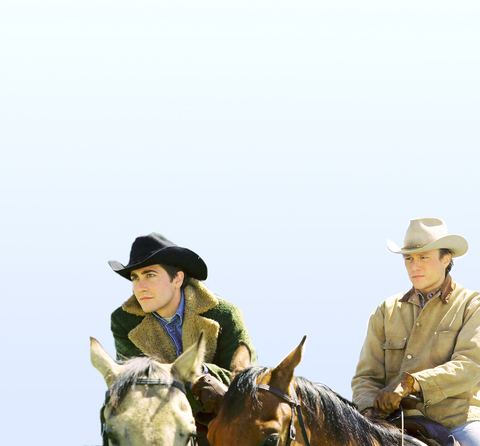
The sexual bouts between these two ranch hands who have never heard the term gay (in 1963, when the story begins, it was still a code word transiting into the mainstream) are described by Proulx as "quick, rough, laughing and snorting."
That's exactly how Lee films their first sexual grappling (discreetly) in the shadows of the cramped little tent. The next morning, Ennis mumbles, "I'm no queer." And Jack replies, "Me neither." Still, they do it again, and again, in the daylight as well as at night. Sometimes their pent-up passions explode in ferocious roughhouse that is indistinguishable from fighting.
This moving and majestic film would be a landmark if only because it is the first Hollywood movie to unmask the homoerotic strain in American culture that Leslie Fiedler discerned in his notorious 1948 Partisan Review essay, Come Back to the Raft Ag'in, Huck Honey. Fiedler characterized the bond between Huckle-berry Finn and Jim, a runaway slave, as an unconscious romantic attachment shared by two males of different races as they flee the more

PHOTO: CHEN YI-CHUAN, TAIPEI TIMES
constraining and civilizing domain of women. He went on to identify that bond as a recurrent theme in American literature.
In popular culture, Fiedler's Freudianism certainly could be applied to the Lone Ranger and Tonto. Minus the ethnic division, it might also be widened to include a long line of westerns and buddy movies, from Red River to Midnight Cowboy to Butch Cassidy and the Sundance Kid: the pure male bonding that dare not explore its shadow side.
Ennis and Jack's 20-year romance begins when they are hired in the summer of 1963 by Joe Aguirre (Randy Quaid), a hard-boiled rancher, to work as sheepherders on Brokeback Mountain in the Wyoming high country. (The movie was filmed in Alberta, in the Canadian Rockies.) Subsisting mostly on canned beans and whiskey, the two cowboys develop a boozy friendship by the campfire.
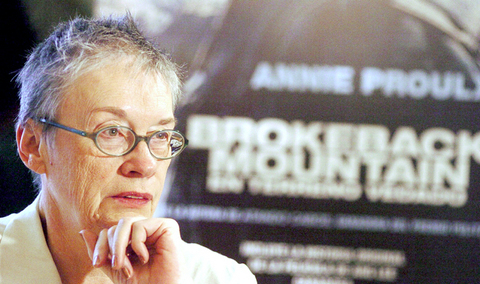
PHOTO: EPA
So taciturn and bottled up that he swallows his syllables as he pulls words out of his mouth in gruff, reluctant grunts, Ennis tells Jack of being raised by a brother and sister after his parents died in a car crash. Jack, brought up in the rodeo, is more talkative and recalls his lifelong alienation from his father, a bull rider.
When signs of an early blizzard cut short their summer employment, Ennis and Jack go their separate ways. Ennis' farewell is a simple "See you around." Both, though, are torn up. Ennis marries his girlfriend, Alma (Michelle Williams), and they have two daughters. Jack meets and marries Lureen (Anne Hathaway), a Texan rodeo queen, with whom he has a son, and joins her father's farm-equipment business.
Four years pass before Jack, who is living in Texas, sends a general-delivery postcard to Ennis, who has settled in Wyoming, saying he will be in the area and would like to visit. The instant they set eyes on each other, their suspended passion erupts into a spontan-eous clinch. Alma sees it all, and her face, from that moment on, remains frozen in misery. The reunited lovers rush to a motel.
So begins a sporadic and tormented affair in which the two meet once or twice a year for fishing trips on which no fish are caught. Jack urges that they forsake their marriages and set up a ranch together. But Ennis, haunted by a childhood memory of his father taking him to see the mutilated body of a rancher,
tortured and beaten to death with a tire iron for living with another man, is immobilized by fear and shame.
Both Ledger and Gyllenhaal make this anguished love story physically palpable. Ledger magically and mysteriously disappears beneath the skin of his lean, sinewy character. It is a great screen performance, as good as the best of Marlon Brando and Sean Penn. The pain and disappointment felt by Jack, who is softer, more self-aware and self-accepting, continually registers in Gyllenhaal's sad, expectant silver-dollar eyes.
The second half of the movie opens up Proulx's story to follow both men's slowly crumbling marriages. For years, Alma chokes on her pain until one day, after she and Ennis have divorced, it rises up as if she were strangling on her own bile. As Jack, desperately frustrated, has clandestine encounters with other men, Hathaway's Lureen slowly calcifies into a clenched robotic shell of her peppery younger self.
Brokeback Mountain is not quite the period piece that some would like to imagine. America's squeaky closet doors may have swung open far enough for a gay rodeo circuit to flourish. But let's not kid ourselves. In large segments of American society, especially in sports and the military, those doors remain sealed. The murder of Matthew Shepard, after all, took place in Brokeback territory. Another recent film, Jarhead (in which Gyllenhaal plays a marine), suggests how any kind of male behavior perceived as soft and feminine within certain closed male environments triggers abuse and violence and how that repression of sexual energy is directly channeled into warfare.
Yet Brokeback Mountain is ultimately not about sex (there is very little of it in the film) but about love: love stumbled into, love thwarted, love held sorrowfully in the heart.
Or, as Proulx writes, "What Jack remembered and craved in a way he could neither help nor understand was the time that distant summer on Brokeback when Ennis had come up behind him and pulled him close, the silent embrace satisfying some shared and sexless hunger."
One tender moment's reprieve from loneliness can illuminate a life.

Last week Joseph Nye, the well-known China scholar, wrote on the Australian Strategic Policy Institute’s website about how war over Taiwan might be averted. He noted that years ago he was on a team that met with then-president Chen Shui-bian (陳水扁), “whose previous ‘unofficial’ visit to the US had caused a crisis in which China fired missiles into the sea and the US deployed carriers off the coast of Taiwan.” Yes, that’s right, mighty Chen caused that crisis all by himself. Neither the US nor the People’s Republic of China (PRC) exercised any agency. Nye then nostalgically invoked the comical specter

April 15 to April 21 Yang Kui (楊逵) was horrified as he drove past trucks, oxcarts and trolleys loaded with coffins on his way to Tuntzechiao (屯子腳), which he heard had been completely destroyed. The friend he came to check on was safe, but most residents were suffering in the town hit the hardest by the 7.1-magnitude Hsinchu-Taichung Earthquake on April 21, 1935. It remains the deadliest in Taiwan’s recorded history, claiming around 3,300 lives and injuring nearly 12,000. The disaster completely flattened roughly 18,000 houses and damaged countless more. The social activist and

Over the course of former President Ma Ying-jeou’s (馬英九) 11-day trip to China that included a meeting with Chinese Communist Party (CCP) leader Xi Jinping (習近平) a surprising number of people commented that the former president was now “irrelevant.” Upon reflection, it became apparent that these comments were coming from pro-Taiwan, pan-green supporters and they were expressing what they hoped was the case, rather than the reality. Ma’s ideology is so pro-China (read: deep blue) and controversial that many in his own Chinese Nationalist Party (KMT) hope he retires quickly, or at least refrains from speaking on some subjects. Regardless

Approaching her mid-30s, Xiong Yidan reckons that most of her friends are on to their second or even third babies. But Xiong has more than a dozen. There is Lucky, the street dog from Bangkok who jumped into a taxi with her and never left. There is Sophie and Ben, sibling geese, who honk from morning to night. Boop and Pan, both goats, are romantically involved. Dumpling the hedgehog enjoys a belly rub from time to time. The list goes on. Xiong nurtures her brood from her 8,000 square meter farm in Chiang Dao, a mountainous district in northern Thailand’s


 RSS
RSS