


While Japan's music industry has long been more progressive than Taiwan's in regard embracing different forms and styles of music, the music of Japan's indigenous people has largely been ignored.
Japanese musician Oki aims to change all this. With half a dozen albums and appearances at several world music festivals, including Womad, under his belt, his revamped and hybrid tonkori-driven Ainu music has recently been made available in Taiwan.
Released last week, Here Comes the Bear is a compilation album featuring a mixed bag of old and new material.

PHOTO: GAVIN PHIPPS, TAIPEI TIMES
"We'd been talking about releasing an album here for several years, but we never really knew how audiences in Taiwan would take to it," he says. "A couple of other Japanese folk artists have enjoyed a modicum of success here recently and although their music is different, TCM [Taiwan Colors Music, a local record company] figured that local audiences are now in a better position to appreciate my music."
Over the past decade Oki has released tonkori music by appearing on what he calls "shit 7-Eleven music albums."
It was his collaborations with Native American flutist R Carlos Nakai, Australian Aboriginal combo Waak Waak Jungi and East Timorese poet Abe Barreto Soares, however, that brought him to the attention of world music fans around the globe.
"It's always good to be introduced to new musicians who are open to the idea of collaborating on projects. The album has only just been released so it's early days still, but I hope that it will open new doors to me in Taiwan, where indigenous music is an accepted and important part of the general music scene."
Born to a Japanese mother and an Ainu father, Oki didn't pay much attention to his cultural heritage until he returned to Japan in 1992 after a five-year stint living and working in New York.
"I knew my father was of the Ainu tribe, but living in cities both at home and abroad I really had no cultural identity. Whether I was in New York or Tokyo I was simply another Japanese," he says.
Indigenous to Hokkaido, the northern part of Honshu, the Kuril Islands, much of Sakhalin and the southern tip of the Kamchatka peninsula, the Ainu were once known as Japan's "noble savages."
The Japanese government began assimilating the Ainu into mainstream Japanese society during the Meiji Restoration Period (1868 to 1912), which was aimed at "unifying the Japanese national character under the auspices of the Emperor."
"The Ainu were forced to hide their identity. We were persecuted and treated like second class citizens," Oki says. "We'd lost nearly every vestige of our cultural identity and the use of our native language had all but died out."
Having suffered almost a century of discrimination the Japanese government joined forces with Ainu elders 10 years ago in the hope of revitalizing and promoting Ainu culture and heritage.
"Obviously the government can't give us back our homeland because [Sakhalin] was ceded to [the Soviet Union] after World War II," Oki says. "It's certainly not going to cause an international incident and demand that Russia return the island simply to give the small number of Ainu who have survived a place to live."
While no actual figures exist, it is estimated that today there are roughly 150,000 Ainu living in Japan and they are concentrated mainly on the southern and eastern coasts of the island of Hokkaido.
After a brief stay in Tokyo, where he worked as a movie special effects artist Oki moved to Hokkaido and began to study the music, culture and heritage of his father's tribe. Due to the Japanese government's assimi-lation programs Oki discovered that only a handful of recordings existed of traditional Ainu music.
"Recordings were made of Ainu music 40 years ago, but the quality was pretty bad and finding people who actually had first-hand knowledge of the music was difficult," he says. "I visited the elders and learned about the history of the tonkori, and forms of Ainu music. It a long process as with the exception of the 40-year-old recordings nothing existed on tape."
Styles of Ainu music have traditionally revolved around the yukar, which is a form of epic poetry and the upopo, which is a vocalized form of contrapuntal, or polyphonic music based around chanting. In addition to vocalized harmonies the Ainu have relied on only two instruments -- the bamboo Jew's harp known as the mukkuri and the tonkori.
Developed by the Ainu who lived on the northern part of Sakhalin, the tonkori is the only stringed Ainu instrument. Although Oki now uses a tonkori manufactured out of Canadian spruce, the instrument was customarily made of pine. Long and flat the tonkori can produce a myriad of haunting tones due to the narrow area in which the tones are forced to reverberate.
"When I first picked [a tonkori] up I didn't really know what to make of it. It was hard to get a tune out of it and I had to spend hours listening to old records in order to get a feel for what it and I were capable of doing," Oki says.
Within four years Oki had managed to master the odd-looking instrument and teamed up with renowned Ainu mukkuri and upopo performer Umeko Ando to release an album. Some of the material hadn't been heard in public for over 50 years.
The material on Oki's debut Taiwan album contains traditional tonkori tunes and other world music.

In late October of 1873 the government of Japan decided against sending a military expedition to Korea to force that nation to open trade relations. Across the government supporters of the expedition resigned immediately. The spectacle of revolt by disaffected samurai began to loom over Japanese politics. In January of 1874 disaffected samurai attacked a senior minister in Tokyo. A month later, a group of pro-Korea expedition and anti-foreign elements from Saga prefecture in Kyushu revolted, driven in part by high food prices stemming from poor harvests. Their leader, according to Edward Drea’s classic Japan’s Imperial Army, was a samurai
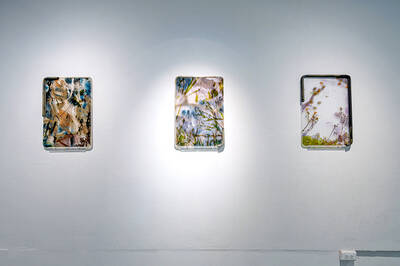
Located down a sideroad in old Wanhua District (萬華區), Waley Art (水谷藝術) has an established reputation for curating some of the more provocative indie art exhibitions in Taipei. And this month is no exception. Beyond the innocuous facade of a shophouse, the full three stories of the gallery space (including the basement) have been taken over by photographs, installation videos and abstract images courtesy of two creatives who hail from the opposite ends of the earth, Taiwan’s Hsu Yi-ting (許懿婷) and Germany’s Benjamin Janzen. “In 2019, I had an art residency in Europe,” Hsu says. “I met Benjamin in the lobby
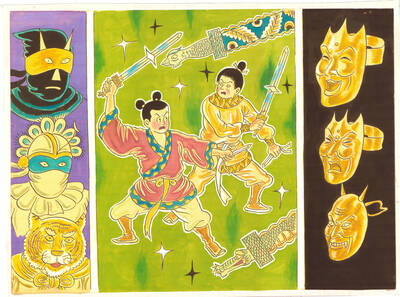
April 22 to April 28 The true identity of the mastermind behind the Demon Gang (魔鬼黨) was undoubtedly on the minds of countless schoolchildren in late 1958. In the days leading up to the big reveal, more than 10,000 guesses were sent to Ta Hwa Publishing Co (大華文化社) for a chance to win prizes. The smash success of the comic series Great Battle Against the Demon Gang (大戰魔鬼黨) came as a surprise to author Yeh Hung-chia (葉宏甲), who had long given up on his dream after being jailed for 10 months in 1947 over political cartoons. Protagonist

Peter Brighton was amazed when he found the giant jackfruit. He had been watching it grow on his farm in far north Queensland, and when it came time to pick it from the tree, it was so heavy it needed two people to do the job. “I was surprised when we cut it off and felt how heavy it was,” he says. “I grabbed it and my wife cut it — couldn’t do it by myself, it took two of us.” Weighing in at 45 kilograms, it is the heaviest jackfruit that Brighton has ever grown on his tropical fruit farm, located


 RSS
RSS