


In many quarters these days, Siegfried Sassoon is best known as one of the principals in Pat Barker's exceptional 1992 novel, Regeneration, about the real-life Sassoon's treatment for shell shock while at Craiglockhart -- or "Dottyville," as Sassoon called it -- a Scottish sanitarium where he had been sent in 1917 after denouncing British participation in World War I and refusing to return to the front.
Sassoon was remanded to Dottyville because it would have been too embarrassing to court-martial him: He was a decorated war hero and a best-selling poet, one of that talented generation of World War I writers who in spare, colloquial language evoked the horror and ultimate meaninglessness of war.
In the anthologies, Sassoon is usually bracketed with Rupert Brooke and Wilfred Owen.
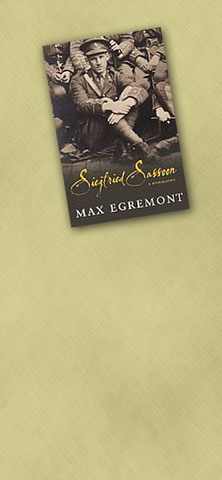
He was more talented than Brooke, arguably less so than Owen, whose career he championed, but it's hard to say what would have become of the others. Brooke and Owen both died in the war, while Sassoon, though twice-wounded, went on to live a long and somewhat wistful life (born in 1886, he died in 1967) and outlasted his own legacy.
He was a minor poet, a writer of misty, Rossetti-like verse, who briefly flared into greatness and then reverted to being minor again, without ever quite understanding what had happened to him.
Siegfried Loraine Sassoon was a bundle of contradictions. He was Jewish, or his father was (he left the family when Sassoon was four) -- the descendant of an enormously wealthy Sephardic family.
His mother was a painter who came from ancient Cheshire stock, and Sassoon grew up on a country estate and in the Church of England, even acquiring that tinge of anti-Semitism customary among the British upper classes, before converting late in life to Roman Catholicism.
Sassoon was an aesthete and a bohemian who was nevertheless an enthusiastic guest at country-house weekends, and his favorite pastimes were cricket, golf and riding to hounds.
He was a rich man who lived in a great house, but called himself a socialist and gave away vast sums to his friends. And Sassoon was gay, closeted at first but then remarkably open for the time. Yet he eventually married and had a son, in whom he was greatly relieved to see evidence of sexual "normality."
Sassoon wrote six volumes of slightly fictionalized autobiography, of which the most famous was his bestselling Memoirs of a Fox-Hunting Man, and since his death there have been at least a half-dozen biographies, of which Max Egremont's is easily the most engaging.
The author is himself a vaguely Sassoonish character, a titled aristo who writes books to help pay for the upkeep of Petworth, his ancestral estate, and he is related to two of the players in the story: Wilfrid Scawen Blunt, an older poet who was one of Sassoon's mentors, and Stephen Tennant, who was the great love of Sassoon's life.
Max Egremont is a historian, not a literary scholar, and he is occasionally a little tone-deaf to the verse, which he mostly cites in snippets, as signposts to what was going on in the life.
He also takes Sassoon's side, more or less, in Sassoon's feud with the moderns and his refusal to learn anything from them -- in fact the signal mistake of his career. In that respect, Sassoon was a little like the American poet Edna St. Vincent Millay.
On the other hand, Egremont is extremely good on the war years, which are, after all, why we care about Sassoon, and he demonstrates, firmly but sympathetically, that Sassoon's famous letter renouncing the war was muddled and naive, the product of manipulation by Bertrand Russell and other Bloomsbury pacifists.
Sassoon eventually went back to the front, and in later years, without renouncing the anti-war sentiments in his poetry, tried to distance himself from this period of protest.
Egremont has also benefited enormously from access to
Tennant family papers and from unpublished Sassoon archives, to which he was given access by the poet's son, George, and the result is the fullest account yet of a romance so unlikely it reads like something out of Firbank.
Most of Sassoon's affairs were discreet arrangements with chaps more or less like himself. Tennant, 10 years younger, was an exotic, flamboyant creature, who wore makeup, collected seashells and dried flowers, and never went anywhere without a case of unguents and cold creams and his fur-lined dressing gown.
Yet Sassoon and Tennant fell for each other passionately, and traipsed together all over Europe, before the affair eventually dissolved in tears and recriminations.
There were sexual problems. (Tennant was unable to achieve orgasm, despite Sassoon's manful efforts.) But even more, Tennant's flightiness and fragility finally wore Sassoon down.
On the rebound, and looking for stability, in 1933 Sassoon married Hester Gatty, an heiress 19 years his junior.
The marriage was happy for a while and in 1936 produced George, whom Sassoon adored, but eventually it, too, collapsed, out of sexual incompatibility and Sassoon's increasing wish to be left alone with his work -- work that, sadly, fewer and fewer people were paying attention to.
The couple split up in 1945, and Sassoon lived the rest of his life alone in their grand house at Heytesbury, which, without his wife's inheritance to pay the bills, grew steadily run down.
He was for years painfully estranged from George, and
stoically endured a string of increa-singly painful ailments, all the while waiting in vain for a knighthood or the laureateship. (John Betjeman, who did get the laureateship, confided to a friend that Sassoon had been denied merely because he was "queer.")
He kept writing, and he was sustained in his old age both by his newly acquired Catholic faith and by a few devoted friends who revered him as a kind of relic of a pastoral England now almost vanished.
Some people, like the critic and translator C.K. Scott Moncrieff, thought Sassoon a ridiculous and outmoded figure, but in Egremont's telling he emerges as an immensely touching and sympathetic one -- a man not entirely at home in his own skin, let alone in the world he was born to, but who plumbed the great trauma of his generation, the horrors of World War I, and unlike so many, told the truth about it and about himself.

Last week Joseph Nye, the well-known China scholar, wrote on the Australian Strategic Policy Institute’s website about how war over Taiwan might be averted. He noted that years ago he was on a team that met with then-president Chen Shui-bian (陳水扁), “whose previous ‘unofficial’ visit to the US had caused a crisis in which China fired missiles into the sea and the US deployed carriers off the coast of Taiwan.” Yes, that’s right, mighty Chen caused that crisis all by himself. Neither the US nor the People’s Republic of China (PRC) exercised any agency. Nye then nostalgically invoked the comical specter

Relations between Taiwan and the Czech Republic have flourished in recent years. However, not everyone is pleased about the growing friendship between the two countries. Last month, an incident involving a Chinese diplomat tailing the car of vice president-elect Hsiao Bi-khim (蕭美琴) in Prague, drew public attention to the People’s Republic of China’s (PRC) operations to undermine Taiwan overseas. The trip was not Hsiao’s first visit to the Central European country. It was meant to be low-key, a chance to meet with local academics and politicians, until her police escort noticed a car was tailing her through the Czech capital. The
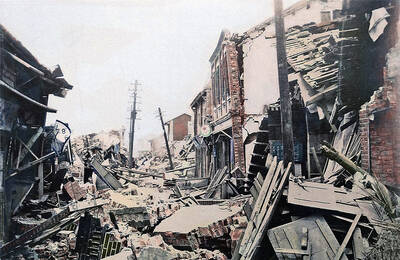
April 15 to April 21 Yang Kui (楊逵) was horrified as he drove past trucks, oxcarts and trolleys loaded with coffins on his way to Tuntzechiao (屯子腳), which he heard had been completely destroyed. The friend he came to check on was safe, but most residents were suffering in the town hit the hardest by the 7.1-magnitude Hsinchu-Taichung Earthquake on April 21, 1935. It remains the deadliest in Taiwan’s recorded history, claiming around 3,300 lives and injuring nearly 12,000. The disaster completely flattened roughly 18,000 houses and damaged countless more. The social activist and

Over the course of former President Ma Ying-jeou’s (馬英九) 11-day trip to China that included a meeting with Chinese Communist Party (CCP) leader Xi Jinping (習近平) a surprising number of people commented that the former president was now “irrelevant.” Upon reflection, it became apparent that these comments were coming from pro-Taiwan, pan-green supporters and they were expressing what they hoped was the case, rather than the reality. Ma’s ideology is so pro-China (read: deep blue) and controversial that many in his own Chinese Nationalist Party (KMT) hope he retires quickly, or at least refrains from speaking on some subjects. Regardless


 RSS
RSS