


Joseph Dan sets himself an imposing task in Kabbalah: A Very Short Introduction. In a little more than 100 pages, he races through more than a thousand years of Jewish religious texts, explaining a vast, amorphous body of beliefs and practices that have influenced Freemasons, Hasidim, Carl Jung, New Age gurus and, more recently, Hollywood celebrities. It's quite a performance, carried off with only a few stumbles.
"There is hardly a Jewish idea that cannot be described as `kabbal-istic' with some justification," writes Dan, a professor of kabbalah at the Hebrew University of Jerusalem. The subject is elusive, and kabbal-istic thought has taken so many twists and turns over the centuries that it makes more sense, Dan argues, to speak of kabbalahs, in the plural. In a sardonic aside, he offers a popular definition of the kabbalah as "something that I have a vague notion of, but somebody,
somewhere, knows exactly what it means."
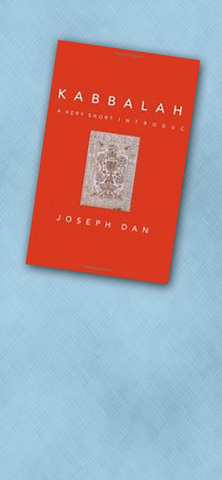
To clarify, Dan begins at the beginning, on Mount Sinai, where Moses received the word of God in the Torah. The word kabbalah comes from the Hebrew for receive (in Israel it identifies the reception desk in every hotel and the receipt in every restaurant). For a thousand years, Dan writes, when Jews referred to the kabbalah, they meant the divine truth revealed to Moses.
In the Middle Ages, however, Jewish scholars in Spain and Provence, and somewhat later in Italy, claimed to possess secret scriptural knowledge that origin-ated with Moses and was passed down orally through the centuries. These scholars and exegetes, later known as kabbalists, dealt especially with two sections of the Torah whose public discussion is forbidden by the Talmud, the collection of ancient rabbinic writings on Jewish law and tradition followed by Orthodox Jews. The first, from Genesis, describes the creation of the world; the second, from the Book of Ezekiel, describes Ezekiel's vision of the celestial chariot.
Over the centuries, the kabbalists, incorporating ideas first expressed in nonkabbalistic treatises dating from late antiquity, worked out a complex interpretation of the divine order and its creation. They described the kingdom of heaven and, in a few treatises, explained how humans can ascend to "face God in his glory."

Medieval kabbalists envisioned a universe arranged hierarchically in 10 divine emanations, called sefirot, and developed numerical, alphabetical and metaphorical correspondences among them. These esoteric systems and the magical aspects of the kabbalah captured the imagination of Christian Renaissance thinkers like Pico della Mirandola. The idea of kabbalists as a dangerous secret cult lies behind the English word cabal.
Dan helpfully sorts out the most influential kabbalistic concepts, especially the notion that individual human actions can influence the divine order and bring about the tikkun, or redemption. This radical proposition was put forward by Isaac Luria, a 16th-century kabbalist, who believed that the universe was born in crisis,
resulting in a system of divine emanations riven by fault lines. Only by strict observance of religious law could the Jews bring about their own redemption and correct the flaws in the universe, ridding it of evil. This idea gained tremendous force, and, Dan writes, "penetrated all aspects of Jewish culture." It remains central to ultra-orthodox Judaism today.
One large point remains obscure. Dan insists that the kabbalah is not mystical. The very concept of mysticism, he argues, is alien to Judaism and Islam. Yet he freely uses the term throughout the book. This is confusing. And his discussion of current kabbalistic thinking is rushed.
In Riddles of Existence, Earl Conee and Theodore Sider, forming a metaphysical tag team, throw themselves at 10 perennial
problems in philosophy. In brief chapters, the authors, both philosophy professors, pose a question (Does God exist? What is time?) and then explain, for a general audience, different ways of answering it. They offer a series of hors d'oeuvres for intellectual diners not quite ready to commit to a full philosophical meal.
There are no answers. Or rather, there are too many answers. The entertainment value lies in picking one's way through ingenious arguments, encountering along the way basic ideas like the law of the excluded middle and the principle of sufficient reason.
Conee and Sider like to start with a common-sense, real-life question -- Why is the person in my baby picture the same as the person I see in the mirror today? -- and then pick apart the comfortable assumptions that carry most of us through life.
Although both authors write clearly and simply, the waters do get deep very quickly. Most readers will pause, if only briefly, when faced with formulations like "any condition is a necessary condition for itself," but help is usually forthcoming, often in the form of humble examples. "Ontological dependence" sounds forbidding, but Conee, in his chapter on God, comes to the rescue with an irresistible invitation: "Consider a tuna salad sandwich." Two slices of bread do not make a tuna salad sandwich, and neither does a heap of tuna salad, but together they do. Voila! Ontological dependence on rye.

Last week Joseph Nye, the well-known China scholar, wrote on the Australian Strategic Policy Institute’s website about how war over Taiwan might be averted. He noted that years ago he was on a team that met with then-president Chen Shui-bian (陳水扁), “whose previous ‘unofficial’ visit to the US had caused a crisis in which China fired missiles into the sea and the US deployed carriers off the coast of Taiwan.” Yes, that’s right, mighty Chen caused that crisis all by himself. Neither the US nor the People’s Republic of China (PRC) exercised any agency. Nye then nostalgically invoked the comical specter

Relations between Taiwan and the Czech Republic have flourished in recent years. However, not everyone is pleased about the growing friendship between the two countries. Last month, an incident involving a Chinese diplomat tailing the car of vice president-elect Hsiao Bi-khim (蕭美琴) in Prague, drew public attention to the People’s Republic of China’s (PRC) operations to undermine Taiwan overseas. The trip was not Hsiao’s first visit to the Central European country. It was meant to be low-key, a chance to meet with local academics and politicians, until her police escort noticed a car was tailing her through the Czech capital. The
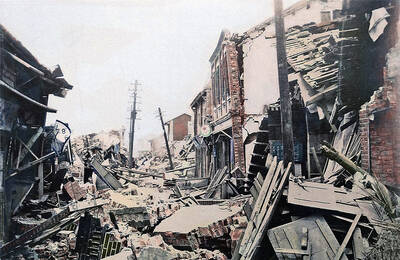
April 15 to April 21 Yang Kui (楊逵) was horrified as he drove past trucks, oxcarts and trolleys loaded with coffins on his way to Tuntzechiao (屯子腳), which he heard had been completely destroyed. The friend he came to check on was safe, but most residents were suffering in the town hit the hardest by the 7.1-magnitude Hsinchu-Taichung Earthquake on April 21, 1935. It remains the deadliest in Taiwan’s recorded history, claiming around 3,300 lives and injuring nearly 12,000. The disaster completely flattened roughly 18,000 houses and damaged countless more. The social activist and

Over the course of former President Ma Ying-jeou’s (馬英九) 11-day trip to China that included a meeting with Chinese Communist Party (CCP) leader Xi Jinping (習近平) a surprising number of people commented that the former president was now “irrelevant.” Upon reflection, it became apparent that these comments were coming from pro-Taiwan, pan-green supporters and they were expressing what they hoped was the case, rather than the reality. Ma’s ideology is so pro-China (read: deep blue) and controversial that many in his own Chinese Nationalist Party (KMT) hope he retires quickly, or at least refrains from speaking on some subjects. Regardless


 RSS
RSS