


With war photographs confronting us daily, do we need an exhibition to remind us of the body's vulnerability? But the havoc caused by war is only one aspect of it. There is disease, domestic violence, environmental pollution, the enfeeblement of old age, starvation, drug addiction and more -- much more. It's a gloomy picture, and The Body at Risk: Photography of Disorder, Illness and Healing at the International Center of Photography, in New York, is not for the squeamish.
The show was assembled by Carol Squiers, a curator at the center, from the work of 16 documentary photographers, among them Lewis Hine, W. Eugene Smith, Dorothea Lange, Donna Ferrato, Sebastiao Salgado and Marion Post Wolcott. Squiers has also written a substantial catalog.
The show takes in a lot of pictorial territory, from the now-familiar shots of maltreated child laborers by Hine, the early 20th-century reformer, to victims of the AIDS rampage in Africa by the South African photographer Gideon Mendel.
A section on the Farm Security Administration, a New Deal health initiative from the mid-1930s to the early 1940s, details the plight of tenant farmers and migrant
laborers during the Depression, and some of the federal programs assisting them. Environmental
pollution is addressed by David Hanson, whose photographs of affected sites, and their monitoring by the Environmental Protection Agency, come with maps and written descriptions.
One of the sections that is most painful in its immediacy -- and the only one in color -- presents images from Lori Grinker's long-running project about war veterans. Addressing the lasting effects of war on the surviving wounded, it doesn't stint in its depiction of maimed bodies.
The psychological residue of combat is seen on the face of Henry Green, a British veteran of the Korean War, who survived the brutal Battle of the Imjin River in 1951. Almost half a century later, he still suffered from post-traumatic stress disorder.
A special slideshow of works from the exhibition and an interview with curator Carol Squiers can be accessed from the International Center of Photography's Web site at www.icp.org.

In late October of 1873 the government of Japan decided against sending a military expedition to Korea to force that nation to open trade relations. Across the government supporters of the expedition resigned immediately. The spectacle of revolt by disaffected samurai began to loom over Japanese politics. In January of 1874 disaffected samurai attacked a senior minister in Tokyo. A month later, a group of pro-Korea expedition and anti-foreign elements from Saga prefecture in Kyushu revolted, driven in part by high food prices stemming from poor harvests. Their leader, according to Edward Drea’s classic Japan’s Imperial Army, was a samurai
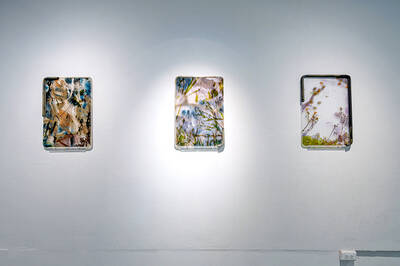
Located down a sideroad in old Wanhua District (萬華區), Waley Art (水谷藝術) has an established reputation for curating some of the more provocative indie art exhibitions in Taipei. And this month is no exception. Beyond the innocuous facade of a shophouse, the full three stories of the gallery space (including the basement) have been taken over by photographs, installation videos and abstract images courtesy of two creatives who hail from the opposite ends of the earth, Taiwan’s Hsu Yi-ting (許懿婷) and Germany’s Benjamin Janzen. “In 2019, I had an art residency in Europe,” Hsu says. “I met Benjamin in the lobby
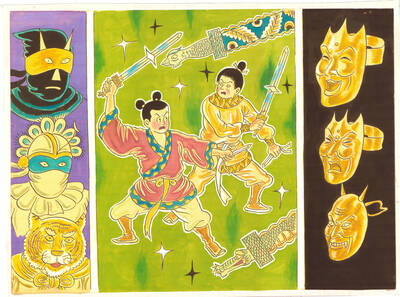
April 22 to April 28 The true identity of the mastermind behind the Demon Gang (魔鬼黨) was undoubtedly on the minds of countless schoolchildren in late 1958. In the days leading up to the big reveal, more than 10,000 guesses were sent to Ta Hwa Publishing Co (大華文化社) for a chance to win prizes. The smash success of the comic series Great Battle Against the Demon Gang (大戰魔鬼黨) came as a surprise to author Yeh Hung-chia (葉宏甲), who had long given up on his dream after being jailed for 10 months in 1947 over political cartoons. Protagonist

Peter Brighton was amazed when he found the giant jackfruit. He had been watching it grow on his farm in far north Queensland, and when it came time to pick it from the tree, it was so heavy it needed two people to do the job. “I was surprised when we cut it off and felt how heavy it was,” he says. “I grabbed it and my wife cut it — couldn’t do it by myself, it took two of us.” Weighing in at 45 kilograms, it is the heaviest jackfruit that Brighton has ever grown on his tropical fruit farm, located


 RSS
RSS