


A longside tragedies, wars and natural disasters, this year has brought its share of unusual, outrageous, tragi-comic and just downright silly news items.
Among the oddities served up by the world of science:
● A Swiss woman sees colors and experiences tastes when she hears music, scientists at the University of Zurich in Switzerland reported. The rare phenomenon, known as synaesthesia, was confirmed in a 27-year-old professional musician, who saw violet on hearing an F sharp and red on a middle C.

PHOTO:AFP
● Researchers at National University in La Jolla, California, threw a dinner party and then analysed the leftovers to see if their guests left significant DNA samples on them. Complete profiles were recovered from 43 percent of the sample, and partial ones from 33 percent. Such work could be useful in catching burglars, who often like tucking into the food found in their victims' kitchens.
● African elephants have at least one thing in common with parrots: they imitate sounds they hear around them, said scientists in the US and Norway. A captive female jumbo in Kenya was found to imitate the noise of trucks on a nearby road, while a male kept with Asian elephants at a zoo in Switzerland mimicked their chirping noises.
● Enterprising students at Brown University in the United States invented an alarm clock that monitors its user's brainwaves and works out the best time to wake him or her up. The only drawback: the sleeper must wear a headband equipped with electrodes.
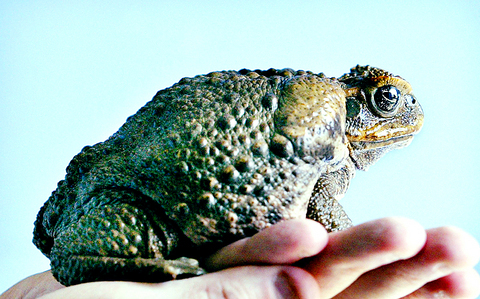
PHOTO: AFP
● Alexis Lemaire, a 24-year-old student in Reims, France, claimed a world record for working out the 13th root of a 200-digit number by mental arithmetic. The feat, checked by a notary, took him 48 minutes and 51 seconds.
● Also in the maths department, Akira Haraguchi, a 59-year-old psychiatric counselor in Japan, recited from memory the value of "pi," a constant which consists of an infinite string of digits, to 83,431 decimal places. It took him 13 hours to beat the previous record, also set by a Japanese, of a mere 54,000 digits.
● The guardians of animal nomenclature had mixed feelings over a proposal to name three newly-discovered species of slime-mould beetle after US President George W. Bush, US Vice President Dick Cheney and US Defense Secretary Donald Rumsfeld. A pair of insect experts reserved the names Agathidium bushi, Agathidium cheneyi and Agathidium rumsfeldi for their latest creepy-crawlies.

PHOTO: EPA
● An odd-looking rodent spotted on sale for meat in a Laotian food market turned out to be not only a new species but also the first member of a new family of mammals to be identified in more than three decades. An alert member of the New York-based Wildlife Conservation Society noticed the creature, which was baptized a stone-dwelling puzzle-mouse -- or, more simply, "rock rat".
● Cane toads, reptiles imported into Australia in the erroneous belief that they would eliminate pests from sugar-cane fields, are attracted by disco-style flashing lights, said researchers in the Northern Territory who are desperate to find a way of eliminating the fast-spreading creatures. "The old toads are definitely a disco animal," said a member of a group called Frogwatch.
● The fashion for television detective series which focus on forensic science may be unwittingly providing tips to real-world criminals, a study by British researchers said. Some forensic scientists were even becoming unwilling to cooperate with the media for precisely that reason.
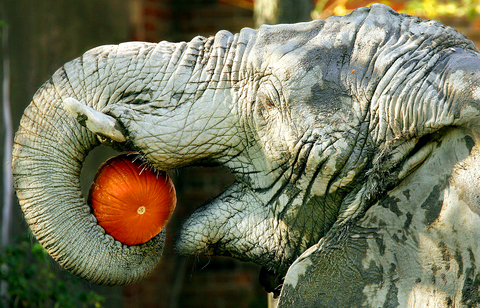
PHOTO: AP
● Proof that scientists have a sense of humor: the annual Ig Nobel awards, which give spoof prizes to the most offbeat research. This year's crop went to the inventor of an alarm that rings then runs away and hides, thus ensuring that the sleeper has to get up to turn it off... to scientists who researched whether humans swim faster in syrup rather than in water... to British boffins who analysed the electrical activity of a locust's brain cell while the insect watched a Star Wars movie... and to a German team that calculated the pressure produced in penguins' anuses when the birds expel their faeces.
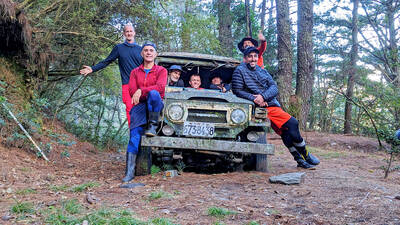
The year was 1991. A Toyota Land Cruiser set out on a 67km journey up the Junda Forest Road (郡大林道) toward an old loggers’ camp, at which point the hikers inside would get out and begin their ascent of Jade Mountain (玉山). Little did they know, they would be the last group of hikers to ever enjoy this shortcut into the mountains. An approaching typhoon soon wiped out the road behind them, trapping the vehicle on the mountain and forever changing the approach to Jade Mountain. THE CONTEMPORARY ROUTE Nowadays, the approach to Jade Mountain from the north side takes an

Last week Joseph Nye, the well-known China scholar, wrote on the Australian Strategic Policy Institute’s website about how war over Taiwan might be averted. He noted that years ago he was on a team that met with then-president Chen Shui-bian (陳水扁), “whose previous ‘unofficial’ visit to the US had caused a crisis in which China fired missiles into the sea and the US deployed carriers off the coast of Taiwan.” Yes, that’s right, mighty Chen caused that crisis all by himself. Neither the US nor the People’s Republic of China (PRC) exercised any agency. Nye then nostalgically invoked the comical specter

Relations between Taiwan and the Czech Republic have flourished in recent years. However, not everyone is pleased about the growing friendship between the two countries. Last month, an incident involving a Chinese diplomat tailing the car of vice president-elect Hsiao Bi-khim (蕭美琴) in Prague, drew public attention to the People’s Republic of China’s (PRC) operations to undermine Taiwan overseas. The trip was not Hsiao’s first visit to the Central European country. It was meant to be low-key, a chance to meet with local academics and politicians, until her police escort noticed a car was tailing her through the Czech capital. The

April 15 to April 21 Yang Kui (楊逵) was horrified as he drove past trucks, oxcarts and trolleys loaded with coffins on his way to Tuntzechiao (屯子腳), which he heard had been completely destroyed. The friend he came to check on was safe, but most residents were suffering in the town hit the hardest by the 7.1-magnitude Hsinchu-Taichung Earthquake on April 21, 1935. It remains the deadliest in Taiwan’s recorded history, claiming around 3,300 lives and injuring nearly 12,000. The disaster completely flattened roughly 18,000 houses and damaged countless more. The social activist and


 RSS
RSS