


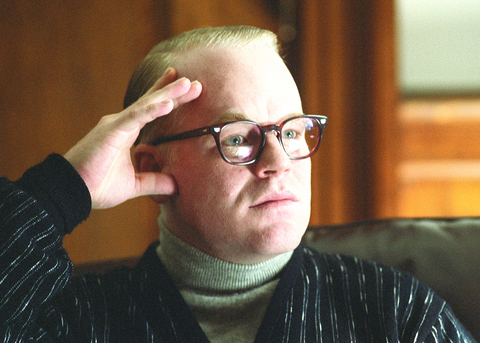
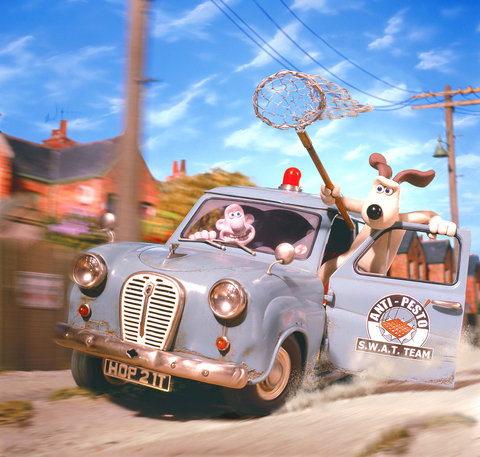
Batman Begins, The Beat That My Heart Skipped, Capote, Darwin's Nightmare, Duma, Enron: The Smartest Guys in the Room, The 40-Year-Old Virgin, Funny Ha Ha, George A. Romero's Land of the Dead, Good Night, and Good Luck, Grizzly Man, Head-On, The Holy Girl, Howl's Moving Castle, In Her Shoes, Keane, Match Point, Millions, Mondovino, Mysterious Skin, No Direction Home: Bob Dylan, Police Beat, Pulse, Red Eye, Rize, The Squid and the Whale, The Sun, Syriana, The Talent Given Us, The Three Burials of Melquiades Estrada, Three Times, Tony Takitani, Tropical Malady, Waiting for the Clouds, Wallace and Gromit: The Curse of the Were-Rabbit, Who's Camus Anyway? and The World.
Was this a good year for the movies or what?
While film industry reporters have been busy filing doom-and-gloom analyses, reports about a disputed box-office slump and prognostications about the narrowing gap between a movie hitting your local multiplex and your local home-video store, a lot of filmgoers have been enjoying an exceptional year of movies.
PHOTOS COURTESY OF AGENCIES
I don't know any film critic who had an easy time whittling this year's offerings down to a neat 10 titles, which is why so many critics have instead trotted out a baker's dozen of favorites, sometimes more. And while the doom and gloom suggests that something major is happening in the US movie industry, it is also clear that those who spend too much time in the dark, including most industry watchers, have no idea what the future bodes for the movies.
Steven Soderbergh, for one, believes that we are in the middle of a paradigm shift. "The economics don't work," he said last September, while promoting his most recent film, Bubble, at the Toronto International Film Festival. "Everybody on both sides, from top to bottom, needs to rethink the issue of compensation and participation. It just has to be redesigned.
Movies cost too much. People are getting paid too much. And a dollar should be a dollar, in my view, no matter where it comes from. It just needs to be rethought. It's already starting to happen. There are already deals being made that acknowledge the fact that it's broken. But whether you're going to see that change in a broad sense prior to the digital changeover, I don't know."
That digital changeover will certainly be part of this paradigm shift, encompassing how movies are produced -- the new technologies, the complex financial deals -- and how they are consumed. In November, Jeff Robinov, president of production at Warner Brothers Pictures, which bankrolled one of Soderbergh's frothier entertainments (Ocean's Twelve), told Laura Holson of The New York Times: "Something is changing in the movie experience. Is it piracy? Is it commercials? Is it the availability of movies? Or are we not creating enough things to drive people out of the home? My biggest fear is having a movie that deserves to be seen, but is not."
Whatever you think of the state of the art and the health of the industry, there is no denying that the experience of moviegoing has changed as radically as our perception of what the movies mean to our lives.
Entertainment news now assumes an increasingly prominent place in the culture, notably in the mainstream press, even as the movies themselves seem less and less relevant to the culture, no matter how hard filmmakers try. It's hard to know what to make of this state of affairs, though given that the movies have survived previous threats like the introduction of sound, television and the government-enforced breakup of the studio system, there is hope that they will survive all this old- and new-media attention, much of which, as it happens, has little to do with whether the films are any good.
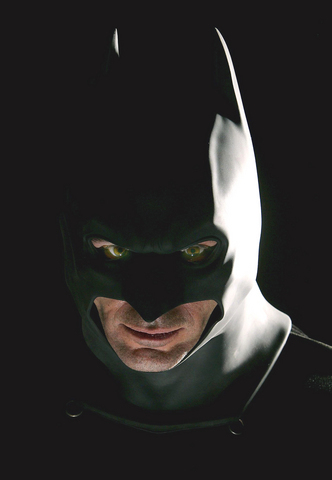
For some, Hollywood remains a catchall for all that's wrong with US movies, but the same company, NBC Universal, that bankrolled King Kong is also behind Brokeback Mountain. Ang Lee's film found studio backing partly because the time was right for this story and partly because the independent-film movement of the 1990s, while short-lived, provided Hollywood fresh blood. Batman Begins, after all, was directed by Christopher Nolan, who also made the indie cult film Memento, while the love interest in The 40-Year-Old Virgin is Catherine Keener, an indie film goddess. Genuine independent filmmakers like Andrew Bujalski (Funny Ha Ha) face a brutal time in today's market, but the DIY ethos that spurred filmmakers to edit on Macs now finds them self-distributing: you can buy Bujalski's latest, Mutual Appreciation, online at www.mutualappreciation.com.
The brutality of this market also means that today's film lovers, especially those living outside the major movie markets, often have to work harder and wait longer than they might like to see the good stuff, but the good stuff is out there -- if not necessarily at the local multiplex, then in film festivals, video stores, mail-order rental outfits and those online companies that sell movies from around the world.
The committed moviegoer has more and arguably better choices than at any time in history. That's especially true if you live in New York or most other big cities. And if you do, don't blame Hollywood if you haven't yet seen A History of Violence or any of the year's best films. Nobody put a gun to your head and forced you to see King Kong.

The year was 1991. A Toyota Land Cruiser set out on a 67km journey up the Junda Forest Road (郡大林道) toward an old loggers’ camp, at which point the hikers inside would get out and begin their ascent of Jade Mountain (玉山). Little did they know, they would be the last group of hikers to ever enjoy this shortcut into the mountains. An approaching typhoon soon wiped out the road behind them, trapping the vehicle on the mountain and forever changing the approach to Jade Mountain. THE CONTEMPORARY ROUTE Nowadays, the approach to Jade Mountain from the north side takes an

Last week Joseph Nye, the well-known China scholar, wrote on the Australian Strategic Policy Institute’s website about how war over Taiwan might be averted. He noted that years ago he was on a team that met with then-president Chen Shui-bian (陳水扁), “whose previous ‘unofficial’ visit to the US had caused a crisis in which China fired missiles into the sea and the US deployed carriers off the coast of Taiwan.” Yes, that’s right, mighty Chen caused that crisis all by himself. Neither the US nor the People’s Republic of China (PRC) exercised any agency. Nye then nostalgically invoked the comical specter

Relations between Taiwan and the Czech Republic have flourished in recent years. However, not everyone is pleased about the growing friendship between the two countries. Last month, an incident involving a Chinese diplomat tailing the car of vice president-elect Hsiao Bi-khim (蕭美琴) in Prague, drew public attention to the People’s Republic of China’s (PRC) operations to undermine Taiwan overseas. The trip was not Hsiao’s first visit to the Central European country. It was meant to be low-key, a chance to meet with local academics and politicians, until her police escort noticed a car was tailing her through the Czech capital. The

April 15 to April 21 Yang Kui (楊逵) was horrified as he drove past trucks, oxcarts and trolleys loaded with coffins on his way to Tuntzechiao (屯子腳), which he heard had been completely destroyed. The friend he came to check on was safe, but most residents were suffering in the town hit the hardest by the 7.1-magnitude Hsinchu-Taichung Earthquake on April 21, 1935. It remains the deadliest in Taiwan’s recorded history, claiming around 3,300 lives and injuring nearly 12,000. The disaster completely flattened roughly 18,000 houses and damaged countless more. The social activist and


 RSS
RSS