


Two Chinese-language films, both contenders for the Best Foreign Language Film Oscar next year, are slated to battle for local audiences this weekend.
Chen Kaige's (陳凱歌) fantasy epic The Promise (無極) packs a martial arts punch, whereas Perhaps Love (如果愛) by Hong Kong director Peter Ho-Sun Chan (陳可辛) is the first grandiose Chinese musical for 30 years and looks set to elevate the romance genre from the status of vignette to a theater of magnificence.
Both films not only had gigantic budgets, star-studded casts and A-list production teams, but they also deal with a common subject matter: a love triangle and a celestial stepping in to the story to navigate the courses of the characters' lives.
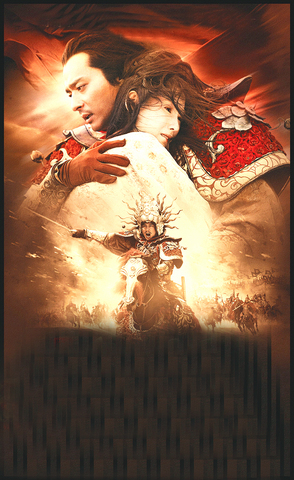
PHOTO COURTESY OF FOX MOVIES
Having the biggest production budget (NT$1.3 billion) of any Chinese-language movie to date and taking three years to complete, The Promise is a blockbuster and doesn't pretend to be anything else.
Set in ancient China, the film revolves around a love triangle between a princess (Cecilia Cheung(張柏芝)), a general of the Crimson Army (Japanese veteran actor Hiroyuki Sanada), and his slave Kunlun (Korea's Jang Dong Gun).
Cursed by a goddess when little, the princess is given ultimate beauty and wealth but is destined not to experience true love until time can flow backwards and the dead can come back to live.
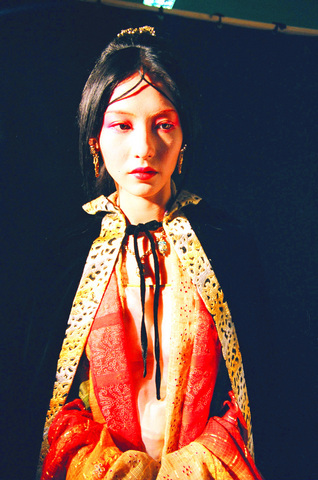
PHOTO COURTESY OF FOX MOVIES
Destiny is the driving force throughout the story and leads the characters to a grand finale in which the slave, who can run faster than light, uses his extraordinary power to break the princess' curse.
With heavy special effects, the film is a show of exquisite cinematography combined with a conventional storyline and sometimes geeky dialogue that occasionally draws unintended laughs from the audience.
The characters, though not fully developed, beguile with their narrative simplicity. Both Hiroyuki Sanada and Jang Dong Gun give tasteful performances when delivering lines in Mandarin. Nicholas Tse (謝霆鋒) succeeds in giving a rather camp portrayal of the chief villain.
Stylish and flashy, the film is an astounding visual spectacle which offers a delightful viewing experience for moviegoers who enjoy a simple plot and impressive action scenes.
Perhaps Love is a return to director Chan's favorite subject: love. It's a love triangle wrapped in a movie within a movie.
Hong Kong actor Lin Jian-dong (played by Takeshi Kaneshiro (
The story journeys back to Beijing ten years earlier when Lin and Sun first met and fell in love. Poor and down-on-her-luck, Sun leaves Lin for Nie who can help her on the way to fame and fortune.
Unaware of their past relationship, Nie tries to reclaim his diminishing fame through taking a part in a musical about a love triangle which mirrors the characters' real life situation.
As Lin and Sun's old love is rekindled, the fictional and the real inextricably intertwine and push Nie to reflect on what's happening.
The film also has its fair share of fantasy elements.
A character named Monty (played by Korean actor Ji Jin-hee) narrates the film. Longing for genuine human emotion, Monty pops up in a number of disguises throughout the movie to guide the characters and help them rediscover the emotions and memories they have long forgotten or denied existed.
With the help of Bollywood choreographer Farah Khan, whose works include Monsoon Wedding (2001) and Vanity Fair (2004), the musical sequences are delightful to watch. Jacky Cheung proves himself to be a rare actor whose rich vocals lend him charisma in the musical numbers.
The cinematography is worth a mention as award-winning cinematographer Peter Pau (Crouching Tiger, Hidden Dragon) created the Shanghai scenes which contrast starkly with the bleak Beijing scenes created by internationally acclaimed Christopher Doyle.
Chan's 1996 classic Comrade, Almost a Love Story (
As Chan stressed, Perhaps Love is not a conventional musical where actors break into songs. It's foremost a love story that encompasses multitude aspects of love and relationships.
Perhaps Love is not your usual musical that fosters warm and sweet feelings. It depicts a more realistic portrait of love composed of desire, affection, sacrifice, selfishness, hatred and all the disturbing and alluring emotions that it is.
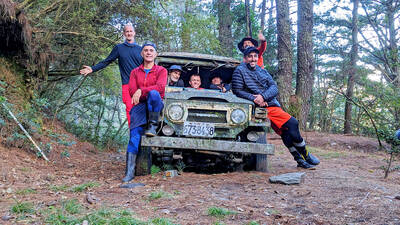
The year was 1991. A Toyota Land Cruiser set out on a 67km journey up the Junda Forest Road (郡大林道) toward an old loggers’ camp, at which point the hikers inside would get out and begin their ascent of Jade Mountain (玉山). Little did they know, they would be the last group of hikers to ever enjoy this shortcut into the mountains. An approaching typhoon soon wiped out the road behind them, trapping the vehicle on the mountain and forever changing the approach to Jade Mountain. THE CONTEMPORARY ROUTE Nowadays, the approach to Jade Mountain from the north side takes an

Last week Joseph Nye, the well-known China scholar, wrote on the Australian Strategic Policy Institute’s website about how war over Taiwan might be averted. He noted that years ago he was on a team that met with then-president Chen Shui-bian (陳水扁), “whose previous ‘unofficial’ visit to the US had caused a crisis in which China fired missiles into the sea and the US deployed carriers off the coast of Taiwan.” Yes, that’s right, mighty Chen caused that crisis all by himself. Neither the US nor the People’s Republic of China (PRC) exercised any agency. Nye then nostalgically invoked the comical specter

Relations between Taiwan and the Czech Republic have flourished in recent years. However, not everyone is pleased about the growing friendship between the two countries. Last month, an incident involving a Chinese diplomat tailing the car of vice president-elect Hsiao Bi-khim (蕭美琴) in Prague, drew public attention to the People’s Republic of China’s (PRC) operations to undermine Taiwan overseas. The trip was not Hsiao’s first visit to the Central European country. It was meant to be low-key, a chance to meet with local academics and politicians, until her police escort noticed a car was tailing her through the Czech capital. The
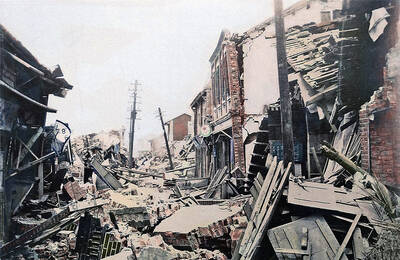
April 15 to April 21 Yang Kui (楊逵) was horrified as he drove past trucks, oxcarts and trolleys loaded with coffins on his way to Tuntzechiao (屯子腳), which he heard had been completely destroyed. The friend he came to check on was safe, but most residents were suffering in the town hit the hardest by the 7.1-magnitude Hsinchu-Taichung Earthquake on April 21, 1935. It remains the deadliest in Taiwan’s recorded history, claiming around 3,300 lives and injuring nearly 12,000. The disaster completely flattened roughly 18,000 houses and damaged countless more. The social activist and


 RSS
RSS