


Globalization has been a trendy theme in art exhibitions ever since the seminal 1990 traveling exhibition Cities on the Move (COTM) which highlighted the rapid urbanization of Asian cities.
Fifteen years ago, it was quite startling for an art exhibition to bring tuk-tuks from Thailand to chaperone European art visitors around Vienna. COTM spawned countless exhibitions exploring similar issues of artists as cultural nomads and the far-reaching effects of globalization.
Border-crossing: the Shadow Dance of Cities currently on view at the Taipei Artist Village and at the Shanghai High Noon Art Center tries to bite off more than it can chew.
PHOTOS COURTESY OF TAIPEI ARTIST VILLAGE
Hsinchu-based curator Sandy Lo Hsiu-chih (羅秀芝) tries to address too many ideas such as transnationalism, immigration, homelessness and diaspora, while a pared back approach would have been more suitable for this small-scale, low budget exhibition.
The exhibition is eager to please with its emphasis on multimedia, especially video works shown on large-screen monitors giving the main exhibition space the feel of an appliance showroom.
The videos all tend to feel the same, in that the camera is turned on randomly to observe, and even acts like a kind of surveillance device which in turn inadvertently gives the impression that anyone with a digital video camera who walks around a city can instantly become a global artist.
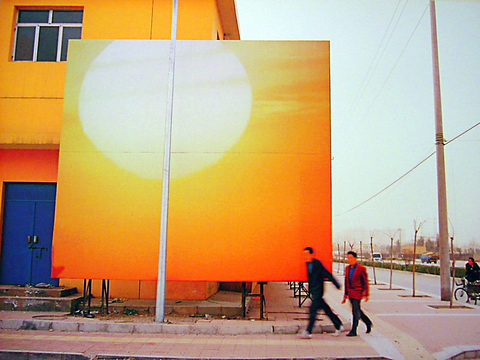
PHOTO COURTESY OF SUSAN KENDZULAKN
It is unfortunate that this grouping of works ultimately dilutes the messages of strong video artists Peng An-An (
The City Message shows videos documenting the artists' absurd street performances in front of famous New York museums.
Yang Chun-luan (

PHOTOS COURTESY OF TAIPEI ARTIST VILLAGE
Photography is an ideal tool to document the fast-growing changes in Asia. China-based Tang Kwang-ming (
Photographer Daniel Traub originally from New York and now based in Beijing creates photojournalist-style work that captures the contrasts between the past and the rapid new changes around the city. Exhibited in western cities, the photos look exotic, however, it is not so epiphanic to look at the work in a Taipei space because right outside the door one can see a similar juxtaposition of cultural contrasts.
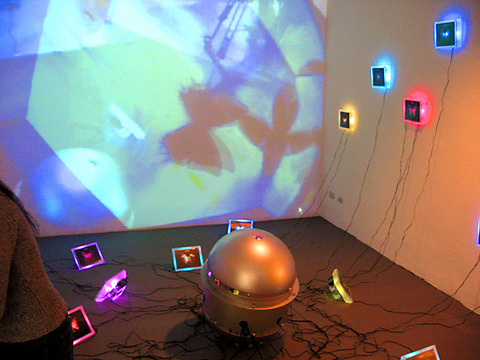
Japanese multimedia duo Off Nibroll's choreographer Yanaihara Mikuni and artist Takahashi Keisuke have a light-hearted, whimsical installation that delights children and makes technology seem fun. Open the curtain into their room, and your shadow gets projected onto a wall, and filled in with video imagery such as flocks of flying birds and herds of galloping horses.
Artist and designer Akibo Lee (
Wires jut out of a small robot-like appliance leading to small LED screens showing butterflies changing color. Butterflies are loaded with sentimental meaning and symbolize beauty. For an exhibition that focuses on the city, it would be more apt to depict a city creature like a cockroach or mosquito rather than a pastoral one.
This writer also has a conceptual installation that addresses the downside of globalization, i.e. the high suicide rate in a briskly changing urban environment.
As border crossings happen with frequency and urgency, the exhibition also gives the argument that slowness and reflection is something we should heartily adopt as an antidote.
Exhibition notes:
What: Border-crossing: the Shadow Dance of Cities
Where: Taipei Artist Village (
Call: (02) 3393 7377
When: Until Jan 22

In late October of 1873 the government of Japan decided against sending a military expedition to Korea to force that nation to open trade relations. Across the government supporters of the expedition resigned immediately. The spectacle of revolt by disaffected samurai began to loom over Japanese politics. In January of 1874 disaffected samurai attacked a senior minister in Tokyo. A month later, a group of pro-Korea expedition and anti-foreign elements from Saga prefecture in Kyushu revolted, driven in part by high food prices stemming from poor harvests. Their leader, according to Edward Drea’s classic Japan’s Imperial Army, was a samurai

The following three paragraphs are just some of what the local Chinese-language press is reporting on breathlessly and following every twist and turn with the eagerness of a soap opera fan. For many English-language readers, it probably comes across as incomprehensibly opaque, so bear with me briefly dear reader: To the surprise of many, former pop singer and Democratic Progressive Party (DPP) ex-lawmaker Yu Tien (余天) of the Taiwan Normal Country Promotion Association (TNCPA) at the last minute dropped out of the running for committee chair of the DPP’s New Taipei City chapter, paving the way for DPP legislator Su
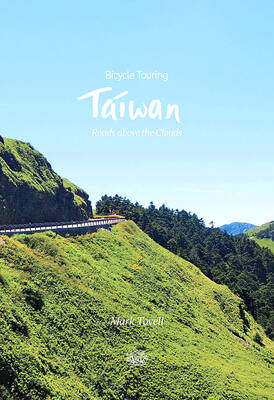
It’s hard to know where to begin with Mark Tovell’s Taiwan: Roads Above the Clouds. Having published a travelogue myself, as well as having contributed to several guidebooks, at first glance Tovell’s book appears to inhabit a middle ground — the kind of hard-to-sell nowheresville publishers detest. Leaf through the pages and you’ll find them suffuse with the purple prose best associated with travel literature: “When the sun is low on a warm, clear morning, and with the heat already rising, we stand at the riverside bike path leading south from Sanxia’s old cobble streets.” Hardly the stuff of your

Located down a sideroad in old Wanhua District (萬華區), Waley Art (水谷藝術) has an established reputation for curating some of the more provocative indie art exhibitions in Taipei. And this month is no exception. Beyond the innocuous facade of a shophouse, the full three stories of the gallery space (including the basement) have been taken over by photographs, installation videos and abstract images courtesy of two creatives who hail from the opposite ends of the earth, Taiwan’s Hsu Yi-ting (許懿婷) and Germany’s Benjamin Janzen. “In 2019, I had an art residency in Europe,” Hsu says. “I met Benjamin in the lobby


 RSS
RSS