


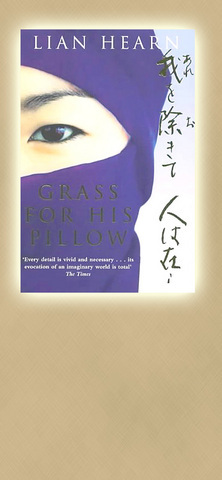
This is the second volume of Lian Hearn's Otori trilogy set in an imaginary version of medieval Japan. Across the Nightingale Floor (reviewed in Taipei Times Dec. 8, 2002) was the first, and The Brilliance of the Moon, which we'll review shortly, is the final one.
The story so far. Across the Nightingale Floor presented a spider's web of strife and intrigue between clans and their warlords. Into this maelstrom stumbled Takeo, barely 16, whose mother had been murdered by Iida Sadamu, evil lord of the Tohan clan. Takeo was rescued by a classic father-figure, Lord Otori Shigeru, who effortlessly used his sword to decaptiate Takeo's assailant. As a member of a clan called The Hidden, Takeo now had to suppress his pacifist instincts to fight Iida's forces alongside Shigeru. Takeo's loyalty resulted in Shigeru making him his adopted son.
Alongside his ordinary martial skills, Takeo has supernatural assets -- an uncannily well-developed sense of hearing and an ability to divide himself into two images, ensuring invisibility to opponents. Though his different tribal allegiances at times generate conflicts of loyalties, they also equip him with an armory of strategic strengths.
As part of the terms of Takeo's adoption, Shigeru became betrothed to Lady Shirakawa Kaede, a woman of legendary beauty and of a similar age to Takeo. Because her first suitor died before the marriage could take place, Kaede acquired the reputation of bringing death to all who desired her. While held hostage from the age of nine by the Tohan clan in Noguchi castle, she spent her time fending off the sexual assaults of castle guards and wishing she had fighting skills. So far, in other words, so predictable for the historical-fantasy genre.
Takeo and Kaede's eventual meeting was predictable and each, appropriately, knew they were destined to be one. Shigeru's inevitable assassination left Takeo free to marry Kaede. He had more complex obligations, however. As a member of the Kikuta clan through his natural father, he had to become part of the tribe or else forfeit his life. A harrowing parting with Kaede followed, after which he set off to embark on an unfamiliar life.
Thus ended Across the Nightingale Floor.
Grass For His Pillow begins with Kaede in a deep sleep, a gift the Kikuta can bring about merely by staring into the eyes of their victim. In her sleep she hears the voice of the White Goddess, who counsels her, "Be patient. He will come for you" -- a promise that has to sustain her through many subsequent troubles. Apart from her newly-discovered pregnancy and subsequent loss of the child, she has to face up to the dire condition of her childhood home. With her mother dead and a father in a state of near-dementia after a skirmish with Lord Arai's army, it falls to Kaede to reorganize the household. This foreshadows her resolve to raise an army finally to secure the Otori and Shirakawa territories.
All these are themes common to this kind of fiction -- the setting in order of the ancestral house, love postponed until the quest is finished and the final confrontation of good and evil. But Lian Hearn does bring a new flavor to this old recipe -- not merely the Japanese setting itself, but also a style that's restrained and even a trifle aloof. This, in other words, is upmarket stuff, but still addictive - and not only for adherents of mythic romances.
Takeo, for instance, has a less than heroic time acquainting himself with the ways of The Tribe. Nicknamed "Dog" on account of his prodigious hearing, he has to learn to juggle, disguise his Otori appearance, and generally do the bidding of The Tribe, all under the eye of a mentor first encountered in Volume One. It isn't until halfway through the book that he comes to his senses and resolves to break with The Tribe and join forces with Kaede. Here most readers will breathe a sigh of relief.
Takeo is next reassured by a prophecy he receives from a blind woman, a member of The Hidden. "Your lands will stretch from sea to sea. Five battles will buy you peace, four to win and one to lose. Many must die, but you yourself are safe from death, except at the hands of your own son." Again, with its echoes of "One ring to find them all and in the darkness bind them" and so on, par for the fantasy-mythological course.
After assembling an army of farmers, outcasts and charcoal-burners, he is comforted by Makoto, someone he met shortly after Shigeru's death, who brings the news that Kaede is not only still alive but raising an army to claim the Maruyama territories for herself.
Takeo's heart swells in admiration. Makoto, a classic faithful-follower figure, becomes his traveling companion. They both find support from some monks at a local temple. They also promise to give him access to records kept by Shigeru outlining the treachery of his uncles that brought about his demise.
Kaede, meanwhile, manages first to quash Lord Arai's advances and then to cool the inconvenient ardor of Lord Fujiwara by asking him to instruct her in military matters. Takeo is alerted to trouble by the whinnying of his horse and is filled with a sense of urgency that he and Kaede must marry at the earliest opportunity, both to ward off further suitors' advances and to cement their military alliance.
"The world stood still in the silent night as the realization sunk in. The backs of my eyes stung as tears came. Heaven was benign, the gods loved me. They had given me Kaede."
Here the final ingredient of great stories, missing from Tolkien and so far from Harry Potter, is dutifully supplied. Lian Hearn has a spare, laser-sharp writing style that adds momentum to what is a strong and engaging tale. Because of her studies in Japanese life and letters, Hearn confers authenticity onto what might otherwise have been an unwieldy narrative.
Even so, it's important to point out that these kind of heroic tales reinforce the military ethic. Recent revelations that computer war-games, with which this story has something in common, are created with the cooperation of the military came, with retrospect, as no great surprise. As with the war-games, so with books like these. You get so used to the good slaying the evil to regain their rightful territories that the slaughter in Iraq comes to seem justifiable. We ought to have have passed beyond such fantasies, but they are proving strangely durable.
If you accept the premises of the genre, you'll enjoy this book is a superior example of it. If you don't, then Grass For His Pillow will appear, despite its many strengths, as inevitably flawed by its underlying military and brute-force assumptions.

Last week Joseph Nye, the well-known China scholar, wrote on the Australian Strategic Policy Institute’s website about how war over Taiwan might be averted. He noted that years ago he was on a team that met with then-president Chen Shui-bian (陳水扁), “whose previous ‘unofficial’ visit to the US had caused a crisis in which China fired missiles into the sea and the US deployed carriers off the coast of Taiwan.” Yes, that’s right, mighty Chen caused that crisis all by himself. Neither the US nor the People’s Republic of China (PRC) exercised any agency. Nye then nostalgically invoked the comical specter

Relations between Taiwan and the Czech Republic have flourished in recent years. However, not everyone is pleased about the growing friendship between the two countries. Last month, an incident involving a Chinese diplomat tailing the car of vice president-elect Hsiao Bi-khim (蕭美琴) in Prague, drew public attention to the People’s Republic of China’s (PRC) operations to undermine Taiwan overseas. The trip was not Hsiao’s first visit to the Central European country. It was meant to be low-key, a chance to meet with local academics and politicians, until her police escort noticed a car was tailing her through the Czech capital. The
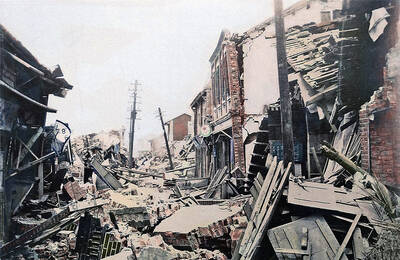
April 15 to April 21 Yang Kui (楊逵) was horrified as he drove past trucks, oxcarts and trolleys loaded with coffins on his way to Tuntzechiao (屯子腳), which he heard had been completely destroyed. The friend he came to check on was safe, but most residents were suffering in the town hit the hardest by the 7.1-magnitude Hsinchu-Taichung Earthquake on April 21, 1935. It remains the deadliest in Taiwan’s recorded history, claiming around 3,300 lives and injuring nearly 12,000. The disaster completely flattened roughly 18,000 houses and damaged countless more. The social activist and

Over the course of former President Ma Ying-jeou’s (馬英九) 11-day trip to China that included a meeting with Chinese Communist Party (CCP) leader Xi Jinping (習近平) a surprising number of people commented that the former president was now “irrelevant.” Upon reflection, it became apparent that these comments were coming from pro-Taiwan, pan-green supporters and they were expressing what they hoped was the case, rather than the reality. Ma’s ideology is so pro-China (read: deep blue) and controversial that many in his own Chinese Nationalist Party (KMT) hope he retires quickly, or at least refrains from speaking on some subjects. Regardless


 RSS
RSS