


Next week's Christmas Concert is something out of the ordinary for the German Cultural Center in Taipei. It's a solo event for a Bavarian zither-player, Willie Huber. The zither is a popular instrument in south Germany, Austria and Switzerland, and Christmas tunes are often played on it. Nonetheless, this particular venue's focus is usually on things rather more experimental.
Jurgen Gerbig, the center's director, believes Taiwan is remar-kable because it has preserved Chinese cultural traditions that have been lost in China. It's not a view that the DPP would be happy seen embracing. But then nor is it one that accords automatically with the director's enthusiasm for the progressive and the avant-garde either. I asked him to explain the apparent contradiction.
"We're here to promote the up-coming rather than the established," he said "But in order for the new to emerge, the traditional it grows from has also to be understood. China is trying to jump from the 19th to the 21st centuries, but in between there's a yawning gap. Taiwan, by contrast, has continuity, and the effect of that on its cultural life is obvious for all to see."

PHOTO COURTESY OF GERMAN CULTURAL CENTER
A perfect example was Lin Hwai-min (
Was the promotion of the modern a characteristic of all the German centers (elsewhere called Goethe Institutes)? "Generally, yes," Gerbig replied. In fact, he felt like a veritable traditionalist compared with some of his fellow directors elsewhere, he said.
Nevertheless, many Taiwanese musicians go to the German-speaking world to study, and when they come back they're frequently enthused by progressive ideas.
The Taipei center gives these musicians a platform to perform from, and an audience willing to listen to their not necessarily always tuneful renditions.
The center also liaises with Taiwanese organizations and individuals wanting to enter into joint artistic ventures with German counterparts. This has been particularly successful in the field of film, most notably with Monika Treut's Tigerwomen Grow Wings and Helma Sanders Brahms' The Black Butterfly, both produced in cooperation with PTS (Taiwan's public television service).
The Cultural Center's premises occupy a modest two floors in a modern building on Heping West Road, close to the Guting MRT Station. It has galleries, the biggest doubling as a performance venue, offices and class-rooms. It's all bright and clean in the best German fashion, something the Taiwanese clearly appreciate. But in reality the center has been in Taiwan since 1963, though in different premises, and until 2000 was even responsible for issuing visas. Currently there are moves to set up a German Information Center in Kaohsiung.
The Taiwanese are fascinated by string instruments, Gerbig believes, and next week they'll easily perceive the similarities between the zither and its Indian and Far Eastern counterparts.
Willi Huber will introduce the instrument in English, and then play a variety of music on it. It should prove a popular show.
That all the German Cultural Center's events, including this Christmas Concert, are presented free of charge is remarkable, I said.
Gerbig laughed. "Well," he replied, "there are some people who think things are worthless unless they have to pay for them. But I like a big crowd, and I have to admit many of our events are filled to capacity. We only have 100 seats, and I like seeing them all filled."
He shouldn't have any problem with that next Thursday evening.
Christmas Concert: A Zither Concert with Willi Huber, Thursday, Dec. 22, 7pm. German Cultural Center, 12F, 20 Heping W Rd, Sec 1, Taipei (台北市和平西路一段20號12樓). Telephone (02) 2365 7294. Web site in German, Chinese and English: www.dk-taipei.org.tw
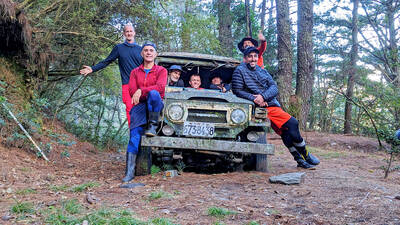
The year was 1991. A Toyota Land Cruiser set out on a 67km journey up the Junda Forest Road (郡大林道) toward an old loggers’ camp, at which point the hikers inside would get out and begin their ascent of Jade Mountain (玉山). Little did they know, they would be the last group of hikers to ever enjoy this shortcut into the mountains. An approaching typhoon soon wiped out the road behind them, trapping the vehicle on the mountain and forever changing the approach to Jade Mountain. THE CONTEMPORARY ROUTE Nowadays, the approach to Jade Mountain from the north side takes an

Last week Joseph Nye, the well-known China scholar, wrote on the Australian Strategic Policy Institute’s website about how war over Taiwan might be averted. He noted that years ago he was on a team that met with then-president Chen Shui-bian (陳水扁), “whose previous ‘unofficial’ visit to the US had caused a crisis in which China fired missiles into the sea and the US deployed carriers off the coast of Taiwan.” Yes, that’s right, mighty Chen caused that crisis all by himself. Neither the US nor the People’s Republic of China (PRC) exercised any agency. Nye then nostalgically invoked the comical specter

Relations between Taiwan and the Czech Republic have flourished in recent years. However, not everyone is pleased about the growing friendship between the two countries. Last month, an incident involving a Chinese diplomat tailing the car of vice president-elect Hsiao Bi-khim (蕭美琴) in Prague, drew public attention to the People’s Republic of China’s (PRC) operations to undermine Taiwan overseas. The trip was not Hsiao’s first visit to the Central European country. It was meant to be low-key, a chance to meet with local academics and politicians, until her police escort noticed a car was tailing her through the Czech capital. The

April 15 to April 21 Yang Kui (楊逵) was horrified as he drove past trucks, oxcarts and trolleys loaded with coffins on his way to Tuntzechiao (屯子腳), which he heard had been completely destroyed. The friend he came to check on was safe, but most residents were suffering in the town hit the hardest by the 7.1-magnitude Hsinchu-Taichung Earthquake on April 21, 1935. It remains the deadliest in Taiwan’s recorded history, claiming around 3,300 lives and injuring nearly 12,000. The disaster completely flattened roughly 18,000 houses and damaged countless more. The social activist and


 RSS
RSS