


Once again, we find ourselves in the thick of the biopic and costume drama season, during which actors, directors and production designers stake their Oscar hopes on the detailed reconstruction of the past. Period movies are nothing new, of course -- playing historical dress-up has been part of filmmaking since the beginning -- but there seems to be, at present, a curious obsession with a single period.
The three high-profile movies about real people that opened this fall -- George Clooney's Good Night, and Good Luck, Bennett Miller's Capote and James Mangold's Walk the Line -- take place mainly in the hard-to-define, decade-straddling era between Korea and Vietnam. Clooney's movie, the most concentrated of the three, flashes back from 1958 to 1954, a pivotal moment in the career of its subject, Edward Murrow. Miller's begins in 1959, with a murder in rural Kansas, and ends in 1966, with the publication of In Cold Blood, Truman Capote's book about the crime. Walk the Line, the most conventionally biographical of the three, charts the rise of Johnny Cash, dwelling for most of its running time on the span of his career between 1955, when Sam Phillips signed him up at Sun Records, and 1968, when he married June Carter and performed his famous concert at Folsom Prison.
This might seem like more of a coincidence if last year's biopics -- Ray, Kinsey, Beyond the Sea -- had not also concerned American celebrities of the postwar era, and if a passel of other recent period pictures, from Mona Lisa Smile and Far From Heaven to What Lies Beneath and the forthcoming Brokeback Mountain, did not mine the same historical ground. Everywhere you look, it seems, you see women in A-line skirts and men in narrow-lapelled sack suits, smoking unfiltered cigarettes and drinking highballs, talking on black rotary-dial phones and traveling the country in wood-paneled buses, accompanied by a soundtrack of appropriate pop, country and R&B tunes. And some of the era's cachet surely resides in the deep reservoir of visual and aural styles it offers. In a way that subsequent decades are not, the late 1950s and early 1960s seem permanently cool.
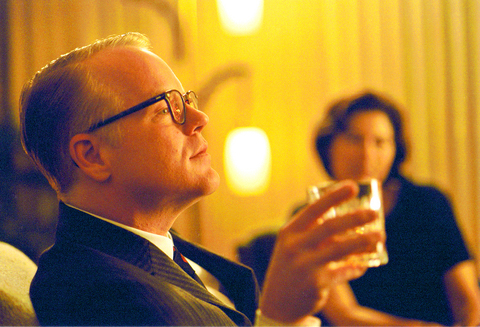
PHOTO: AP
But that perception is itself most likely the product of a particular generational perspective. The years in question coincide with the formative years of the baby boomers, a cohort whose endless self-discovery has dominated American popular culture for as long as some of us can remember. Perhaps more relevant, for Americans born in the 1960s -- including Clooney, Mangold, Miller and this critic -- the Eisenhower and Kennedy years lie just over the horizon of living memory, and therefore are likely to exert a particular fascination. Characters like Johnny Cash, Ray Charles, Edward Murrow and Truman Capote are at once tantalizingly close and intriguingly remote. We may recognize their names, faces and voices, but still wonder where they came from and who they really were.
Watching these movies, with their painstaking detail and their trompe l'oeil leading performances, we may also wonder how we got from there to here, a line of inquiry that the pictures frustrate by means of their elaborate visual fidelity. The difference between a period film and a historical film, in other words, is that while a historical film implies a continuity with the present, the period film, far more common in Hollywood, seals the past in a celluloid vitrine, establishing a safe distance between then and now.
And the period in question, eventful and tumultuous though it may have been, also represents a zone of safety -- if not of comfort, exactly, then at least of clarity. The notion of the Eisenhower years as a time of dullness and conformity -- a dubious revisionist legacy of the 1960s in any case -- has been replaced by a series of images and stories that emphasize both ferment and stability. When these movies deal with political and social issues, it is almost always with the optimism of hindsight. The prejudice and repression that figure in Brokeback Mountain, Kinsey and Far From Heaven will eventually be overcome, the major evidence for this progress being the existence of the movies themselves. The specter of McCarthy, whose scowling visage haunts Good Night, and Good Luck, will be expunged, as will the racism that casts its shadow over Ray.
It is interesting that all of these movies, while gesturing toward various manifestations of social change, evade or stop short of the upheaval and rebellion now commonly thought of as characterizing the 1960s. That story may be at once too thoroughly assimilated into the cultural memory and, at the same time, still too contentious to engage the imaginations of today's filmmakers. The ideological and culture fractures of the present, moreover, feed a nostalgic longing for images of consensus. It is not just that Ray Charles and Johnny Cash, mavericks in their own day, have become objects of universal admiration, but also that the stories of their ascension to stardom are, implicitly, stories about the public that has such people in common.
The greatest nostalgia these films express is for the culture that produced characters like Charles and Cash, Murrow and Capote -- all of them creations of a celebrity-driven mass media at an early phase of its dominance, and all of them distinguished, at least in retrospect, with a kind of self-invented, all-American authenticity that seems to have vanished from the cultural scene. That authenticity may not have been visible at the time, but if movies can't synthesize authenticity, what good are they? Remember when television news was a bastion of integrity? When nonfiction pieces in glossy magazines changed the way people thought about journalism and literature? When the music charts were dominated by innovators who gave traditional American forms a modern, personal spin? Neither do I. That's the point.

In late October of 1873 the government of Japan decided against sending a military expedition to Korea to force that nation to open trade relations. Across the government supporters of the expedition resigned immediately. The spectacle of revolt by disaffected samurai began to loom over Japanese politics. In January of 1874 disaffected samurai attacked a senior minister in Tokyo. A month later, a group of pro-Korea expedition and anti-foreign elements from Saga prefecture in Kyushu revolted, driven in part by high food prices stemming from poor harvests. Their leader, according to Edward Drea’s classic Japan’s Imperial Army, was a samurai

Located down a sideroad in old Wanhua District (萬華區), Waley Art (水谷藝術) has an established reputation for curating some of the more provocative indie art exhibitions in Taipei. And this month is no exception. Beyond the innocuous facade of a shophouse, the full three stories of the gallery space (including the basement) have been taken over by photographs, installation videos and abstract images courtesy of two creatives who hail from the opposite ends of the earth, Taiwan’s Hsu Yi-ting (許懿婷) and Germany’s Benjamin Janzen. “In 2019, I had an art residency in Europe,” Hsu says. “I met Benjamin in the lobby
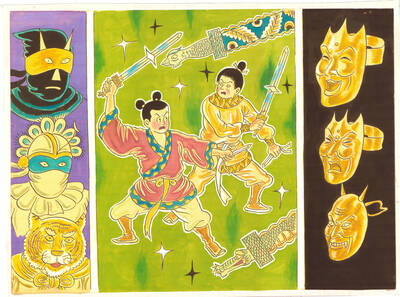
April 22 to April 28 The true identity of the mastermind behind the Demon Gang (魔鬼黨) was undoubtedly on the minds of countless schoolchildren in late 1958. In the days leading up to the big reveal, more than 10,000 guesses were sent to Ta Hwa Publishing Co (大華文化社) for a chance to win prizes. The smash success of the comic series Great Battle Against the Demon Gang (大戰魔鬼黨) came as a surprise to author Yeh Hung-chia (葉宏甲), who had long given up on his dream after being jailed for 10 months in 1947 over political cartoons. Protagonist

A fossil jawbone found by a British girl and her father on a beach in Somerset, England belongs to a gigantic marine reptile dating to 202 million years ago that appears to have been among the largest animals ever on Earth. Researchers said on Wednesday the bone, called a surangular, was from a type of ocean-going reptile called an ichthyosaur. Based on its dimensions compared to the same bone in closely related ichthyosaurs, the researchers estimated that the Triassic Period creature, which they named Ichthyotitan severnensis, was between 22-26 meters long. That would make it perhaps the largest-known marine reptile and would


 RSS
RSS