


A film festival on Canada, New Zealand and Taiwan's indigenous peoples will begin on Monday.
Thirty-two films will be shown in university audito-riums around the island free of charge until the end of next year.
The non-profit film festival is part of the International Indigenous Creativity Conference. The Council of Indigenous People (CIP), under the supervision of the Executive Yuan, signed a memorandum of
understanding with the Canadian government in 1994 and an arrangement with New Zealand last year to promote indigenous peoples' issues, allowing the three countries to organize the festival.
The festival starts at Chung Yuan University in Chungli City.
From there, the films will travel around Taiwan to Bunun tribes in Taitung, eastern Taiwan, Chiayi University, Pingtung Aboriginal Cultural Park, Shunyi Aboriginal Museum, Hualien Donghua University and Taichung's Providence University.
Other organizations and academic parties interested in showing the films are still trying to get in touch with the organizers.
Director of the General Relations Department of the Canadian Trade Office David Hamilton said during a news conference that the 13 films from his country were selected by the National Film Board of Canada among 450 made during the past 30 years.
"Indigenous peoples' culture is boundless. Canadian indigenous peoples are trying to tell their story to the world through these movies. We hope to bring a new point of view for Taiwanese audiences regarding indigenous peoples' issues," Hamilton said.
Indigenous peoples represent 4 percent of Canada's total population, while Taiwan's Aborigines make up 2 percent of the island's residents.
The festival will feature 14 films made by three Taiwanese indigenous directors.
Among the films from Taiwan, one of the most controversial is the one entitled, What is your real name? by Mayao Biho. The film talks about the controversy of Taiwanese indigenous people and whether to use their names in their ancestral tongue on identi-fication cards.
"Local regulations have for the last 11 years allowed indigenous people here to use their names in their mother tongue. But as of the end of September, there were only 890 indigenous people who rectified their Chinese name into their real name. But 65 of these apparently regret having done so, " said Mayao, who also has his mother tongue name on his ID card.
The film director humorously compared the number of people who rectified their name with the number of black-faced spoonbills, a protected migratory bird that overwinters in Taiwan.
"There are also about 800 of them. Last year we were winners because there were more of us than the birds. But this year we lost because there were more than 900 birds," Mayao said.
Mayao said that he was extremely surprised that his film was chosen because the topics he usually tackles are critical of the government.
Two of the Canadian films, Kanehsatake made by Alanis Obomsawin and No Turning Back from Greg Coyes, report on violent armed conflicts between indigenous peoples and governmental authorities when native peoples strive for the right to own their ancestral lands and to restore their civil rights.
Mayao said that indigenous activitism, such as fighting for the right to have names recorded in mother tongues, the right to follow Aboriginal cultural practices and to own ancestoral land, mostly follows the trend of Canada.
"If they didn't start, the indigenous people here wouldn't be that aware and have a path to follow," Mayao said.

In late October of 1873 the government of Japan decided against sending a military expedition to Korea to force that nation to open trade relations. Across the government supporters of the expedition resigned immediately. The spectacle of revolt by disaffected samurai began to loom over Japanese politics. In January of 1874 disaffected samurai attacked a senior minister in Tokyo. A month later, a group of pro-Korea expedition and anti-foreign elements from Saga prefecture in Kyushu revolted, driven in part by high food prices stemming from poor harvests. Their leader, according to Edward Drea’s classic Japan’s Imperial Army, was a samurai

Located down a sideroad in old Wanhua District (萬華區), Waley Art (水谷藝術) has an established reputation for curating some of the more provocative indie art exhibitions in Taipei. And this month is no exception. Beyond the innocuous facade of a shophouse, the full three stories of the gallery space (including the basement) have been taken over by photographs, installation videos and abstract images courtesy of two creatives who hail from the opposite ends of the earth, Taiwan’s Hsu Yi-ting (許懿婷) and Germany’s Benjamin Janzen. “In 2019, I had an art residency in Europe,” Hsu says. “I met Benjamin in the lobby
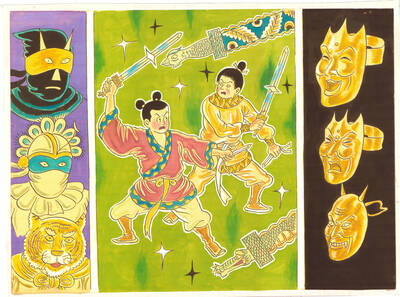
April 22 to April 28 The true identity of the mastermind behind the Demon Gang (魔鬼黨) was undoubtedly on the minds of countless schoolchildren in late 1958. In the days leading up to the big reveal, more than 10,000 guesses were sent to Ta Hwa Publishing Co (大華文化社) for a chance to win prizes. The smash success of the comic series Great Battle Against the Demon Gang (大戰魔鬼黨) came as a surprise to author Yeh Hung-chia (葉宏甲), who had long given up on his dream after being jailed for 10 months in 1947 over political cartoons. Protagonist

A fossil jawbone found by a British girl and her father on a beach in Somerset, England belongs to a gigantic marine reptile dating to 202 million years ago that appears to have been among the largest animals ever on Earth. Researchers said on Wednesday the bone, called a surangular, was from a type of ocean-going reptile called an ichthyosaur. Based on its dimensions compared to the same bone in closely related ichthyosaurs, the researchers estimated that the Triassic Period creature, which they named Ichthyotitan severnensis, was between 22-26 meters long. That would make it perhaps the largest-known marine reptile and would


 RSS
RSS