


Recently among artists, curators and critics in Taiwan's art circles there has been discussion about the differences in Western and Eastern aesthetics and perceptions. In our media-saturated world formed by Hollywood movie images, the question that many Taiwanese artists ask themselves is: Can today's artists have an Asian perspective. And if so, is an Asian point of view different from a Western one?
Two exhibitions currently on view unwittingly explore this issue, as the three artists are from Taiwan, yet were educated in art institutions in the US.
The medium of choice for these artists is photography.
PHOTOS COURTESY OF THE ARTIST
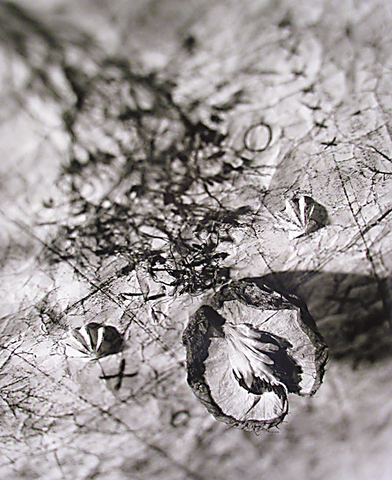
For her exhibition at TIVAC titled Minutiae, Kuo Hsiu-li (
Also at TIVAC are works by Huang Yachi (
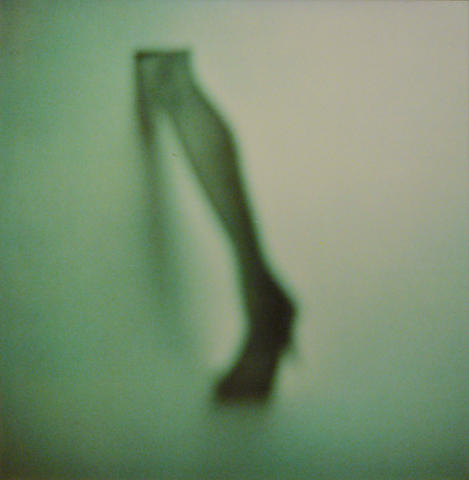
Huang created The Model House as a way to explore the concept of the ideal home. Each image of a home or building is blurred with a greenish tint, as if a sickly pallor has descended on an idealistic idea of home. In this way Huang criticizes media imagery that sells a box and calls it an ideal living situation.
Exhibitions at IT Park tend to have long introductions that border on the poetic. This exhibition is no exception and the title almost prepares you for the viewing experience.
Los Angeles-based artist and Yale graduate Arthur Ou's (
Where Huang's work is quickly recognized and easy to digest, Ou's is like a puzzle that needs to be decoded and deciphered. For a start, the exhibition title sets the tone for what is to follow.

The key word "annihilation" is often repeated at the same time as nuclear explosion. Here Ou refers to the obliteration of experience due to the illusory nature of memory.
He works like an archeologist digging up artifacts via his conceptual photography and sculptural installations, that include a cabinet of ceramic artifacts, a 3D architectural model of a building and lighting fixtures.
Overall, his attention to the most minute detail enhances the viewer's sensory perceptions of the surrounding environment. But Ou's archeology is an archeology of the present moment, as a way to preserve the "now" -- before we forget it.
After looking at these artists' works, categorizing these images and artistic thoughts as Western or Eastern seems a futile endeavor.
Exhibition notes:
What: `The Model House' by Huang Yachi; `Minutiae' by Kuo Hsiu-Li
Where: Taiwan Internat ional Visual Arts Center (TIVAC), 1F, 29, Ln 45, Liaoning Street, Taipei (
Call: (02) 2773 3347
Hours: Tuesday to Friday, 12pm to 9pm; Saturday to Sunday, 12pm to 6pm, to Dec. 21
A Solo Exhibition by Arthur Ou, On Every New Thing There Lies Already the Shadow of Annihilation
Where: IT Park, 2/3fl, 41, Yitong St, Taipei
Call: (02) 2507 7243
Hours: Tuesday to Saturday, 1pm to 10pm
When: To Dec. 24

In late October of 1873 the government of Japan decided against sending a military expedition to Korea to force that nation to open trade relations. Across the government supporters of the expedition resigned immediately. The spectacle of revolt by disaffected samurai began to loom over Japanese politics. In January of 1874 disaffected samurai attacked a senior minister in Tokyo. A month later, a group of pro-Korea expedition and anti-foreign elements from Saga prefecture in Kyushu revolted, driven in part by high food prices stemming from poor harvests. Their leader, according to Edward Drea’s classic Japan’s Imperial Army, was a samurai

Approaching her mid-30s, Xiong Yidan reckons that most of her friends are on to their second or even third babies. But Xiong has more than a dozen. There is Lucky, the street dog from Bangkok who jumped into a taxi with her and never left. There is Sophie and Ben, sibling geese, who honk from morning to night. Boop and Pan, both goats, are romantically involved. Dumpling the hedgehog enjoys a belly rub from time to time. The list goes on. Xiong nurtures her brood from her 8,000 square meter farm in Chiang Dao, a mountainous district in northern Thailand’s

Located down a sideroad in old Wanhua District (萬華區), Waley Art (水谷藝術) has an established reputation for curating some of the more provocative indie art exhibitions in Taipei. And this month is no exception. Beyond the innocuous facade of a shophouse, the full three stories of the gallery space (including the basement) have been taken over by photographs, installation videos and abstract images courtesy of two creatives who hail from the opposite ends of the earth, Taiwan’s Hsu Yi-ting (許懿婷) and Germany’s Benjamin Janzen. “In 2019, I had an art residency in Europe,” Hsu says. “I met Benjamin in the lobby

April 22 to April 28 The true identity of the mastermind behind the Demon Gang (魔鬼黨) was undoubtedly on the minds of countless schoolchildren in late 1958. In the days leading up to the big reveal, more than 10,000 guesses were sent to Ta Hwa Publishing Co (大華文化社) for a chance to win prizes. The smash success of the comic series Great Battle Against the Demon Gang (大戰魔鬼黨) came as a surprise to author Yeh Hung-chia (葉宏甲), who had long given up on his dream after being jailed for 10 months in 1947 over political cartoons. Protagonist


 RSS
RSS