


It was the 1980s and the virtuoso violinist Yehudi Menuhin was performing at the Salle Pleyel in Paris. "He played an encore and I'm sitting in the orchestra and I said to my wife, `Something happened to his violin,'" said Etienne Vatelot, one of the world's great violin restorers, warming to the story.
After the concert Vatelot asked Menuhin why the sound was different during the concert and the encore. "He laughed and explained that he had two Stradivari with him in the dressing room," Vatelot said. "He used one for the concert, but when he came out for the encore he accidentally picked up the second."
As Vatelot spoke, he cradled with a trembling hand the top of an 18th-century violin that appeared to have been stepped on by a high-heel shoe. "I come in every day," he said, a smile curling about his lip, "but I can no longer do certain things that require a steady hand."
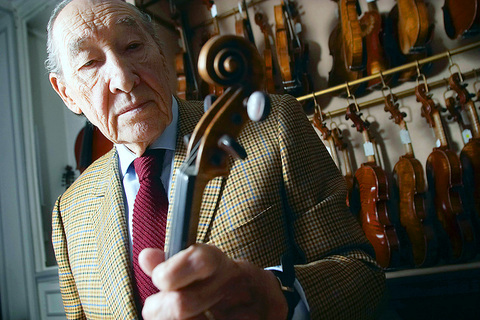
PHOTO: NY TIMES NEWS SERVICE
So four younger violin restorers sat around him tapping, sawing and shaving in a mad jumble of rusted tools, varnish pots and, of course, stringed instruments whose bodies lay about like tortoise shells.
Certainly a steady hand was one of the attributes, along with a passion for musical instruments, that helped Vatelot, 80, become one of the leading luthiers, as makers, restorers and dealers of stringed instruments are called. But what keeps him in the business is above all a keen ear for the qualities of a violin and a physician's diagnostic skill for analyzing what may be wrong with it. For more than half a century, virtuoso violinists and cellists from around the world have brought their instruments to him to be fixed, tuned and generally brought back to life. Along the way, he has helped revive a craft in France that nearly disappeared in the decades after World War II.
Vatelot was born in Mirecourt, known as "the city of violins," the son of a violin maker and the great-great grandson of a guitar maker. "There were 1,000 violin makers in a city of 6,000," he said.
In 1909 his father, Marcel Vatelot, moved to Paris to open a workshop in the central Rue Portalis, in the rooms still used by Vatelot. Marcel Vatelot gained entry into Parisian musical circles through his wife, Jehane, the daughter of a noted cellist of the time, Andre Hekking. Their circle included the composer Maurice Ravel. Later, Marcel Vatelot sent his son to Mirecourt and to New York, where he worked with Rembert Wurlitzer, who ran the foremost violin restoration shop in America, to learn the craft.
While Marcel Vatelot was respected, he was not nearly as gifted as his son, who soon eclipsed him. It was just after 1950 that the great soloists began to beat a path to Vatelot's door. "I had particularly at heart the search for the why of a tone, and the modifying of a tone," he said. "This permitted me to have a clientele of great soloists, Pablo Casals, Yehudi Menuhin, Isaac Stern."
But business was slow in those years. "Classical music was not fashionable, the business was reduced to some old amateurs," Vatelot said, seated in his office surrounded by violins and photos of great soloists who entrusted their instruments to him and became his friends: the cellists Mstislav Rostropovich and Yo Yo Ma, the violinists Isaac Stern, David Oistrach and Ivry Gitlis.
So with the filmmaker Claude Santelli, who produced a moving documentary on violin restoration, and with the cooperation of soloists like Menuhin and the violinist Arthur Grumiaux, Vatelot labored on a project to establish a school for young luthiers in Mirecourt.
"At the start I was at pains to find five apprentices," he said, a twinkle in his lively eyes. "Now, there are 200," he said, lumping together current students and graduates.
As prices for violins soared in the decades after the war the business became lucrative, but Vatelot poured much of what he made back into his craft. In 1975 he founded the Marcel Vatelot Foundation to give scholarships to apprentice violin makers from disadvantaged families. But his greatest gift remains his passion for music and ability to diagnose what ails any stringed instrument, but particularly a violin, and to prescribe treatment. "If someone comes in with a Stradivari or a Guarneri, he comes in and checks it out," said the conductor David Stern, whose father Isaac Stern was a regular client and close friend of Vatelot's.
Isaac Stern normally brought his violins to the New York violin maker Rene Morel, but at least once a year he would visit Vatelot in Paris.
On one occasion, when Vatelot coaxed him to say what he thought was wrong with his instrument (he played a Guarneri), Stern replied, "Etienne, you know better than I do!"
He believes there is a tonality that fits the violinist's personality, so he tries when possible to hear the violinist in concert. (In fact, he still maintains his lifetime practice of attending violin concerts virtually every night of the week.) Failing that, he will have the violinist play in his workshop and, on occasion, will play the instrument himself.
"I may find the instrument is whistling a bit, or is not quite in form," he said. "It can be due to several things. First of all the humidity, if the instrument is too dry, or too humid. In Indonesia, for example, there is very high humidity. Secondly, if the tone is bad you do various tests."
He may order the violin cleaned or, if there is damage to the wood, repaired; the finger board, usually made of soft ebony wood, may be uneven and in need of being sanded down. He may adjust the tension of the strings, the angle of the bridge, the tiny wood piece that supports the strings. He may adjust by millimeters the sound post, the slender wedge of wood inside the violin that the French call l'ame, or the "soul," of the violin, for its crucial role in creating the tone.
Vatelot has often compared his activity to that of a physician, diagnosing an illness and prescribing the remedy. "You are like a doctor doing a verification of the health of the instrument, to see if all is in place" he said. "In general, a soloist is like other people, he doesn't want to change doctors. He chooses a violin maker and keeps his confidence in him."
Which may explain why, when friends celebrated Vatelot's birthday earlier this month with a concert at the Salle Gaveau in Paris, the guests included the virtuoso violin soloists Salvatore Accardo and Anne-Sophie Mutter, in addition to the conductor and pianist Daniel Barenboim.
Vatelot has handed over the day-to-day running of the shop to Jean-Jacques Rampal, the son of the virtuoso flutist Jean-Pierre Rampal, who was a close friend of Vatelot's.
The younger Rampal said that with the exception of Rostro-povich, Vatelot's musical generation is almost gone. "It's sad for him," Rampal said. "It was his faithful universe."
For the time being, Vatelot says, he will continue coming to the workshop every day. Pointing to an overstuffed armchair in his office, he said: "In 1959 my father handed over his workshop to me. Every afternoon he would sit in that armchair and he would say, `I want to die gazing at the restoration of violins.'"

In late October of 1873 the government of Japan decided against sending a military expedition to Korea to force that nation to open trade relations. Across the government supporters of the expedition resigned immediately. The spectacle of revolt by disaffected samurai began to loom over Japanese politics. In January of 1874 disaffected samurai attacked a senior minister in Tokyo. A month later, a group of pro-Korea expedition and anti-foreign elements from Saga prefecture in Kyushu revolted, driven in part by high food prices stemming from poor harvests. Their leader, according to Edward Drea’s classic Japan’s Imperial Army, was a samurai
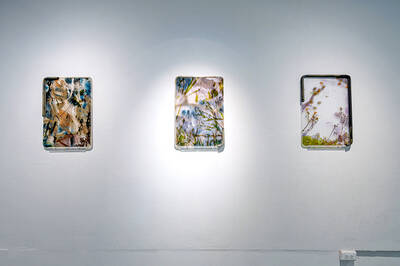
Located down a sideroad in old Wanhua District (萬華區), Waley Art (水谷藝術) has an established reputation for curating some of the more provocative indie art exhibitions in Taipei. And this month is no exception. Beyond the innocuous facade of a shophouse, the full three stories of the gallery space (including the basement) have been taken over by photographs, installation videos and abstract images courtesy of two creatives who hail from the opposite ends of the earth, Taiwan’s Hsu Yi-ting (許懿婷) and Germany’s Benjamin Janzen. “In 2019, I had an art residency in Europe,” Hsu says. “I met Benjamin in the lobby

April 22 to April 28 The true identity of the mastermind behind the Demon Gang (魔鬼黨) was undoubtedly on the minds of countless schoolchildren in late 1958. In the days leading up to the big reveal, more than 10,000 guesses were sent to Ta Hwa Publishing Co (大華文化社) for a chance to win prizes. The smash success of the comic series Great Battle Against the Demon Gang (大戰魔鬼黨) came as a surprise to author Yeh Hung-chia (葉宏甲), who had long given up on his dream after being jailed for 10 months in 1947 over political cartoons. Protagonist

A fossil jawbone found by a British girl and her father on a beach in Somerset, England belongs to a gigantic marine reptile dating to 202 million years ago that appears to have been among the largest animals ever on Earth. Researchers said on Wednesday the bone, called a surangular, was from a type of ocean-going reptile called an ichthyosaur. Based on its dimensions compared to the same bone in closely related ichthyosaurs, the researchers estimated that the Triassic Period creature, which they named Ichthyotitan severnensis, was between 22-26 meters long. That would make it perhaps the largest-known marine reptile and would


 RSS
RSS