


Russia is a Slavic nation and historically an Orthodox Christian one. But it is also Islamic, and since the fall of the Soviet Union 14 years ago, Islam has grown increasingly visible and influential.
This is worrisome to some Slavic Russians, who fear not only Muslim extremists, but the possibility that Russia could one day become a majority Muslim state.
Still, if the threat -- and reality -- of conflict exists, it is also true that in many places, Muslim and Christian cultures are peacefully adapting to each other.
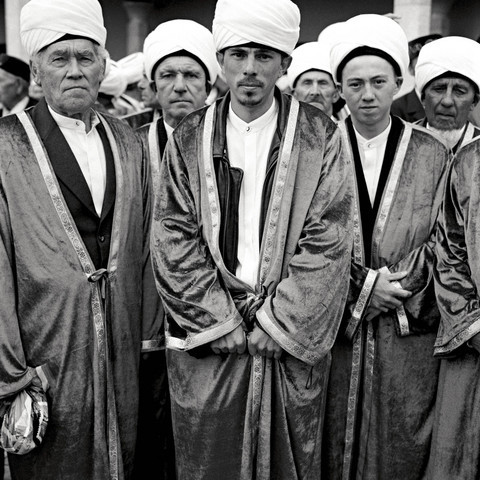
PHOTOS: NY TIMES
Islam spread into what became the Russian Empire in the 10th century -- 66 years ahead of Christianity, said Ravil Gainutdin, chairman of Russia's Council of Muftis. "Islam is a religion of native peoples in Russia and a traditional religion of this country," he said.
There are now an estimated 14 million to 23 million Muslims in Russia, as much as 16 percent of the population. They are in the majority in Russia's turbulent south, but more live quietly in places like Tatarstan and Bashkortostan on the Volga River, and in virtually every city.
Given the historic domination of the church, the czars and then
communism, Islam here has adopted an essentially Russian character. Believers pick and chose tenets of faith to follow, just as Orthodox Christians do. Even in predominantly Muslim cities, for example, alcohol flows abundantly.
"No one challenges me if I drink coffee during Ramadan," Murat Khokon, a physics professor at the University of Kabardino-Balkariya, a southern republic, said in an interview over an afternoon coffee during Ramadan. "It is between me and God. This is the culture we have here."
Even so, fundamentalism -- sometimes called "pure" Islam -- has made inroads among those who lacked access to the faith's teachings under communism.
The Kremlin, increasingly, has sought to control Islam, persecuting those who worship outside state-sanctioned "official" mosques. A crackdown in Nalchik, Kabardino-Balkariya's capital, closed six mosques and many Muslims were harassed. In October, at least 136 people died when armed men attacked police and security posts in what their relatives said was a revolt against official abuses.
"Russia," said Ali Pshigotyzhev, whose son was arrested following the fighting, "was not ready for the rebirth of Islam."
Could Russia be a model of relations between Islam and Christianity? That might seem an improbable question, given the tensions here. But in Kazan, the capital of Tatarstan, the two faiths have established a peaceful co-existence since the Soviet collapse.
In a sign of Islam's revival among the deeply traditional Tatars, the authorities recently opened the Kul Sharif Mosque inside the city's historic Kremlin. Its location is symbolic: It stands not far from the Annunciation Cathedral, which like the Kremlin itself, was built under Ivan the Terrible, the czar who conquered Tatarstan in 1552. It is named after the man who died resisting Ivan's troops.
It might not suggest a historic reconciliation, but the mosque represents Islam's place beside Christianity in today's Russia.
"Russian Muslims are people brought up on the culture of both Europe and Asia," Ravil Gainutdin, chairman of Russia's Council of Muftis, who is from Tatarstan, said. "And for the Muslims of our country, living side by side with Christians, Buddhists, Jews, is an experience that is centuries old."
An estimated 1 million Muslims live in Moscow, making it Europe's most Islamic city -- at least ethnically. Outwardly, though, the onion domes of Russian Orthodoxy dominate the cityscape. The Moscow Cathedral Mosque, the city's oldest, built in 1904, is a small building, literally in the shadow of the basketball arena built for the 1980 Olympics. The Council of Muftis has begun construction of a larger mosque next door, reflecting Islam's expansion in Russia. Islam's practices its prayers, its separation of men and women are universal, but the shoes are unmistakably Russian.
Islam's revival in the North Caucasus, on Russia's southern frontier, has been
accompanied by suspicion, conflict and, in Chechnya, war. In Cherkessk, capital of Karachayevo-Cherkessia, there is only one small mosque, built by believers in 1997. A billboard -- quoting the Prophet Muhammad, in Russian, raises funds for a new one. At the city's Islamic Institute, opened in 1993, 66 students learn the tenets of Islam, as well as Arabic, though under the scrutiny of the state, which remains suspicious of those who study Islam outside of state-sanctioned institutions.
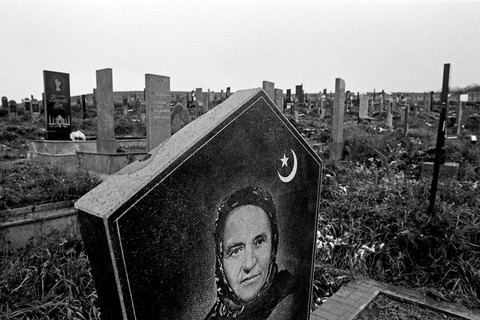
At the Muslim cemetery in Nalchik, in neighboring Kabardino-Balkariya, etchings on headstones belie the influence of Russian culture; as Islam proscribes such imagery. The cemetery's newest graves include those killed in two days of fighting in October, provoked by government repression against devout Muslims.

In late October of 1873 the government of Japan decided against sending a military expedition to Korea to force that nation to open trade relations. Across the government supporters of the expedition resigned immediately. The spectacle of revolt by disaffected samurai began to loom over Japanese politics. In January of 1874 disaffected samurai attacked a senior minister in Tokyo. A month later, a group of pro-Korea expedition and anti-foreign elements from Saga prefecture in Kyushu revolted, driven in part by high food prices stemming from poor harvests. Their leader, according to Edward Drea’s classic Japan’s Imperial Army, was a samurai

Located down a sideroad in old Wanhua District (萬華區), Waley Art (水谷藝術) has an established reputation for curating some of the more provocative indie art exhibitions in Taipei. And this month is no exception. Beyond the innocuous facade of a shophouse, the full three stories of the gallery space (including the basement) have been taken over by photographs, installation videos and abstract images courtesy of two creatives who hail from the opposite ends of the earth, Taiwan’s Hsu Yi-ting (許懿婷) and Germany’s Benjamin Janzen. “In 2019, I had an art residency in Europe,” Hsu says. “I met Benjamin in the lobby
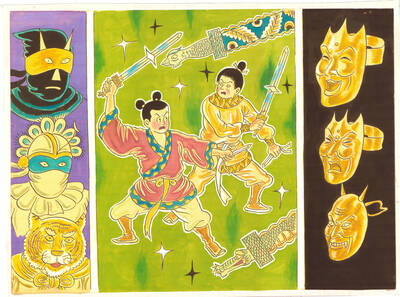
April 22 to April 28 The true identity of the mastermind behind the Demon Gang (魔鬼黨) was undoubtedly on the minds of countless schoolchildren in late 1958. In the days leading up to the big reveal, more than 10,000 guesses were sent to Ta Hwa Publishing Co (大華文化社) for a chance to win prizes. The smash success of the comic series Great Battle Against the Demon Gang (大戰魔鬼黨) came as a surprise to author Yeh Hung-chia (葉宏甲), who had long given up on his dream after being jailed for 10 months in 1947 over political cartoons. Protagonist

A fossil jawbone found by a British girl and her father on a beach in Somerset, England belongs to a gigantic marine reptile dating to 202 million years ago that appears to have been among the largest animals ever on Earth. Researchers said on Wednesday the bone, called a surangular, was from a type of ocean-going reptile called an ichthyosaur. Based on its dimensions compared to the same bone in closely related ichthyosaurs, the researchers estimated that the Triassic Period creature, which they named Ichthyotitan severnensis, was between 22-26 meters long. That would make it perhaps the largest-known marine reptile and would


 RSS
RSS