


Yesterday was the 70th birthday of Helmut Lachenmann, one of the most fearsome creative intellects in new music.
Lachenmann's work invites controversy. The bulk of his output is large-scale, requiring orchestral musicians to learn specialized, unconventional techniques, plus a whole new notation. At times they have reacted with incredulity, or hostility -- in Stuttgart, members of the Southwest Radio Symphony Orchestra initially refused to play his work Staub, despite it being the orchestra's own commission.
Today, such confrontations are mostly a thing of the past: musicians' resistance has given way to respect, thanks to Lachenmann's combination of charm, integrity and quiet authority. He takes his own violin to rehearsals to demonstrate fingerings for obscure harmonics, and likes to work in detail with individual players.
Principal flautist Gaby Pas-Van Riet was one of his few admirers at the time of the Stuttgart "revolt" in 1985. Delighted by her determination, laughter and passion, Lachenmann spoke of writing something for her one day. Ten years later, she received a phone call: the "something" had become an enormous double concerto for flute and trombone, eight male voices and orchestra.
The resulting composition was Nun, one of the most remarkable orchestral works of the past decade. Unlike many of the composer's other works, in which precision is paramount, Nun climaxes in a part-free cadenza, during which the soloists improvise around given figurations. The conductor also improvises, moulding the orchestra at will, adding and removing instrumental groups.
Helmut Lachenmann was born in Stuttgart and studied at its Musikhochschule, where he later became professor of composition. For many years he taught at the Darmstadt summer school, in the footsteps of Stockhausen, Boulez, Ligeti and Adorno. His music is radical and politically motivated, and it is easy to label him as typical of the incestuous German avant-garde scene and its contorted polemics. But that would be simplistic.
As a young man, Lachenmann went to Venice to study with Luigi Nono. It was a life-changing experience. Then in his 40s, Nono was a prominent leftwing idealist and member of the Italian Communist party. He was already growing apart from the Darmstadt avant garde, whose music, according to Lachenmann, he regarded as "baroque." For Nono, every note had to have a political and structural purpose. It was a gruelling apprenticeship. "I never dared to write a trill," Lachenmann recalls. "If I wrote two notes together, Nono would say, `This is a melodic cell,' or he would demand, `Where is your political standpoint?'"
Perhaps the timeless atmosphere of Venice also affected Lachenmann. His music sounds nothing like Nono's, but to an even greater degree it is purged of conventional "bourgeois" procedures. And it is full of resonances: high and low, simple or intricate. Sounds breathe into life, crackle and bustle, erupt and cascade, aggregating into staccato chords whose tones linger in the air, like distant bells. A fine example is his piano concerto Ausklang (Sounds Fading).
On his return from Venice, Lachenmann resolved to continue Nono's conceptually purist ethic and create music that would be rigorously non-figurative. Like others at the time, he explored every possible way instruments could be used. Working at the margins of sound, his early scores contain as many gradations of noise as of pitch.
Sound-producing actions are so magnified as to assume the structural role of conventional tones. It's a bit like viewing a fabric from the back, with the rough and fraying knots revealed and the pattern dimly perceived.
Lachenmann's textural imagination and handling of context have become increasingly impressive. His aim was once to jolt an audience out of complacent listening habits, and in the mature, large-scale work we are drawn into a vortex in which the cumulative dynamic of local events develops a thrilling momentum. Fellow composer Wolfgang Rihm remarks how the basic tempo of the music is fast. Even in the agonizingly long moments of stasis we sense the rapid foundation, the sudden flash of particles racing along the ground and their hidden suction.
Lachenmann, Rihm suggests, "is perhaps the only composer who truly composes classically."

In late October of 1873 the government of Japan decided against sending a military expedition to Korea to force that nation to open trade relations. Across the government supporters of the expedition resigned immediately. The spectacle of revolt by disaffected samurai began to loom over Japanese politics. In January of 1874 disaffected samurai attacked a senior minister in Tokyo. A month later, a group of pro-Korea expedition and anti-foreign elements from Saga prefecture in Kyushu revolted, driven in part by high food prices stemming from poor harvests. Their leader, according to Edward Drea’s classic Japan’s Imperial Army, was a samurai

Located down a sideroad in old Wanhua District (萬華區), Waley Art (水谷藝術) has an established reputation for curating some of the more provocative indie art exhibitions in Taipei. And this month is no exception. Beyond the innocuous facade of a shophouse, the full three stories of the gallery space (including the basement) have been taken over by photographs, installation videos and abstract images courtesy of two creatives who hail from the opposite ends of the earth, Taiwan’s Hsu Yi-ting (許懿婷) and Germany’s Benjamin Janzen. “In 2019, I had an art residency in Europe,” Hsu says. “I met Benjamin in the lobby
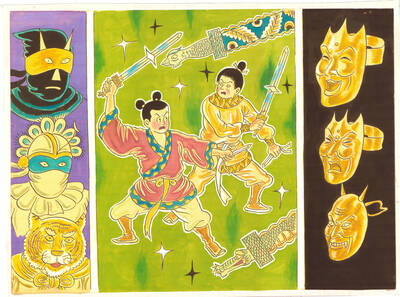
April 22 to April 28 The true identity of the mastermind behind the Demon Gang (魔鬼黨) was undoubtedly on the minds of countless schoolchildren in late 1958. In the days leading up to the big reveal, more than 10,000 guesses were sent to Ta Hwa Publishing Co (大華文化社) for a chance to win prizes. The smash success of the comic series Great Battle Against the Demon Gang (大戰魔鬼黨) came as a surprise to author Yeh Hung-chia (葉宏甲), who had long given up on his dream after being jailed for 10 months in 1947 over political cartoons. Protagonist

A fossil jawbone found by a British girl and her father on a beach in Somerset, England belongs to a gigantic marine reptile dating to 202 million years ago that appears to have been among the largest animals ever on Earth. Researchers said on Wednesday the bone, called a surangular, was from a type of ocean-going reptile called an ichthyosaur. Based on its dimensions compared to the same bone in closely related ichthyosaurs, the researchers estimated that the Triassic Period creature, which they named Ichthyotitan severnensis, was between 22-26 meters long. That would make it perhaps the largest-known marine reptile and would


 RSS
RSS