


With classical audiences dwindling, it's not surprising the major recording companies are pulling out all the stops to attract the young. The strategy goes back 50 years, but with their ever-increasing back-catalogues of performances already in their copyright, they have ever more to gain from preventing them slipping into oblivion. Sony BMG, for this reason presumably as well as more altruistic ones, is this month promoting the debut CD album The 5 Browns, a major bid to attract American and other teenagers to music in the classical idiom.
Desirae, Deondra, Gregory, Melody and Ryan Brown are a set of siblings in their 20s. They all learnt piano from the age of three and, far more surprisingly, all won scholarships to New York's prestigious Juilliard School of Music. This feat won them TV slots in the US on 60 Minutes and Oprah, and now sees them launched with a CD, plus a bonus 12-minute DVD.
On the DVD they play two five-pianos-at-a-time numbers and give a chatty interview with plentiful mention of how scary they found recording and how much they also enjoy hip-hop, jazz etc. The aim is clear -- to do everything possible to attract, and not to alienate, the ultra-cool younger generation.

PHOTOS COURTESY OF THE MANUFACTURERS
The CD, fortunately, doesn't indulge in any significant dumbing-down. They play items from Rachmaninoff, Ravel, Debussy and Prokofiev, either all five of them together or else singly (once as a pair). The standard is high. But what matters is their youth, and to understand this you have to see them playing and talking on the all-too-brief DVD.
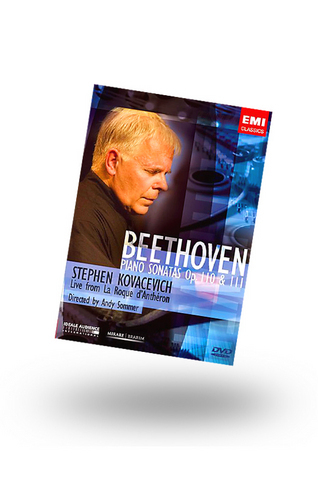
Utterly different is the somber new DVD of Stephen Kovacevich playing Beethoven's two last piano sonatas, together with some short encore pieces by Beethoven and Schubert. You only have to consider the music to know pretty much what to expect. Beethoven's last five piano sonatas are generally considered some of the most profound piano music ever written -- intellectual, ethereal, highly-wrought, both plumbing the depths and scaling the heights. The "Arietta" of Opus 111, for example, has been described as occupying "remote spiritual regions," after which "celestial utterances" nothing more could possibly be said. (The sonata does indeed stop here, without the conventional scherzo or finale).
Thus it is that, in a recital recorded last summer before a small audience in France, Kovacevich can be seen concentrating all his efforts, sweating profusely (or is he crying?), but finally triumphant. It's the kind of music that demands nothing less. It's hard on the listener too, so much so that you wonder for once quite what the sight of the soloist on DVD adds to the experience. Does it distract from your intellectual concentration? Possibly. Anyway, this, like the summit of Everest, is for dedicated devotees only, in this case devotees of Beethoven and the extremes of Romantic piano music in general.
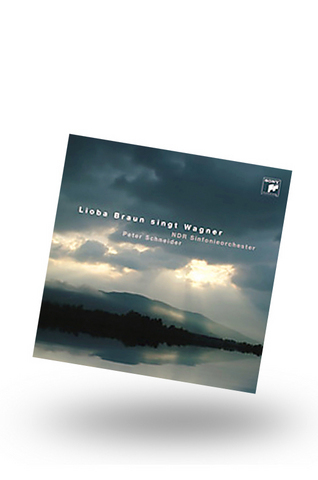
Wagner believed he was Beethoven's successor. Purists have sometimes scoffed at this claim, but the most significant difference is that Wagner was a man of the theatre and Beethoven's genius, despite Fidelio, was decidedly non-theatrical. Few can imagine the reclusive voyager leaping on stage and fervently acting everyone's parts as Wagner did.
Sony Classical now offers mezzo-soprano Lioba Braun in some of Wagner's greater operatic moments, plus his cycle of art-songs, the Wesendonck-Leider. These leider are forerunners of Richard Strauss' Four Last Songs -- possibly the only occasion when this late-comer actually outdid his illustrious master. Originally set to piano accompaniment, only one of them was orchestrated by the composer. Here are all five with orchestra, the other four in the usual versions of Felix Mottl.
The Norddeutschen Rundfunk Sinfonieorchester, playing superbly under Peter Schneider, are co-stars with the soloist on this CD. Braun has a good all-round voice, and only in the concluding liebestod from Tristan do you feel she might have bitten off rather too much. But there are stellar competitors in the catalogue for the other roles she sings here -- Kundry, Sieglinde, Waltraute -- as well, and many of these other tracks are impressive. This, then, is a generous and dependable CD, acceptable so long as you don't expect to hear a once-in-a-lifetime liebestod.
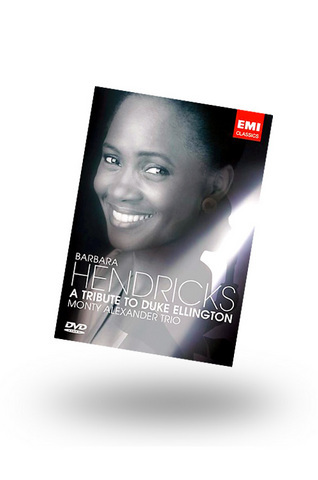
Finally there's A Tribute to Duke Ellington, the release on DVD of classical soprano Barbara Hendricks' appearance at the 1994 Montreux Jazz Festival. You see her in the relatively subdued setting of the Montreux Jazz Cafe; the tables look widely-spaced and you imagine ticket prices were high. She enters into the spirit of the 15 Duke Ellington numbers she sings, while at the same time hitting some quasi-operatic final notes. The Monty Alexander Trio she performs with are clearly ecstatic at her presence, and everyone seems overjoyed at her performance.
She's subsequently sung this kind of music in public quite frequently, but this was her first time. With her adopted Swedish nationality, her science degree, her championing of international causes, and now the variety of music she sings, Hendricks is a true original. This DVD will be very popular with many different kinds of audiences, and the fact that I didn't enjoy it very much myself is almost wholly irrelevant.

In late October of 1873 the government of Japan decided against sending a military expedition to Korea to force that nation to open trade relations. Across the government supporters of the expedition resigned immediately. The spectacle of revolt by disaffected samurai began to loom over Japanese politics. In January of 1874 disaffected samurai attacked a senior minister in Tokyo. A month later, a group of pro-Korea expedition and anti-foreign elements from Saga prefecture in Kyushu revolted, driven in part by high food prices stemming from poor harvests. Their leader, according to Edward Drea’s classic Japan’s Imperial Army, was a samurai
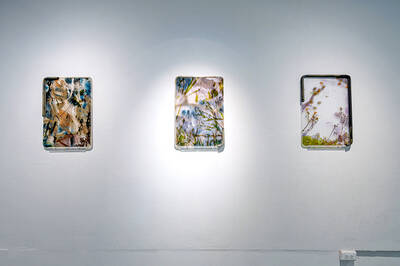
Located down a sideroad in old Wanhua District (萬華區), Waley Art (水谷藝術) has an established reputation for curating some of the more provocative indie art exhibitions in Taipei. And this month is no exception. Beyond the innocuous facade of a shophouse, the full three stories of the gallery space (including the basement) have been taken over by photographs, installation videos and abstract images courtesy of two creatives who hail from the opposite ends of the earth, Taiwan’s Hsu Yi-ting (許懿婷) and Germany’s Benjamin Janzen. “In 2019, I had an art residency in Europe,” Hsu says. “I met Benjamin in the lobby
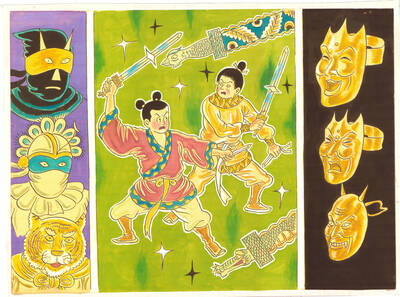
April 22 to April 28 The true identity of the mastermind behind the Demon Gang (魔鬼黨) was undoubtedly on the minds of countless schoolchildren in late 1958. In the days leading up to the big reveal, more than 10,000 guesses were sent to Ta Hwa Publishing Co (大華文化社) for a chance to win prizes. The smash success of the comic series Great Battle Against the Demon Gang (大戰魔鬼黨) came as a surprise to author Yeh Hung-chia (葉宏甲), who had long given up on his dream after being jailed for 10 months in 1947 over political cartoons. Protagonist

A fossil jawbone found by a British girl and her father on a beach in Somerset, England belongs to a gigantic marine reptile dating to 202 million years ago that appears to have been among the largest animals ever on Earth. Researchers said on Wednesday the bone, called a surangular, was from a type of ocean-going reptile called an ichthyosaur. Based on its dimensions compared to the same bone in closely related ichthyosaurs, the researchers estimated that the Triassic Period creature, which they named Ichthyotitan severnensis, was between 22-26 meters long. That would make it perhaps the largest-known marine reptile and would


 RSS
RSS