


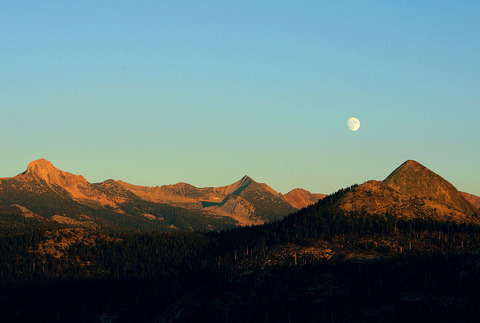
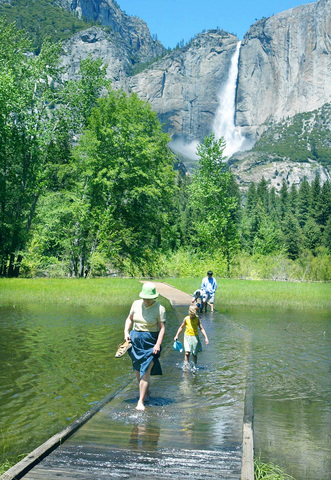
Hikers in national parks such as Yosemite and Sequoia-Kings Canyon are encountering a danger more hazardous than bears: illegal marijuana farms run by Mexican drug cartels and protected by booby traps and guards carrying AK-47s.
National Park Service officials testified in Congress on Thursday that illegal drug production in national parks, forests and other federal lands had grown into a multibillion-dollar business in recent years -- mostly concentrated in California.
"These activities threaten our employees, visitors and our mission of protecting some of the nation's most prized natural and cultural resources," Karen Taylor-Goodrich, the National Park Service's associate director for visitor and resource protection, told the House Resources Subcommittee on National Parks.
PHOTOS: NY TIMES
Last year, National Park Service officers seized about 60,000 marijuana plants, with an estimated street value of US$240 million, from parks in California. About 44,000 pot plants were removed from Sequoia National Park near California's Central Valley. Another 10,000 plants were seized in Yosemite National Park.
The Park Service also has found pot farms and other drug trafficking activities in the Santa Monica Mountains National Recreation Area and the Whiskeytown National Recreation Area in Shasta County as well as two Bay Area parks: the Golden Gate National Recreation Area and Point Reyes National Seashore.
The increasing use of national parks and other public lands for illegal pot farming is part of a major shift in the marijuana trade. Ten years ago, almost all of the state's pot was grown in the "Emerald Triangle," an area encompassing Humboldt, Mendocino and Trinity counties in Northern California, law enforcement officials said.
But Mexican drug cartels now are seizing on the state's mild climate and vast stretches of remote lands to set up pot farms across California. Tightened security on the US-Mexico border has also convinced many drug gangs it is easier to grow marijuana in the state than to smuggle it into the country.
Park service officials said the drug cartels took extreme measures to protect their plants, which can be worth US$4,000 each. Growers have been known to set up booby traps with shotguns. Guards armed with knives and military-style weapons have chased away hikers at gunpoint. In 2002, a visitor to Sequoia was briefly detained by a drug grower, who threatened to harm him if he told authorities the pot farm's secret location.
During a raid of an illegal pot farm in Santa Clara County in June, a California Fish and Game officer was wounded and a suspect shot and killed.
"In prior years, guards used to flee from Park Service law enforcement but now stand their ground with leveled guns using intimidation tactics," Laura Whitehouse, the Central Valley program manager for the National Parks Conservation Association, told the committee.
The illicit pot farms can also cause environmental damage. Growers often cut trees, dig ditches, create crude dams on streams, and haul in plastic hoses and other equipment to irrigate the plants. Fertilizers and other chemicals used by growers pollute watersheds and kill native species. Last year, the Park Service spent US$50,000 to clean up tonnes of litter, debris and human waste at pot farms that were discovered or abandoned.
Congress approved a slight increase in funding for Park Service law enforcement for next year, US$3.6 million, US$746,000 of it for drug eradication efforts in California parks. But federal and state officials say they still lack the money and personnel to patrol vast areas in and around the state's parks.
"It's a US$2 billion or a US$4 billion problem, and we're throwing US$1 million at it," said Supervisor Allen Ishida of Tulare County, whose deputies seized 157,000 pot plants on public and private lands and made 28 arrests this year.
Representative Steve Pearce, the chairman of the national parks subcommittee, said it would be tough to find more money in the federal budget as Congress deals with rising deficits and is considering cutting many programs. He urged the Park Service to put more officers on drug eradication instead of "writing parking tickets."
Donald Coelho, the Park Service's chief of law enforcement, agreed that more money was not the only solution. He said a coordinated strategy by state, federal and local law enforcement officials ultimately could put a dent in the Mexican cartels' operations.
"Sometimes it takes time to work your way through an organization," Coelho said.
State narcotics officers and the Drug Enforcement Administration seized a record 1.1 million pot plants on public and private lands in California this year, up from 621,000 plants last year, through an aggressive campaign called CAMP, or Campaign Against Marijuana Planting. The street value of those drugs is estimated at US$4.5 billion.
But state and federal officials said drug growers were adapting quickly -- for example, planting smaller pot farms that are tougher to spot from surveillance planes and helicopters. Some growers have responded to drug raids in Sequoia and other parks by moving their farms to nearby Forest Service or Bureau of Land Management lands.
Without a more comprehensive plan, "we are just shifting the problem from one jurisdiction to another," Ishida said.
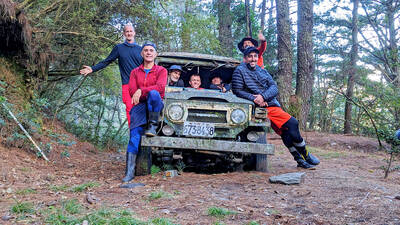
The year was 1991. A Toyota Land Cruiser set out on a 67km journey up the Junda Forest Road (郡大林道) toward an old loggers’ camp, at which point the hikers inside would get out and begin their ascent of Jade Mountain (玉山). Little did they know, they would be the last group of hikers to ever enjoy this shortcut into the mountains. An approaching typhoon soon wiped out the road behind them, trapping the vehicle on the mountain and forever changing the approach to Jade Mountain. THE CONTEMPORARY ROUTE Nowadays, the approach to Jade Mountain from the north side takes an

Last week Joseph Nye, the well-known China scholar, wrote on the Australian Strategic Policy Institute’s website about how war over Taiwan might be averted. He noted that years ago he was on a team that met with then-president Chen Shui-bian (陳水扁), “whose previous ‘unofficial’ visit to the US had caused a crisis in which China fired missiles into the sea and the US deployed carriers off the coast of Taiwan.” Yes, that’s right, mighty Chen caused that crisis all by himself. Neither the US nor the People’s Republic of China (PRC) exercised any agency. Nye then nostalgically invoked the comical specter

Relations between Taiwan and the Czech Republic have flourished in recent years. However, not everyone is pleased about the growing friendship between the two countries. Last month, an incident involving a Chinese diplomat tailing the car of vice president-elect Hsiao Bi-khim (蕭美琴) in Prague, drew public attention to the People’s Republic of China’s (PRC) operations to undermine Taiwan overseas. The trip was not Hsiao’s first visit to the Central European country. It was meant to be low-key, a chance to meet with local academics and politicians, until her police escort noticed a car was tailing her through the Czech capital. The
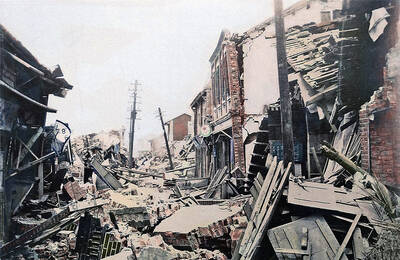
April 15 to April 21 Yang Kui (楊逵) was horrified as he drove past trucks, oxcarts and trolleys loaded with coffins on his way to Tuntzechiao (屯子腳), which he heard had been completely destroyed. The friend he came to check on was safe, but most residents were suffering in the town hit the hardest by the 7.1-magnitude Hsinchu-Taichung Earthquake on April 21, 1935. It remains the deadliest in Taiwan’s recorded history, claiming around 3,300 lives and injuring nearly 12,000. The disaster completely flattened roughly 18,000 houses and damaged countless more. The social activist and


 RSS
RSS