


There are two reasons why a new book on the Japanese acts against World War II prisoners in Thailand involved on the construction of the Burma Railway might not be welcome. The first is that this conflict ended 60 years ago, and to open old wounds is undesirable. And the second is that the crimes of the defeated have from time immemor-ial received more publicity than those of the victors. For both these reasons it's not in the best of taste to add fuel to a fire that exists increasingly only in the historical record.
Against this view, Brian MacArthur, a veteran journalist from London's Times newspaper, argues that the gradual demise of the prisoners involved requires that their testimony be gleaned and recorded one last time.
This task Surviving the Sword efficiently attempts. Even so, any such account is likely to revive anti-Japanese sentiment -- in its war-time form probably a contributory factor in the shameless fire-bombing of Japan's cities in the later months of the war, and finally the two atomic bombs, all targeting civilians virtually exclusively.

MacArthur nevertheless points out that the statistics for the prisoners of war held by the Japanese are particularly ugly. Official records show that 132,142 Allied (British, American, Dutch and Australian) prisoners were taken in Asia by Japanese forces. Of these, some 64,000 were sent to work on the Burma-Thailand railway, a fifth of whom died there. And 27 percent of all Japan's prisoners died in captivity, compared to 4 percent of prisoners held by the Germans.
Bad as these statistics are, there were other cases, albeit unproven, of mass ill-treatment of prisoners that have received rather less publicity. Most controversial is the question of the number of German prisoners who died in Allied hands in Western Europe after May 1945. This is still the subject of a highly acrimonious dispute. At worst is an image of men held in fields surrounded by barbed-wire, with minimal rations, for up to a year and a half, with very many deaths resulting, as alleged by James Bacque in his controversial book Other Losses (Stoddart, 1989). Bacque estimates 1 million died in these conditions, though this figure has been very strenuously contested.
Any Briton will be familiar with tales of cruelties committed against Western POWs between 1942 and 1945 on the banks of the River Kwai. My own instinct is to try and see things from the other side as well. One book in particular has proved useful in this regard. Prisoners of War and their Captors in World War II, edited by Bob Moore and Kent Fedorowich (Berg, 1996) is an even-handed collection of academic essays by different authors that treats Italians held in the UK, Britons held in Germany, Africans held by assorted captors, and so on. It contains both a chapter on Japan's work-camps in Thailand that looks at the individual Japanese (plus the Korean and, yes, Taiwanese guards they employed) and one written by a Japanese academic on his compatriots' attitudes to war-prisoners in history. Both shed a very different light on the matter than MacArthur's otherwise conscientious collection.
All the facts, however, proclaim that in war everyone suffers and almost everyone is guilty of something or other. Many Americans being carried in Japanese ships, for example, were killed when their own aircraft attacked these vessels, as happened when the Avisan Maru was sunk. How are we to compare these actions and categories of suffering, to establish a pecking-order of inhumanity?
One way might be to indulge in a numbers game. If we do that, the Allies are quickly seen to come out worse than the Germans and Japanese. A key work here is Sven Lindqvist's A History of Bombing [Granta, 2001; reviewed in Taipei Times Nov. 11, 2001]. The bombing of civilians in the cities of Hiroshima, Nagasaki, Tokyo, Dresden and Hamburg (and there were many other Japanese and German cities fire-bombed and carpet-bombed) resulted in massive death-tolls, compared to which the German blitz on London almost seems like sniper-fire. And the US never suffered any bombing of its cities at all, the nearest being the Japanese attack on its fleet in Pearl Harbor.
To apportion blame after wars, in other words, even if it were desirable, is all but impossible. The inevitable pain suffered on all sides in any conflict positively shouts out to be mitigated by supportive myths, in this case those of sadistic Japanese guards, stiff upper-lipped Britons, matey Australians and relaxed, gum-chewing Americans. It's all grossly simplistic. A job had been ordered by Tokyo, the Japanese considered a posting to the Thailand camps as an insult reserved for the incompetent, the climate made illness following lack of sanitation and malnutrition much more likely than in colder regions, the Westerners at that date were in the habit of considering themselves as masters of the Asian peoples, and so on. Nevertheless, far more Asians -- around 1 million -- labored on that railway than did Westerners, and around 100,000 of them died (compared to some 12,000 Western deaths). The fate of these Asians has received scant historical attention.
This new book consists mostly of interview and diary material from former British prisoners, now, if still living, in their 80s and 90s -- the memories of men who, in any analysis, suffered terribly from the climate, the shortages of food and medicines, and the work they were expected to accomplish, as well as the cruelty of some of their captors. But it needs to be put into perspective. This other books do, less vividly, perhaps, but in the event with more skepticism, as well as through viewing lenses with a less exclusive focus than this one's.
Publication Notes:
Surviving the sword
By Brian Macarthur
438 pages
Random House

In late October of 1873 the government of Japan decided against sending a military expedition to Korea to force that nation to open trade relations. Across the government supporters of the expedition resigned immediately. The spectacle of revolt by disaffected samurai began to loom over Japanese politics. In January of 1874 disaffected samurai attacked a senior minister in Tokyo. A month later, a group of pro-Korea expedition and anti-foreign elements from Saga prefecture in Kyushu revolted, driven in part by high food prices stemming from poor harvests. Their leader, according to Edward Drea’s classic Japan’s Imperial Army, was a samurai

Located down a sideroad in old Wanhua District (萬華區), Waley Art (水谷藝術) has an established reputation for curating some of the more provocative indie art exhibitions in Taipei. And this month is no exception. Beyond the innocuous facade of a shophouse, the full three stories of the gallery space (including the basement) have been taken over by photographs, installation videos and abstract images courtesy of two creatives who hail from the opposite ends of the earth, Taiwan’s Hsu Yi-ting (許懿婷) and Germany’s Benjamin Janzen. “In 2019, I had an art residency in Europe,” Hsu says. “I met Benjamin in the lobby
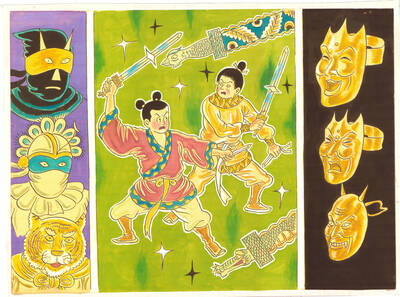
April 22 to April 28 The true identity of the mastermind behind the Demon Gang (魔鬼黨) was undoubtedly on the minds of countless schoolchildren in late 1958. In the days leading up to the big reveal, more than 10,000 guesses were sent to Ta Hwa Publishing Co (大華文化社) for a chance to win prizes. The smash success of the comic series Great Battle Against the Demon Gang (大戰魔鬼黨) came as a surprise to author Yeh Hung-chia (葉宏甲), who had long given up on his dream after being jailed for 10 months in 1947 over political cartoons. Protagonist

The following three paragraphs are just some of what the local Chinese-language press is reporting on breathlessly and following every twist and turn with the eagerness of a soap opera fan. For many English-language readers, it probably comes across as incomprehensibly opaque, so bear with me briefly dear reader: To the surprise of many, former pop singer and Democratic Progressive Party (DPP) ex-lawmaker Yu Tien (余天) of the Taiwan Normal Country Promotion Association (TNCPA) at the last minute dropped out of the running for committee chair of the DPP’s New Taipei City chapter, paving the way for DPP legislator Su


 RSS
RSS