


Sir Simon Rattle, chief conductor of the Berlin Philharmonic Orchestra, said in Beijing earlier this week that much of the future of classical music lies here in Asia. He's so right in this, as the characteristically young age of the continent's orchestral players abundantly testifies.
The Berlin Philharmonic is among the handful of orchestras consistently rated as the world's best and Rattle one of the cutting-edge maestros of our day. Both have important histories that will add luster to their performances. The orchestra, which is currently on a tour of Asia, performs at Taipei's National Concert Hall on Thursday and Friday of next week, beginning at 7.30pm.
Thursday's concert features a Berlioz overture (Le Corsair), Ravel's ballet music La Mere l'Oye, and then Beethoven's Third Symphony (Eroica). Friday night offers Haydn's Symphony No: 86 (one of his Paris symphonies), Asyla by the young British composer Thomas Ades, and Richard Strauss's celebrated tone-poem Ein Heldenleben (A Hero's Life).
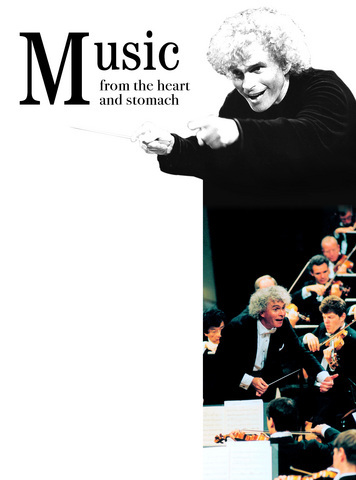
The Berlin Philharmonic has often been called a tough line-up -- "macho" as conductor Bernard Haitink once put it. Rattle himself has spoken of it as playing music with some kind of particularly physical commitment. Certainly its sound is perceived by many as being harder, clearer and more brilliant than the softer tones of, say, the equally celebrated Vienna Philharmonic.
The orchestra's history is both star-studded and representative of the triumphs and disasters of the 20th century. It came into being in 1882, at that time having no permanent home and giving concerts in a former roller-skating rink. Its first conductor was Hans von Bulow, and his reign was characterized by a new serious approach and long rehearsals. He was followed during the period of World War I by Arthur Nikisch, with the ensemble continuing to play even while starving crowds rioted outside its doors.
Jazz arrived with particular force in the Berlin of the 1920s, but this was also the era in which now legendary conductor Wilhelm Furtwangler took to the rostrum, beginning in 1923. He continued through the period of hyper-inflation and eventual economic collapse in Germany which directly led to the rise to power of the Nazis in 1933.
Furtwangler's tenure inevitably became controversial. Initially he resigned when the Nazis banned modern music, taking his cue from the specific banning of Paul Hindemith's Mathis der Maler, a work he had commissioned. But he later returned and though his supporters point to the extent he protected his Jewish musicians from persecution, his decision naturally made him enemies, especially after the fall of the Nazis in 1945. Such dilemmas are faced by many artists in authoritarian societies, and Furtwangler's was arguably simply one of several choices available, all with their different pros and cons.
Von Karajan
In 1944 the Philharmonic Hall on Bernburgerstrasse, the orchestra's home, was bombed. But concerts soon began again, this time under Sergiu Celibidache, Furtwangler meanwhile undergoing "denazification" at the hands of the victorious Allies. He returned in 1947, however, and five years later was reinstated as chief conductor.
Furtwangler died in 1954 from the effects of tuberculosis. The musicians, then all men, reportedly broke down in tears at the news. Who could possibly replace him? But the following year a successor was found, and Herbert von Karajan was appointed to the job for life. He remained for 34 years.
Energy characterized Von Karajan's reign. He stayed awake throughout a night train journey from Aachen to Berlin learning scores, one musician reported. Although physically small, he would brook no contradiction. "When he stopped to say something and we went on playing, he just blew his top," one instrumentalist remembers. His own self-discipline, however, made the orchestra willing followers.
After the Berlin Wall was constructed in 1961 to keep refugees from fleeing East Germany (Berlin was an isolated enclave inside the communist state), the Berlin Philharmonic became an emblem of Western democratic liberties. This was helped by its own democratic structure. It has always elected its chief conductor, and has a considerable say in guest conductors, touring schedules and the like, with a two-thirds majority needed for all important decisions.
Von Karajan resigned in 1989 and died three months later. Claudio Abbado was elected his successor, and slowly changed the overall sound from the rather solemn, bottom-heavy one of tradition to something more transparent. With the tearing down of the Berlin Wall that same year, and the subsequent collapse of East Germany, the orchestra began recruiting new players from Eastern Europe.
In 1998 Abbado announced he would be resigning the following year. In 1999 Simon Rattle, the British conductor who had labored long and successfully to convert the City of Birmingham Symphony Orchestra into an international line-up, was appointed his successor, to start work in 2002.
At that time Rattle stated that he saw Berlin as simultaneously somewhere German, somewhere international like New York, and somewhere unpredictable like the American wild West of old, and thought the orchestra should reflect all these different facets of its home-city's personality. He wanted it to be both classical and hungry for the modern, like the city itself.
"What I love about the orchestra is that it's very emotional," he said then. "It makes them not always the easiest to deal with, but it's ... you know, the music, most of it comes from the heart but it [also] comes from somewhere deep in the stomach. And this very physical engagement in the music, which I know was always there in the Furtwangler time also ... it's something very special."
The orchestra had a reputation for being tough, remembered visiting UK conductor Roger Norrington. "Could you play it this way?" he would ask them. "No, we play it like that," would come the reply.
`Knocked sideways'
Rattle is a keen advocate of contemporary music, determined to lure his audiences away from familiar 19th century classics and into new territory. He has been a life-long enthusiast, for instance, for the music of Hans Werner Henze, declaring that when he first heard his Second Symphony, in Liverpool at the age of 11, he was "knocked sideways by it."
Hence the presence in Friday's program of Thomas Ades' Asyla. Ades is the superstar of British and, some would say, international music in the classical style. Still only 29, his most popular work, Living Toys, has received over 50 performances worldwide.
His chamber opera Powder Her Face (1995) was greeted with astonishing acclaim. "A new substantial talent who can write real music and make it accessible as pop,"
commented the Wall Street Journal. "All the extrovert panache of a great opera composer," raved the New Yorker. In 1999 the opera was given the honor of being screened nationwide on UK television on Christmas Day.
Asyla was Ades' first large-scale orchestral work. Rattle himself commissioned it for his Birmingham forces and they premiered it in 1997, with the BBC Symphony Orchestra giving the London premiere two years later. When the work appeared on an EMI CD in 2000 it was the only classical disc to be short-listed for the prestigious Mercury Music Prize Record of the Year, and won the Grawemeyer Prize, the largest international prize for new compositions.
It's arguable that Ades is precisely the kind of young composer Rattle is looking for -- new, but far removed from the difficult-to-listen-too obscurities of much new classical music from the mid-century years. The performance of Asyla in Taipei next Friday will be the high-point of the Berlin Philharmonic's visit, which is for the rest confined to well-loved and time-tested works.
If having a place in Taipei's social pecking-order depends on conspicuous consumption, then these two concerts will be must-see events. Top-price tickets are NT$12,000, and indeed at the time of writing only tickets at that price and at NT$10,000 were still available for Thursday Nov. 17, with tickets at NT$8,000 and upwards available for Friday, Nov. 18.
What Taipei classical audiences love more than anything else is seeing people perform in the flesh who they've seen before in the electronic media. Both Rattle and the Berlin Philharmonic are well represented in all the CD catalogues. So let the feeding-frenzy commence!
The Berlin Philharmonic plays at Taipei's National Concert Hall on Thursday, Nov. 17 and Friday, Nov. 18, starting at 7.30pm. For ticket inquiries, call (02) 3393 9888, or go to www.artsticket.com.tw

Last week Joseph Nye, the well-known China scholar, wrote on the Australian Strategic Policy Institute’s website about how war over Taiwan might be averted. He noted that years ago he was on a team that met with then-president Chen Shui-bian (陳水扁), “whose previous ‘unofficial’ visit to the US had caused a crisis in which China fired missiles into the sea and the US deployed carriers off the coast of Taiwan.” Yes, that’s right, mighty Chen caused that crisis all by himself. Neither the US nor the People’s Republic of China (PRC) exercised any agency. Nye then nostalgically invoked the comical specter

Relations between Taiwan and the Czech Republic have flourished in recent years. However, not everyone is pleased about the growing friendship between the two countries. Last month, an incident involving a Chinese diplomat tailing the car of vice president-elect Hsiao Bi-khim (蕭美琴) in Prague, drew public attention to the People’s Republic of China’s (PRC) operations to undermine Taiwan overseas. The trip was not Hsiao’s first visit to the Central European country. It was meant to be low-key, a chance to meet with local academics and politicians, until her police escort noticed a car was tailing her through the Czech capital. The
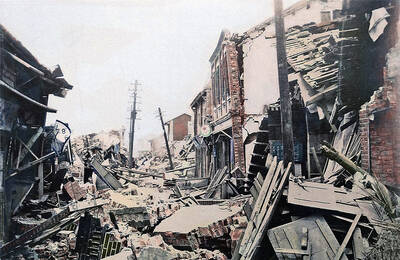
April 15 to April 21 Yang Kui (楊逵) was horrified as he drove past trucks, oxcarts and trolleys loaded with coffins on his way to Tuntzechiao (屯子腳), which he heard had been completely destroyed. The friend he came to check on was safe, but most residents were suffering in the town hit the hardest by the 7.1-magnitude Hsinchu-Taichung Earthquake on April 21, 1935. It remains the deadliest in Taiwan’s recorded history, claiming around 3,300 lives and injuring nearly 12,000. The disaster completely flattened roughly 18,000 houses and damaged countless more. The social activist and

Over the course of former President Ma Ying-jeou’s (馬英九) 11-day trip to China that included a meeting with Chinese Communist Party (CCP) leader Xi Jinping (習近平) a surprising number of people commented that the former president was now “irrelevant.” Upon reflection, it became apparent that these comments were coming from pro-Taiwan, pan-green supporters and they were expressing what they hoped was the case, rather than the reality. Ma’s ideology is so pro-China (read: deep blue) and controversial that many in his own Chinese Nationalist Party (KMT) hope he retires quickly, or at least refrains from speaking on some subjects. Regardless


 RSS
RSS